
 HD Cameras and Webcam
 Projectors and Speakers
 VOIP Phones and Gateway
 Access Control
 LTE and 5G Devices
 Smart Sensors And Automation
 Fiber and SFP Modules
 Firewall & Cloud Controllers
 Network Adapters and Accessories
 Network Switches
 PoE Switches
 Point To Point Wireless Radio
 Routers
 Wireless Access Points
 IP Cameras
 Memory Cards
 NVR
NVR Smart WiFi Cameras
 Storage Devices
 Desktop & Laptop RAMs
 Internal and External Hard Drives
 Storage Accessories and Enclosures
 SSD and NVMe Drives
 USB Flash Drives


India’s CCTV manufacturing industry is following a familiar playbook

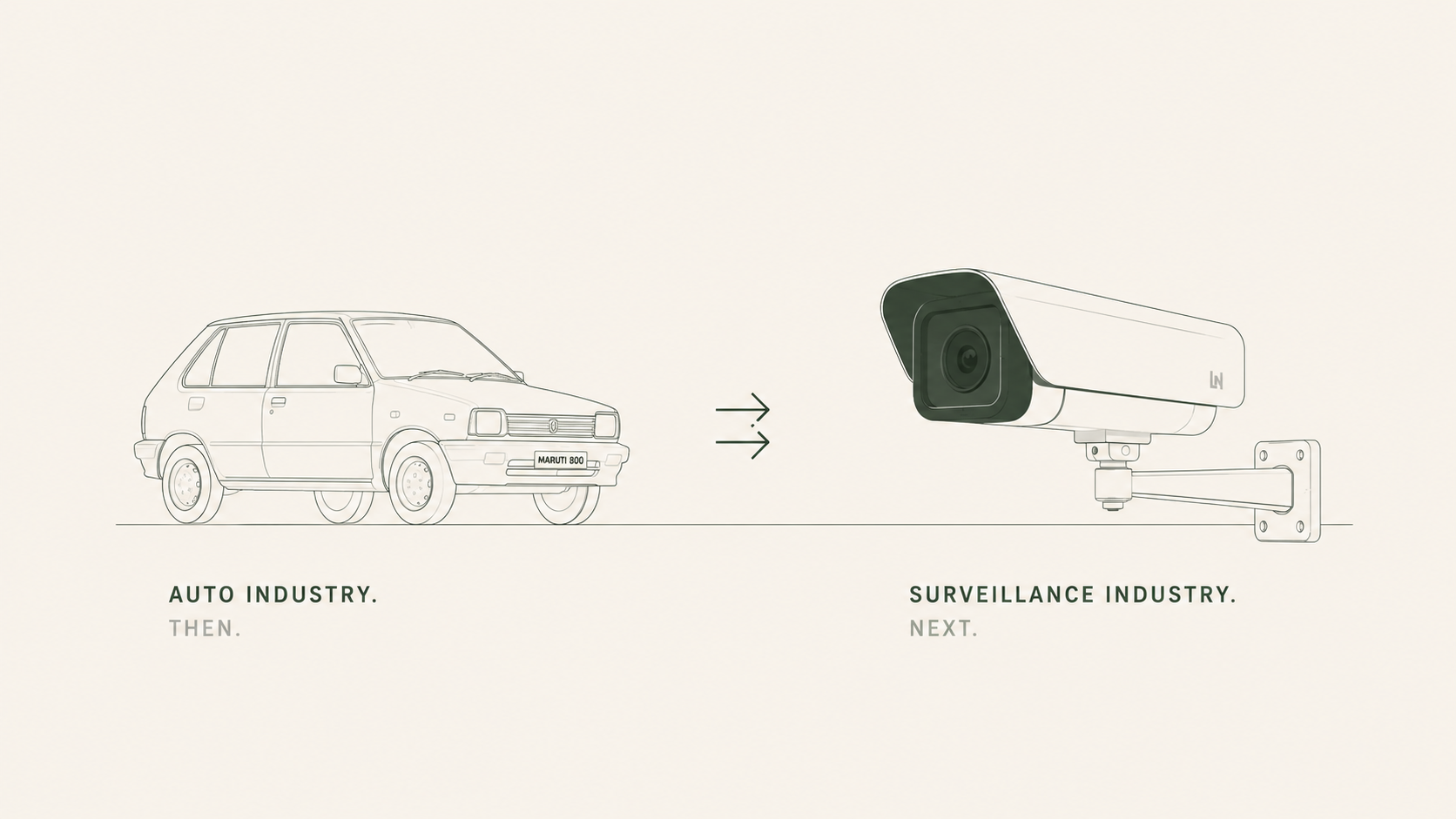
In this issue of Tech Tomorrow, we look at why the chaos in India's CCTV market might actually be the beginning of something much bigger, and why we've seen this story play out before.
Here's what we think is going to happen.
In 1983, the first Maruti 800 rolled off an assembly line in Gurgaon. The engine was Suzuki's. The transmission was Suzuki's. India contributed the factory floor, the labor, and a dream that one day, maybe, it wouldn't need to depend on Japan for every critical part under the hood.
Forty years later, Maruti exports cars to over 100 countries. Mahindra builds SUVs that make a Jeep Compass look overpriced. Royal Enfield ships motorcycles across Europe while Harley-Davidson quietly exits India because it simply can't compete on value. Nobody asks anymore whether India can build cars. That question was settled a long time ago.
We think something very similar is starting to happen in India's surveillance industry. And the trigger isn't ambition or innovation, it's a set of regulations called the BIS ER and STQC.
If you follow the CCTV market at all, you already know things have been chaotic since April. The STQC (Standardisation Testing and Quality Certification) and ER 01 compliance mandate essentially blocked a bunch of brands from selling in India. Supply chains got disrupted. Prices went up. Dealers started panicking. And if you're someone who buys or installs cameras for a living, you've probably spent the last few weeks wondering what's going on and when things will settle down.
But here's the thing: that chaos is only the surface-level story. The real story is structural, and it goes much deeper.
For years, the dominant business model in India's CCTV market worked like this: fly to China, buy finished camera kits, slap an Indian brand name on them, and sell. It was easy, it was cheap, and it worked. Dozens of brands operated this way. Some of them made serious money doing it.
BIS ER / STQC killed that model. The mandate requires compliance with security and quality standards that a relabeled Chinese import simply cannot meet. Foreign firmware with potential backdoors? Out. Unverified data routing? Out. Products without traceability back to a trusted supply chain? Out.
Now, you might think this is just another "Make in India" push. It isn't.
The primary trigger here isn't industrial ambition, it's national security. CCTV cameras sit inside government offices, military installations, airports, and critical infrastructure. The risk of running foreign firmware on those systems - firmware that could have backdoors, that could route data to servers outside India - is a risk the government decided it can no longer take. STQC and BIS are the execution tools for that decision. The domestic manufacturing boom, the job creation, the ecosystem building, those are real, but they're the side effects, not the stated goal. PLI schemes already cover electronic components like PCBs and camera modules that go into surveillance products, and if that support ever extends to finished surveillance hardware directly, the transition could accelerate even faster.
But here's where it gets interesting. When you restrict imports for security reasons, you accidentally create something else entirely: domestic manufacturing capability.
Think about it. Once cheap Chinese imports are blocked, there's a supply gap. Someone has to fill it. So local companies start investing first in assembly, then in integration, then in R&D. Money flows in because demand hasn't disappeared; it's just been redirected. And slowly, an ecosystem starts forming.
We visited Matrix Comsec's factory in Vadodara, Gujarat, recently. And honestly, it's what triggered this entire piece, because what we saw made us think about where all of this could be heading. Five buildings, each about 25,000 square feet. Separate R&D wings. A manufacturing facility about 20-30 kilometers away with over 200 employees on the floor. IP phones, intercoms, access control systems, Matrix Comsec has been building communication hardware since the early 90’s. When they saw the intercom business shrinking, they diversified into CCTV. Not by importing, but by building.
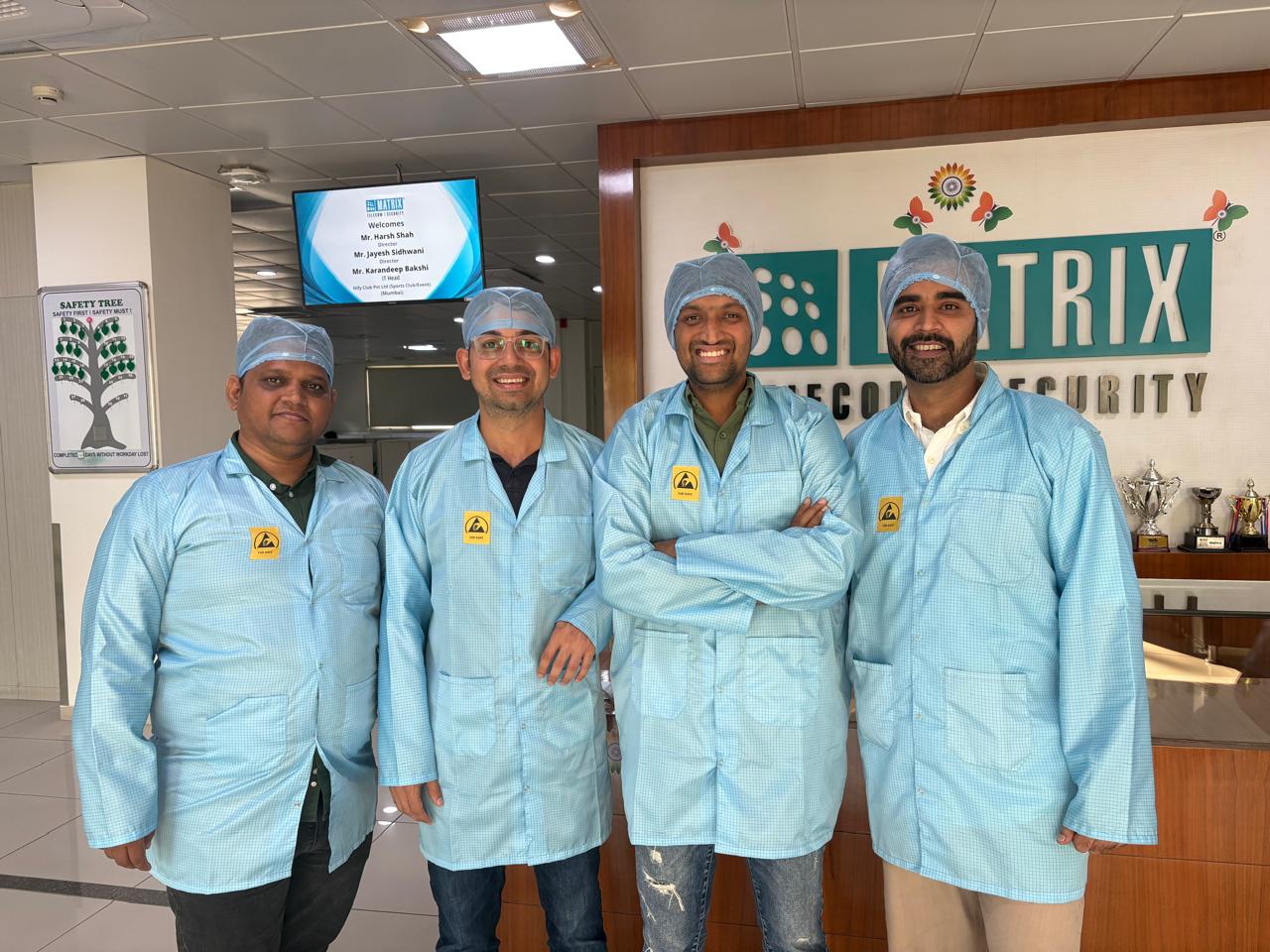
And they're not alone. CP Plus, India's largest CCTV brand (listed on the stock market in Aug 2025) raising capital, operating India's largest surveillance manufacturing facility in Kadapa, and just last month launched an R&D centre in Taiwan focused on AI-powered video analytics. If you compare their product line today against any global brand, the hardware specs match up. Two megapixel cameras, five megapixel cameras, number plate detection, they have it all.
And these are just two names. Across the country, dozens of manufacturers, from Sparsh to Godrej Security to HiFocus, are investing in facilities, hiring R&D teams, and building product lines that didn't exist three years ago. This isn't one company's bet. It's an industry-wide response to a structural shift.
The one area where Indian brands are still behind is software. The user interface, cloud connectivity, ease of setup; if you compare, say, a Hikvision app to an Indian brand's app, the gap is noticeable. But here's something that changed how we think about this: software is a solvable problem. It's a money problem. CP Plus alone did ₹3,112 crore in revenue and ₹351 crore in profit in 2024-25. At that scale, software investment isn't a question of capability; it's a question of priority. And priorities shift fast when the market demands it. Hardware gaps require factories, supply chains, and years of infrastructure. Software gaps require money and intent, and the money is clearly there.
And that's exactly what's happening. These companies are growing, reinvesting, and improving - fast.
And for anyone who still doubts whether India can build serious hardware, we'd like to remind you of a few things. ISRO put a satellite around Mars for $74 million. NASA's equivalent mission costs ten times that. BrahMos builds supersonic cruise missiles that countries line up to buy. IdeaForge, a company started by IIT Bombay engineers, is now the third-largest dual use drone manufacturer in the world, with over 950,000 flights completed, 70% of its components localized, and a manufacturing JV in the United States. Nobody questions whether India can build missiles, satellites, or drones anymore. The intent was there, the effort followed, and the results speak. Cameras are simpler hardware. The only thing that was missing was the push, and STQC just provided it
This is where the automobile industry comes in as a blueprint. Think about how India's auto industry evolved. Phase one: Maruti-Suzuki. Engine from Japan, everything else gradually localized: glass, tyres, body panels, seats. Phase two: Indian companies started building their own infotainment systems, their own distribution networks, their own design teams. Phase three: full-stack Indian brands like Tata and Mahindra competing with and beating global giants on their home turf.
The surveillance industry is in phase one right now. Core components, chips, and image sensors are still imported. Assembly and integration are happening in India. Basic R&D is starting. But the trajectory is set, and it's the same trajectory.
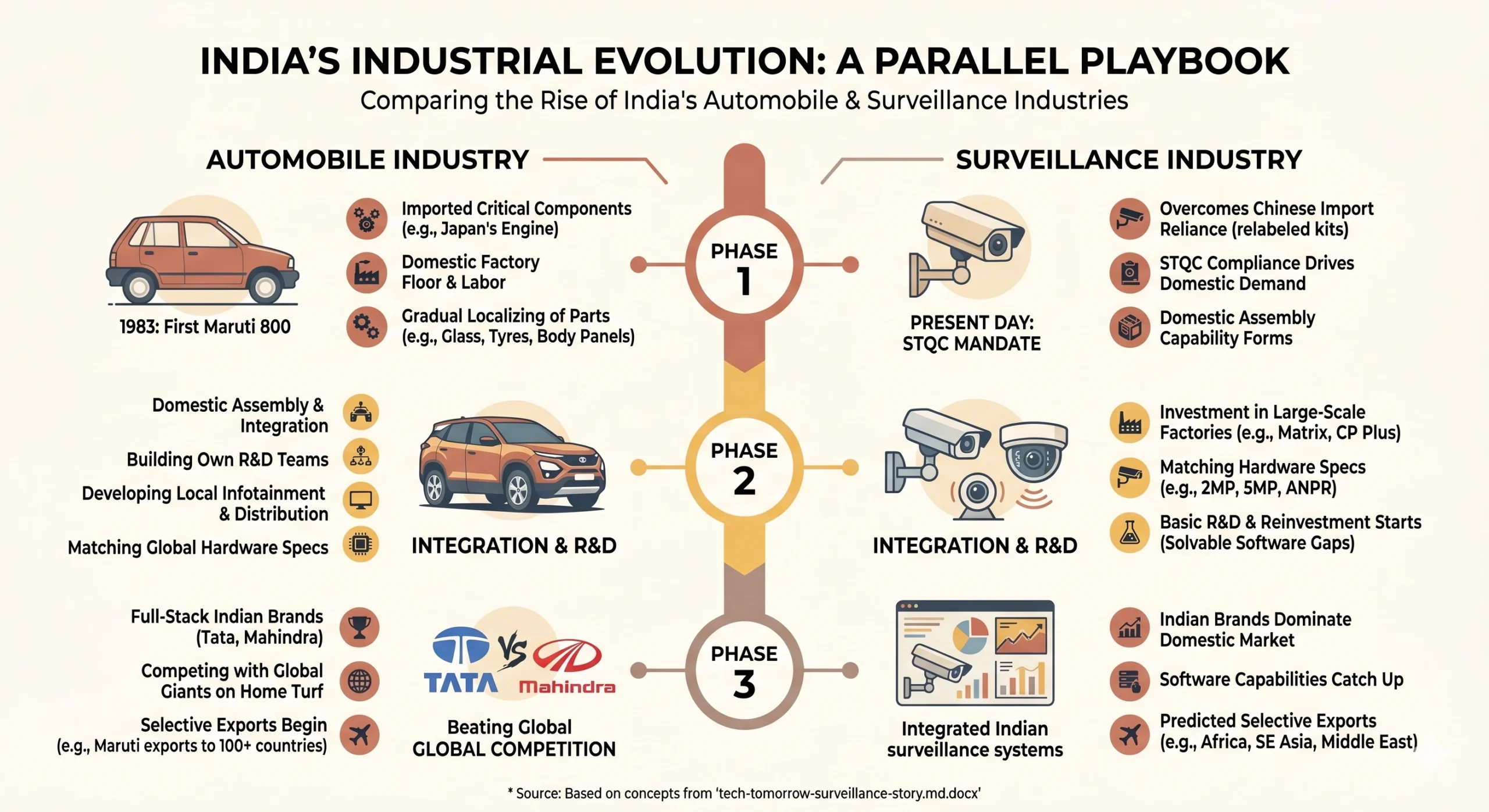
And just like auto didn't stay confined to cars - it spawned parts manufacturers, seat makers, electronics suppliers, an entire ancillary ecosystem - surveillance won't stay confined to cameras. The companies building cameras today are one investment cycle away from building dashcams, body-worn cameras, and other security hardware. The manufacturing base and the R&D teams are already in place; what changes next is the product range. The tech foundation is already there.
Right now, the truth is, Indian made cameras are more expensive than what the market is used to. That's because manufacturers are still operating at low volumes with limited capital. The scale economies haven't kicked in yet. If you're a dealer or an installer, you're feeling this in your margins today, and that's real.
But this is also temporary. It's basic business economics, but as volume grows, costs drop. As companies make more money, they reinvest in efficiency, automation, and better supply chains. This won't take ten years. Demand is insane. Once these companies have two good years of revenue, they'll triple their operations, and prices will come down. It's the same cycle that played out in the auto industry. Early Marutis were expensive relative to people’s earnings. Today, you can buy a car with features that would have seemed luxurious ten years ago, at a fraction of the adjusted price.
There's also the chip dependency problem, and it's worth mentioning here. India doesn't manufacture semiconductors at scale yet. That's the one critical component that's still fully imported, and it makes the electronics supply chain more fragile than the auto sector’s ever was. Tata has announced plans for semiconductor manufacturing, but that's years away from meaningful output. Until then, chip prices and chip availability will remain the one variable Indian manufacturers can't control.
But here's what we find remarkable: despite the higher prices, despite the software gap, despite the chip dependency, Indian brands are winning anyway. Not because they're better. Not yet. But because the policy environment has shifted demand so decisively, the market has changed completely. And every sale, every installation, every satisfied customer is another data point that builds confidence in the ecosystem.
Look at Prama. The same promoter who ran Prama Hikvision, Hikvision's joint venture in India since 2009, launched Prama India as a fully independent indigenous brand in 2020, with its own manufacturing facility near Mumbai. That's not a rebrand. That's a bet on a future where the Indian identity is the asset, not the foreign partnership. Give it a few years, and for most buyers, 'Prama' will just mean an Indian surveillance brand.
So, where is this heading? If the pattern holds, and we think it will, here's what the next few years look like. Indian brands dominate the domestic market first. Prices normalize as scale kicks in. Software catches up. The ecosystem expands beyond cameras into adjacent categories. And then, eventually, selective exports begin. To Africa, Southeast Asia, and the Middle East. Price-sensitive markets have similar infrastructure needs and face similar security concerns.
That's not a guarantee. It's a prediction. But it's a prediction based on a pattern that has already played out once, in an industry that's far more complex than surveillance.
The auto industry took about two decades to go from "Suzuki's engine in an Indian body" to "Indian brands exporting globally." The surveillance industry, with today's capital availability, access to technology, and policy tailwinds, could do it faster.
The real question isn't whether India can build cameras. It clearly can. We've walked the factory floors. We've seen the scale. The real question is whether the ecosystem can build the software, close the chip gap, and earn brand trust fast enough, before the next disruption comes along.
We think the answer is yes. But we'll be watching closely.
And if you disagree, if you think Indian brands can't build cameras that compete globally, that this is just wishful thinking, that the software gap is permanent, and that the ecosystem will never mature, bookmark this piece. Come back in two years. We'll both have our answer.
Let us know what you think about it in the comments below.