
 HD Cameras and Webcam
 Projectors and Speakers
 VOIP Phones and Gateway
 Access Control
 LTE and 5G Devices
 Smart Sensors And Automation
 Fiber and SFP Modules
 Firewall & Cloud Controllers
 Network Adapters and Accessories
 Network Switches
 PoE Switches
 Point To Point Wireless Radio
 Routers
 Wireless Access Points
 IP Cameras
 Memory Cards
 NVR
NVR Smart WiFi Cameras
 Storage Devices
 Desktop & Laptop RAMs
 Internal and External Hard Drives
 NAS Storage & Enclosures
 SSD and NVMe Drives
 USB Flash Drives


WiFi Dongle vs 5G Dongle vs 5G Router (2026): What actually makes sense in India?

The confusion that costs you money
If you've searched for "WiFi dongle" or "5G dongle" recently, you've probably noticed something frustrating: Amazon shows three completely different product types under the same search term, and every tech article gives conflicting advice. Some recommend USB dongles, others push portable hotspots, and router guides talk about all three like they're interchangeable.
Here's the truth: these are three completely different product categories, and most people end up buying the wrong one because no one explains the differences clearly. This isn't just confusing; it's expensive. People waste money on obsolete technology, damage their phone batteries by using hotspots 24/7 without understanding the real cost, or buy devices that overheat and fail within months.
We spent some time researching this mess and analyzed 100+ sources, including ISP documentation, Reddit threads, government telecom data, and product specifications. What we found was surprising: the dongle market in India has fundamentally changed since 2023, but almost nobody is talking about it honestly.
Here's what you'll learn in this guide:
- Why "WiFi dongle" searches return three different product categories
- The uncomfortable truth about 5G dongle availability in India (spoiler: they barely exist)
- Why have major operators stopped manufacturing 4G dongles
- The hidden ₹3,000-5,000 cost of using your phone as a permanent hotspot
- What actually works for gaming, streaming, and work-from-home in 2026
Let's start by clearing up the terminology mess.
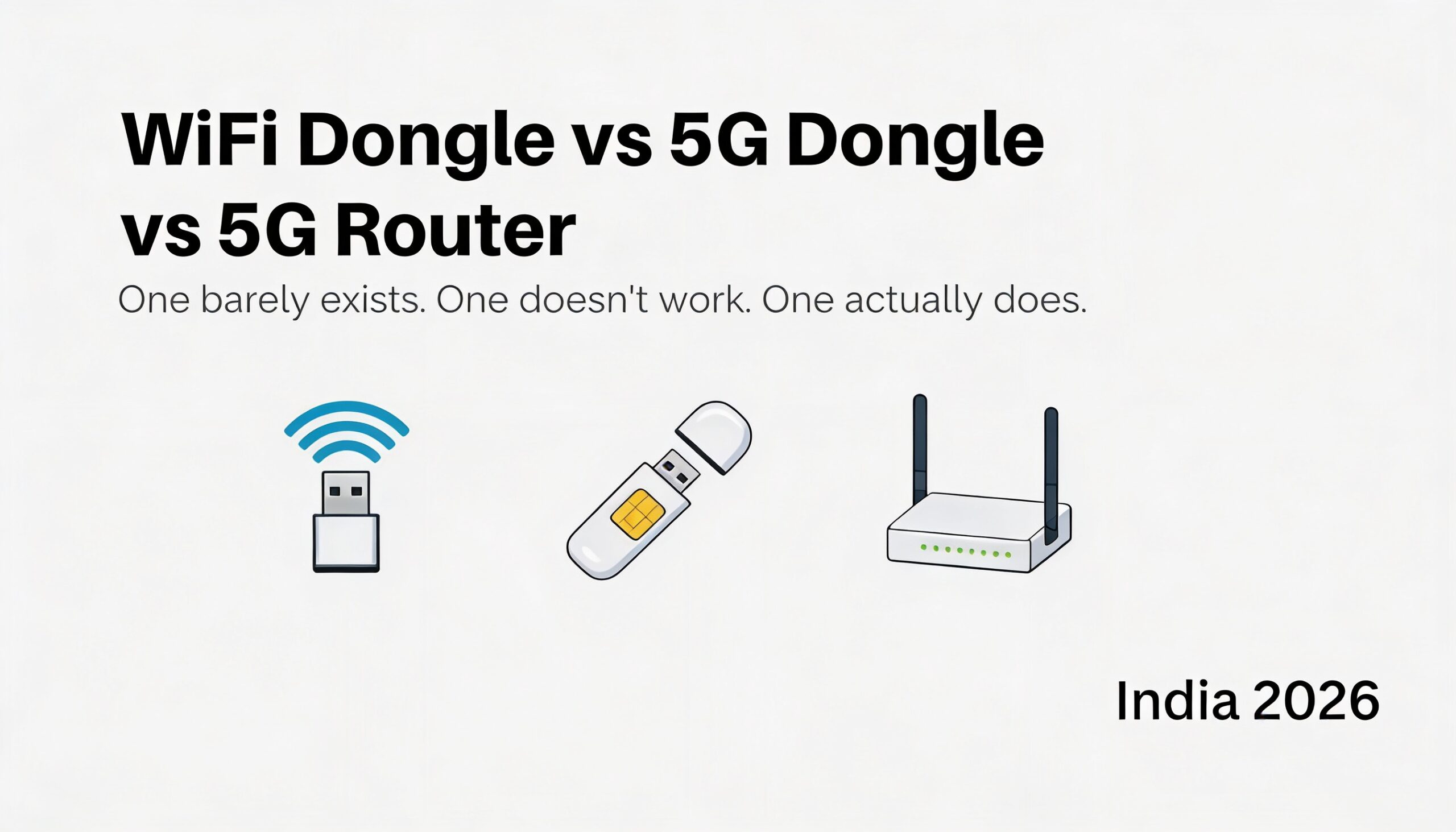
What people actually mean when they search ‘WiFi Dongle’ - the three-way confusion
When someone searches "WiFi dongle," they could mean any of these three devices:
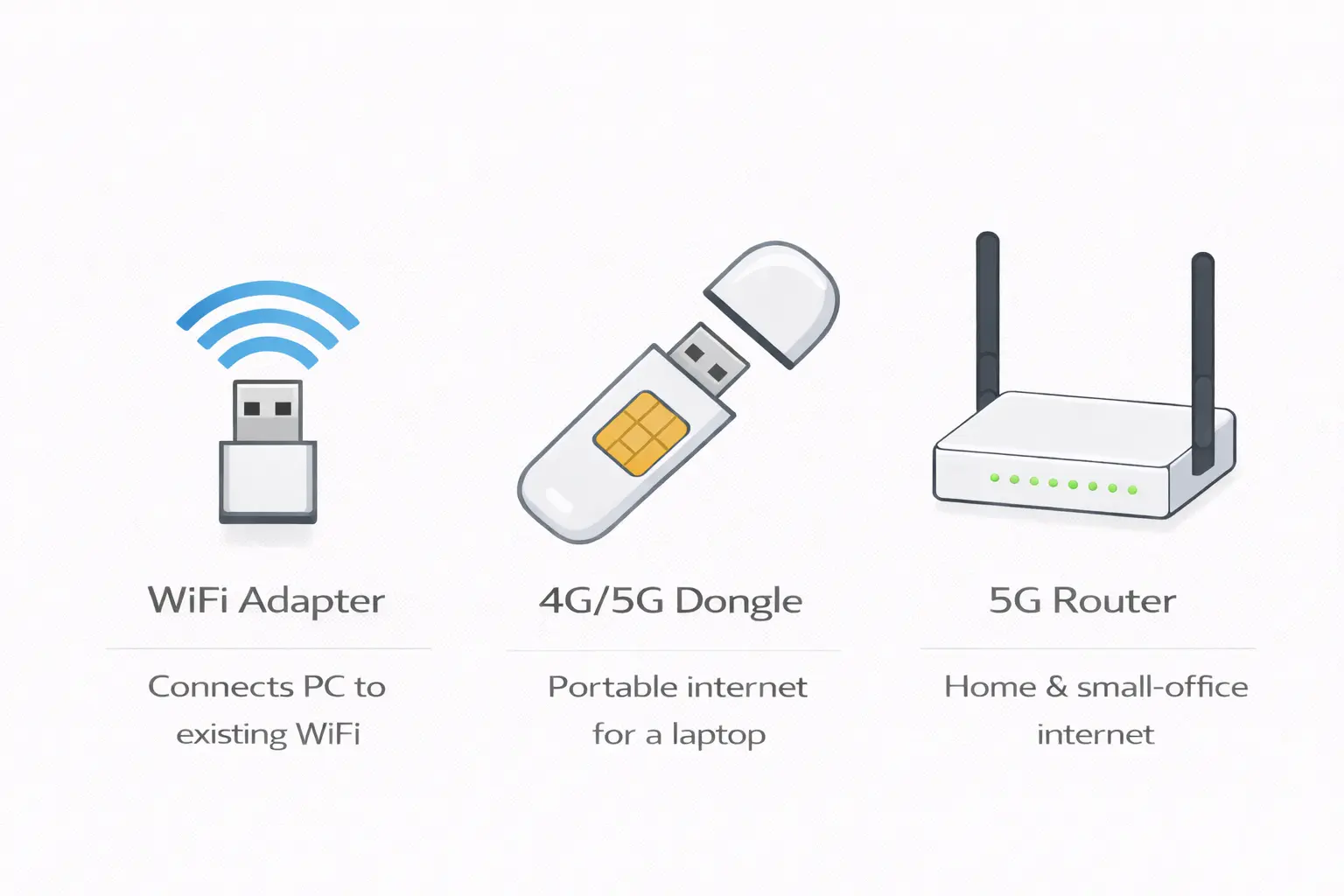
1. WiFi adapter (USB WiFi receiver)
Think of this like adding Bluetooth to a PC that doesn't have it. A WiFi adapter is a small USB device that lets your desktop computer connect to an existing WiFi router. It doesn't provide internet; it just gives your device the ability to receive WiFi signals.
Cost: ₹300-800 What it does: Connects PC to WiFi router What it doesn't do: Provide internet by itself Example: TP-Link TL-WN725N, D-Link DWA-131
2. 4G/5G USB Dongle (Data card)
This is what people actually want when they search for portable internet. It's a USB modem with a SIM card slot that plugs into your laptop and provides internet through cellular networks. Historically, these were popular for travelers and remote workers.
Cost: ₹2,500-8,000 (if you can find them) What it does: Provides internet via SIM card What it doesn't do: Work reliably for more than 60-90 minutes Example: Huawei E3372, ZTE MF833V
3. Portable WiFi router (what most people actually need)
A small battery-powered device with a SIM slot that creates a WiFi network. Multiple devices can connect simultaneously. This is technically not a ‘dongle’ at all; it's a portable router.
Cost: ₹1,500-3,500 What it does: Creates WiFi network from SIM card What it doesn't do: Match the performance of a proper 5G router Example: JioFi, MiFi, Pocket WiFi
Why this confusion exists
The term dongle originated in the 1980s as tech jargon for any small device that plugs into a computer port. Over the decades, it morphed to describe everything from software license keys to USB accessories. In India, marketers and sellers use ‘WiFi dongle’ as a catch-all term because that's what people search for—even when the products serve completely different purposes.
Amazon/Flipkart sellers mix all three categories under "dongle" search results. YouTube videos from 2020-2022 use "WiFi dongle" when they mean "internet dongle." Even ISP websites (Jio, Airtel) call both WiFi adapters and cellular modems "dongles."
The result? You search for one thing and end up buying something that doesn't solve your problem
The 5G Dongle that barely exists (India 2026 reality)
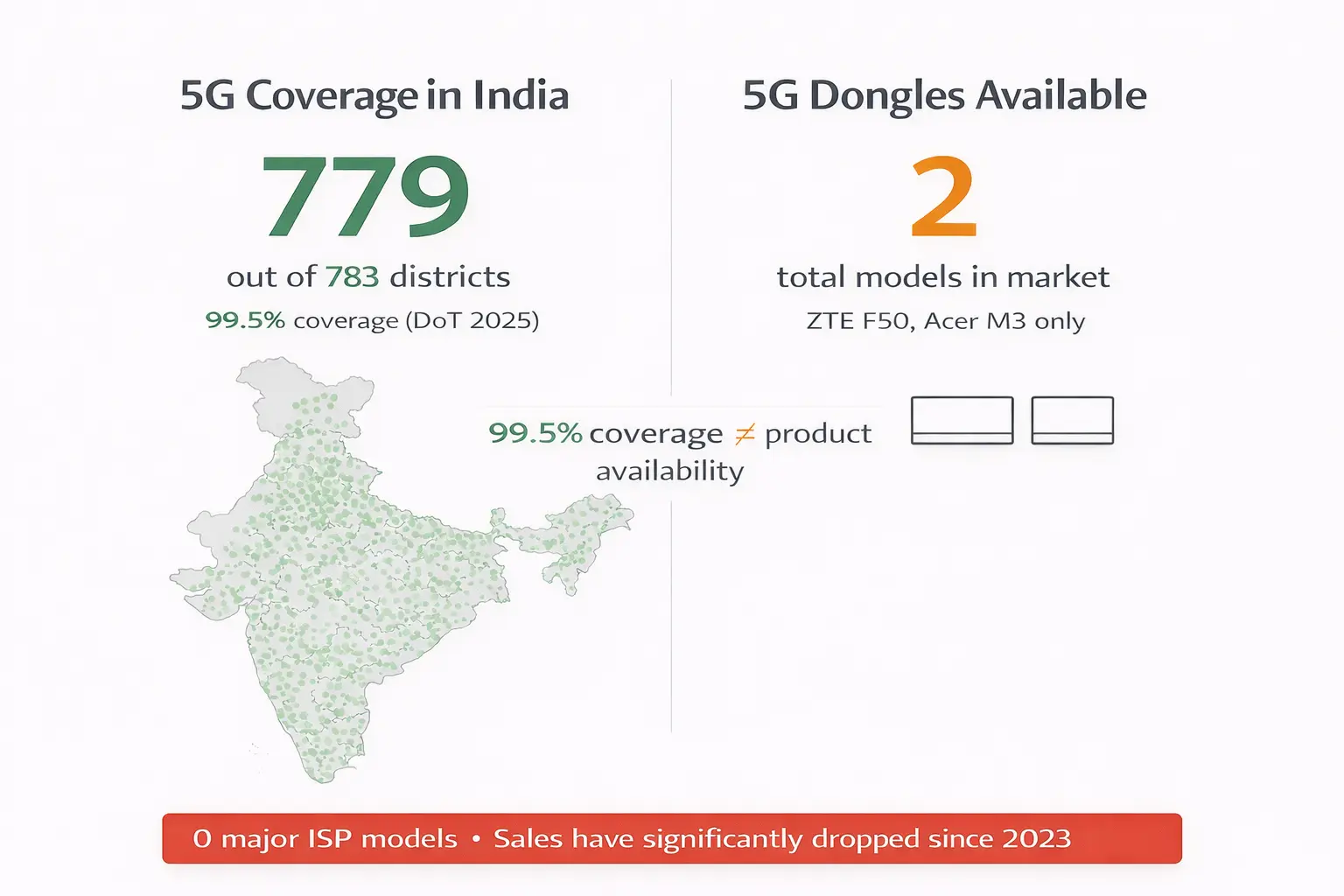
Here's the truth nobody wants to tell you: 5G dongles are essentially unavailable in India.
What's actually available
As of January 2026, only two 5G USB dongle models are sold in India:
- ZTE F50 5G (₹7,000-₹8,000) – Limited stock, mostly sold out
- Acer Connect Enduro M3 (₹16,000) – Includes battery, technically a pocket hotspot
Why ISPs abandoned 5G Dongles
Indian telecom operators made a strategic decision: instead of launching 5G dongles, they went with fixed wireless installations.
- Jio's approach: Instead of selling 5G dongles, Jio launched AirFiber; a wireless 5G home router that targets fiber broadband replacement. Their business model shifted from selling devices to selling fixed wireless access subscriptions at ₹599-1,999 per month with unlimited data.
- Airtel's strategy: Similar pivot. Airtel promotes 5G routers and home internet plans rather than portable dongles. Their Xstream AirFiber competes directly with Jio in the home internet space.
Why this happened:
- Control over network quality – Fixed installations prevent network congestion from uncontrolled portable devices
- USB thermal limitations – 5G generates heat that USB form factors can't dissipate (more on this below)
- Unlimited 5G on phones – Jio and Airtel already offer unlimited 5G data on mobile plans, reducing dongle demand
What Reddit says
A January 2025 thread on r/IndiaTech asked: "Is there a thing called 5g dongle?"
Top response: "Currently no 5G dongles available in India. Those claiming to be 5G are scams."
Other responses: I've been searching for weeks. Doesn't exist in any practical sense."
"Just get a 5G router or use your phone. Dongles are dead tech."
"Found one on Amazon for ₹8K. Reviews said it overheats and disconnects. Returned it."
The reality is harsh: if you're searching for a 5G dongle in India, you're looking for a product category that manufacturers have abandoned.
Why 4G Dongles are disappearing (and why that matters)
Even 4G USB dongles, once everywhere, have vanished from mainstream retail.
Market obsolescence (2023-2026)
Economic Times reported in October 2023 that dongle sales dropped 73% year-over-year as operators discontinued most models. By 2026, finding a brand-new 4G dongle from major manufacturers is nearly impossible.
What killed the dongle market:
- Data prices crashed – Average 1-1.5 GB/day now standard, making phone hotspots viable
- Smartphone ubiquity – 4G/5G phones have better modems than cheap dongles
- 5G unlimited plans – Jio/Airtel offer unlimited 5G data on mobile SIMs
- Public WiFi proliferation – Cafes, railway stations, and airports offer free WiFi
Performance problems became unsolvable - which brings us to the physics issue nobody discusses...
The thermal throttling problem nobody talks about
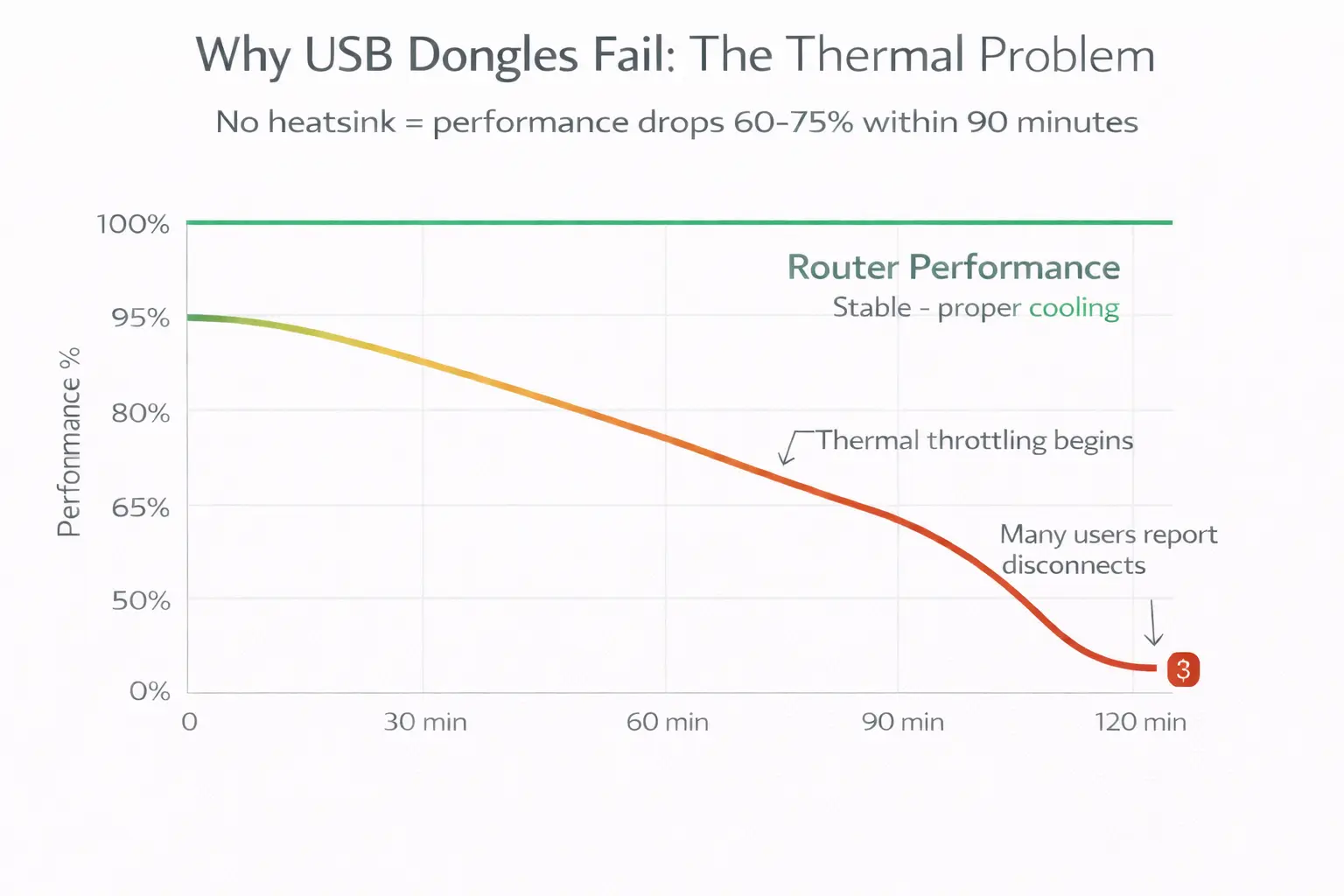
Here's the uncomfortable engineering reality - USB dongles face an unsolvable physics problem: heat dissipation.
When a dongle transmits and receives cellular data, it generates heat, lots of it. The 4G/5G modem, amplifier, and antenna are all crammed into a tiny plastic shell the size of your thumb. There's no space for proper cooling.
According to ATP Inc's thermal management research, devices under constant load that can't dissipate heat effectively undergo thermal throttling; they deliberately slow down to prevent physical damage.
What happens in real use:
Time Active | Performance | User Experience |
|---|---|---|
0-30 min | 90-100% advertised speed | Great - downloads fly, video smooth |
30-60 min | 70-85% (noticeable slowdown) | Buffering starts, downloads slower |
1-2 hours | 50-65% (significant degradation) | Frustrating - frequent disconnects |
2+ hours | 30-50% (barely usable) | Many users report complete failure |
Reddit evidence (real user experiences)
This isn't theory. Search Reddit for "dongle overheating", and you'll find dozens of threads showing DIY cooling solutions - users taping dongles to ice packs, rigging up tiny fans, or wrapping them in aluminum foil.
One r/techsupportgore post showed a photo captioned: "WiFi dongle died, overheated, and melted its own case."
From r/IndianGaming discussions:
- "Works fine for 20 minutes, then ping jumps to 200ms+"
- "Tried three different models. All overheat and disconnect"
- "Switched to 4G router, night and day difference"
- "Works fine for browsing but disconnects during video calls"
- "Lasted 12 months then completely stopped working"
The pattern is consistent: dongles work initially, then thermal physics ruins the experience.
Why routers don't have this problem:
Routers, by contrast, have larger enclosures with heat sinks and sometimes active cooling to allow natural airflow. They're designed for 24/7 operation without thermal throttling. According to Inseego's antenna design documentation, proper router chassis design can improve sustained performance by 40-60% compared to compact USB form factors
The phone hotspot math nobody tells you
When I mention dongle problems, most people say: "I'll just use my phone's hotspot." That seems logical until you run the actual numbers.
The 65% faster battery drain reality
When your phone acts as a mobile hotspot, three power-intensive processes run simultaneously:
- Cellular modem - Maintaining 4G/5G connection
- WiFi radio - Broadcasting the hotspot network
- Data processing - Routing traffic between devices
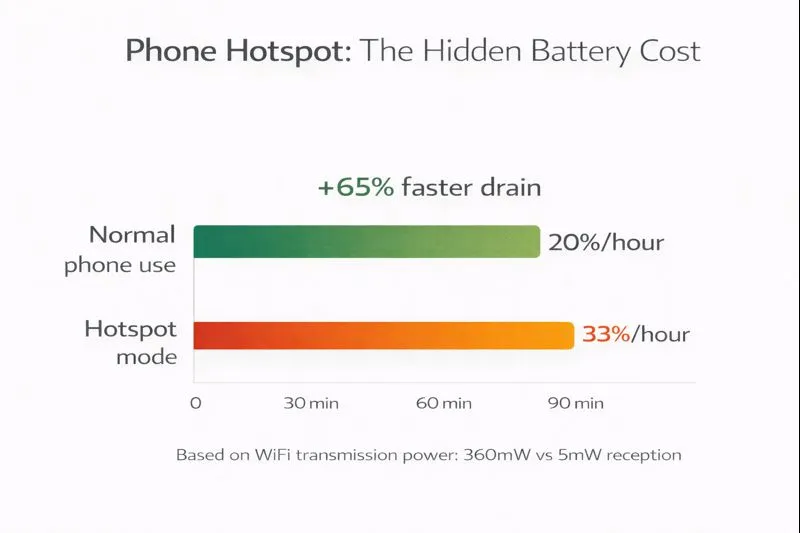
According to ZimConnections' battery drain analysis, mobile hotspot usage drains batteries 65% faster than normal phone usage. If your phone normally lasts 8 hours of active screen time, expect just under 5 hours when running a hotspot.
Real-world impact:
- Normal use: ~20% battery drain per hour
- Hotspot mode: ~33% battery drain per hour
- Long session impact: 2-3 hours of hotspot = 60-90% battery gone
But that's not the real cost.
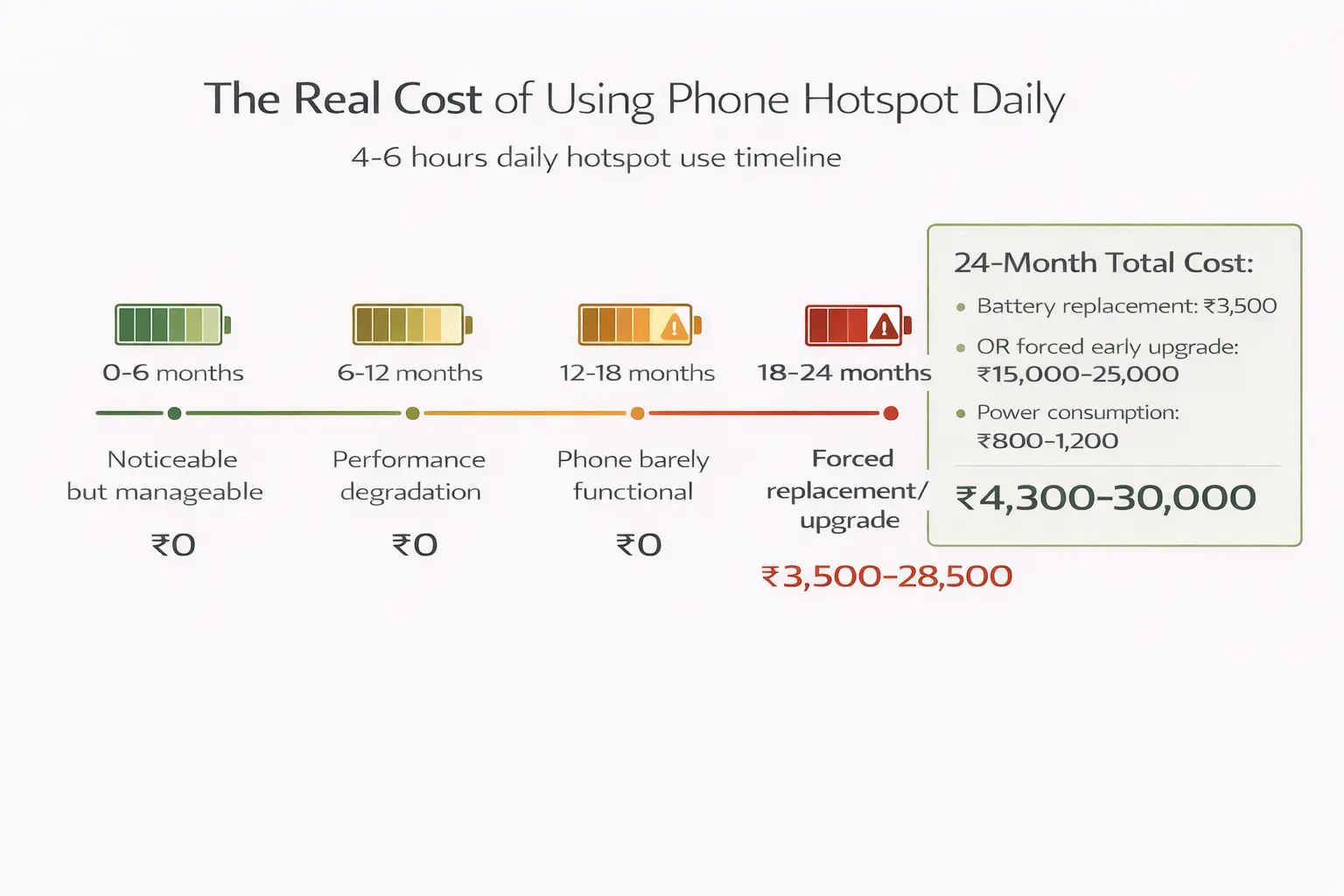
The 18-Month battery degradation timeline
Lithium-ion batteries degrade with charge cycles and heat. Hotspot mode generates significant internal heat, accelerating this wear.
Here's the realistic timeline if you use phone hotspot as your primary internet (4-6 hours daily):
Timeframe | Impact | Cost Implication |
|---|---|---|
0-6 months | Battery capacity drops to 85-90% | Noticeable but manageable |
6-12 months | Capacity at 75-80%, noticeable capacity reduction | Performance degradation |
12-18 months | Capacity below 70%, won't last half a day | Phone barely functional |
18-24 months | Severe degradation, shutdown at 20-30% battery | Forced battery replacement: ₹3,000-5,000 |
24-Month total cost calculation:
- New battery replacement: ₹3,500 (average for mid-range phones)
- OR early phone upgrade (forced 6-12 months earlier): ₹15,000-25,000 depreciation loss
- Power consumption cost (charging 2-3 times daily): ₹800-1,200 extra electricity
Hidden cost of "free" phone hotspot: ₹4,300-30,000 over 24 months
Compare this to a ₹6,000-8000 4G/LTE router that lasts 3-5 years with no battery degradation issues.
When phone hotspot actually works
Phone hotspot isn't inherently bad.
Use as… | Don’t use as… |
|---|---|
Occasional emergency internet (laptop at coffee shop once a week) | Primary home internet (6+ hours daily) or serving multiple devices |
Short duration use (under 60 minutes per session) | Work-from-home video calls (overheating + battery drain) |
Light tasks (email, browsing, not video streaming) | Gaming (inconsistent ping, thermal throttling) |
Single device connection (just your laptop, not the whole household) | 4K streaming or heavy downloads |
Flagship phones (₹30,000+) have superior Qualcomm X65/X70 modems, more antenna space, and better thermal management than budget dongles. Ironic twist: Your phone hotspot performs better than a dongle, but slowly kills your phone's battery.
What actually works in India 2026 (Decision framework)
Now that we've cleared up the confusion, here's what to actually buy based on your needs.
Scenario 1: Desktop PC needs WiFi
You need: USB WiFi Adapter (actual WiFi dongle)
What to buy: TP-Link Archer T2U Plus or similar dual-band adapter
Why: Your PC lacks built-in WiFi. You have a router already (home WiFi or someone else's network). You just need the connection hardware.
Don't buy: Cellular dongle or router; you already have internet, you just need the adapter.
Scenario 2: Temporary internet eed (Travel, short-term project)
You need: Internet for 1-3 hours daily, occasional use
What to buy:
- Option A: Use your existing phone hotspot (best for under 10 days)
- Option B: JioFi portable router (₹1,999, ₹239-419/month plans)
Why: Short-term usage won't destroy your battery. JioFi or similar makes sense if you travel frequently or need to connect multiple devices during trips.
Don't buy: USB dongle (thermal issues) or full 5G router (overkill for temporary needs)
Scenario 3: Multi-device home internet (No fiber available)
This is where 90% of "dongle" searchers actually belong.
You need: 4G/5G Sim Router, 5-30 devices, all-day internet, streaming, etc
What to buy - (A) MikroTik Chateau 5G R17 ax, (B) TP link MR200
Why: Works with any SIM (Jio, Airtel, Vi), Reliable cooling and performance, no thermal throttling, proven technology, wide support
Check out our 5G SIM Router Buyer’s Guide India 2026 to know more on how and what to pick
Scenario 4: Gaming, streaming
You need: Low latency, stable connection, no lag spikes
What to buy: 4G/5G Router with Ethernet Connection (A) TP Link Archer MR 600, (B) Mikrotik Chateau 5G R17 ax (has lower latency than a 4G router)
Why: Mobile networks use CGNAT (adds a latency layer), Ethernet bypasses WiFi interference and reduces latency by 5-20ms
For detailed latency analysis and gaming-specific router picks, see our 5G Router Gaming performance guide.
Scenario 5: Don't buy anything
When to stick with what you have:
- Fiber broadband is coming to your area in 3-6 months (check with ISPs)
- Your current phone hotspot works fine, and you use under 2 hours daily
- You're in a temporary living situation (rental, moving soon)
- Budget is tight, and home WiFi exists nearby (family, neighbor sharing)
Why: Fiber remains superior to any mobile broadband solution. If it's arriving soon, use phone hotspot temporarily rather than investing in equipment you'll replace quickly.
Cost reality check: 24-month ownership comparison
Here's what different solutions actually cost over two years:
Solution | Upfront Cost | Monthly Cost | 24-Month Total | Best For |
|---|---|---|---|---|
Phone Hotspot | ₹0 | ₹0-499 (data plan) | ₹4,300-15,000* | Emergency/occasional only |
JioFi Portable | ₹1,999 | ₹239-419 | ₹7,000-14,000 | Travelers, temporary needs |
4G USB Dongle | ₹2,500-4,000 | ₹299-599 | ₹9,000-20,000 | Don't buy (thermal issues) |
4G Router | ₹8,999 | ₹299-599 | ₹16,000-24,000 | Budget home internet |
5G Router | ₹15,000-50,000 | ₹419-1,199 | ₹25,000-80,000 | High-speed home internet |
Fiber Broadband | ₹0-2,000 | ₹599-1999 | ₹13,000-30,000 | Best if available |
Key insights:
- Phone hotspot's "free" cost is misleading; battery replacement adds ₹3,500-5,000 hidden cost
- JioFi wins for portability needs under 2-hour daily usage
- 4G router beats phone hotspot on cost after 18 months
- 5G router premium (costs more than 4G) pays off in speed and longevity
- Fiber remains the cheapest long-term solution when available
The Bottom Line: What to buy in 2026
Here's the honest ranking of solutions from best to worst for permanent internet:
Fiber Broadband - If available in your area, this remains unbeatable (faster, cheaper, more reliable)
5G SIM Router - Best mobile broadband option for long-term use in 5G coverage areas
4G SIM Router - Solid budget choice, proven technology, works anywhere
Portable WiFi (JioFi/MiFi) - Good for travelers and temporary needs, acceptable for light home use
Phone Hotspot - Free initially, expensive long-term due to battery damage. Only for occasional emergency use.
USB Dongles (4G/5G) - Avoid entirely. Thermal throttling makes them unreliable after 30-60 minutes. Market has moved on.
WiFi Adapters - These aren't internet sources. Only buy if your PC lacks WiFi and you already have a router.
Final Recommendation: Start here
Step 1: Check if fiber broadband is available or coming soon
- If yes: Wait for fiber or use phone hotspot temporarily
- If no: Continue to Step 2
Step 2: Assess your 5G coverage
- Visit OpenSignal or your ISP's coverage map
- If strong 5G: Consider 5G router
- If 4G only: Proceed with 4G router
Step 3: Calculate your actual usage
- Under 2 hours daily: JioFi or phone hotspot acceptable
- 3-6 hours daily: 4G router minimum
- 6+ hours or multi-device: 5G router worth the premium
Step 4: Set budget
- ₹0-5,000: Phone hotspot (short-term only) or JioFi
- ₹5,000-12,000: 4G router (best value for most)
- ₹12,000+: 5G router (future-proof investment)
What NOT to buy under any circumstances:
- USB dongles (4G or 5G) - thermal throttling ruins reliability
- WiFi dongles expecting them to provide internet - they won't
- Anything marketed as 'unlimited 5G dongle' - too good to be true, likely scam
Ready to skip dongles entirely? Check our comprehensive guide to Best 5G SIM Routers India 2026 or check our LTE and 5G Routers that work for gaming, streaming, and multi-device households.
Frequently Asked Questions (The Honest Answers)
Will a WiFi dongle give me internet anywhere?
No. WiFi dongles (USB WiFi adapters) only connect to existing WiFi routers. They don't provide internet by themselves. You need a cellular modem (4G/5G dongle or mobile hotspot) for internet from SIM cards.
Are 5G dongles available in India?
Barely. Only 2 models exist (ZTE F50 at ₹7-8K, Acer M3 at ₹16K) as of January 2026. Limited stock, questionable long-term support. Phone hotspot or 5G router are better investment.
Why does my 4G dongle overheat and disconnect?
USB form factor lacks proper cooling. Heat generation from data transmission exceeds dissipation capacity. Thermal throttling after 30-60 minutes is universal across brands due to physics constraints, not quality issues. This is why the dongle category is declining.
Is a 4G router worth buying if I have 5G in my area?
Depends on budget and 5G consistency:
- 4G router : Stable performance, good for gaming via Ethernet, proven technology
- 5G router : Faster speeds, future-proof, but check 5G indoor coverage first and is little expensive
If 5G coverage is spotty indoors, a 4G router is more reliable.
Which is cheaper long-term: phone hotspot or router?
24-month total cost:
- Phone hotspot: ₹10-15K (including ₹3-5K battery replacement)
- 4G router: ₹8-14K
- 5G router: ₹15-50K
Phone hotspot has hidden costs (battery health degradation, reduced phone utility). Router offers better value over 2+ years.
Can I connect a WiFi dongle to my TV?
It depends on what you mean by "WiFi dongle." If you're asking about connecting a USB WiFi adapter to make your non-smart TV connect to WiFi - no, that won't work. TVs don't have drivers for USB WiFi adapters.
What actually works for TV internet:
- Smart TVs: Already have built-in WiFi, just connect to your router
- Non-smart TVs: Use a streaming stick (Amazon Fire Stick, Chromecast) that has WiFi built-in
- No home WiFi at all: Get a 4G/5G router first, then connect TV or streaming stick to that router's WiFi
If your TV has an Ethernet port and you have a router, use wired connection for better streaming quality (no buffering)
Do WiFi dongles work with all SIM cards (Jio, Airtel, Vi)?
USB WiFi adapters don't use SIM cards at all; they only connect to existing WiFi.
Cellular dongles (4G/5G USB modems) theoretically work with all Indian SIM cards, but reality is messy:
- Most dongles are unlocked and accept any SIM
- Some carrier-branded dongles (rare now) may be locked
- Network band support varies - a dongle might not support all of Vi's 4G bands, causing poor speeds
Better approach: Buy a proper 4G/5G router instead. Routers like TP-Link Archer MR600 clearly list supported bands and work with all Indian carriers. You avoid the SIM compatibility guessing game plus all the thermal throttling problems.
Check before buying: Verify the device supports bands 3, 5, 40, 41 for India (minimum 4G compatibility)
What's better: 5G dongle or 5G router?
5G router wins in every category:
Factor | 5G Dongle | 5G Router | Winner |
Sustained performance | 30-60 min before throttling | Hours/days continuous | Router |
Cooling | None (tiny plastic shell) | Heat sinks, larger chassis | Router |
Device capacity | 1 device (USB port) | 10-32 devices simultaneously | Router |
Ethernet option | No (USB only) | Yes (for gaming) | Router |
Antenna quality | Internal, weak | External/internal, stronger | Router |
Longevity | 12-18 months typical | 3-5 years | Router |
The only advantage dongles have: Smaller pocket size. But JioFi portable routers (₹1,999) are nearly as compact and don't overheat.
What to read next
- Best 5G SIM Routers in India 2026: Buyer's Guide + Picks ← Start here for router recommendations
- 5G Router for Live Streaming - Real Performance India 2026
- 5G Router for Gaming India (2026): Real Latency, CGNAT truth & when NOT to use them
- 5G Router Price in India 2026: Complete Buying Guide and Comparison
- Can 5G Home Internet Replace WiFi? (Honest 2026 Answer for India)