
 HD Cameras and Webcam
 Projectors and Speakers
 VOIP Phones and Gateway
 Access Control
 LTE and 5G Devices
 Smart Sensors And Automation
 Fiber and SFP Modules
 Firewall & Cloud Controllers
 Network Adapters and Accessories
 Network Switches
 PoE Switches
 Point To Point Wireless Radio
 Routers
 Wireless Access Points
 IP Cameras
 Memory Cards
 NVR
NVR Smart WiFi Cameras
 Storage Devices
 Desktop & Laptop RAMs
 Internal and External Hard Drives
 NAS Storage & Enclosures
 SSD and NVMe Drives
 USB Flash Drives


SSD Brands Explained: How 50 Brands Exist When Only 5 Companies Actually Make Them

In This Issue
• Why 50 SSD brands exist when only 3-4 companies make the chips
• The three-layer model: Who actually makes what
• China’s YMTC: The wild card disrupting the NAND oligopoly
• What’s really inside your SSD
🏭 How It Actually Works
Understanding SSD Brands: The Three-Layer Model
The SSD industry is structured in three distinct layers, and understanding this explains why so many SSD brands can coexist.
Layer 1: NAND manufacturers (The real makers)
Only a handful of companies actually fabricate the NAND flash memory chips that store your data:
Samsung (South Korea): The largest NAND producer globally, supplying chips to countless SSD brands while also making their own SSDs.
SK Hynix (South Korea): Major supplier, acquired Intel’s NAND business in a two-phase deal (2021-2025).
Micron (USA): Makes NAND but recently announced the shutdown of its Crucial consumer brand (ending Feb 2026) to focus on enterprise and AI markets.
Kioxia/Western Digital (Japan, formerly Toshiba / USA): 20+ year joint venture operating shared fabs in Japan; Kioxia (formerly Toshiba) and WD co-develop and co-produce NAND together.
And increasingly, YMTC (China) – more on them in a moment.
Think of them as steel mills. They produce the raw material that everyone else assembles. These companies operate massive fabs requiring billions in investment, which is why new competitors rarely enter this space.
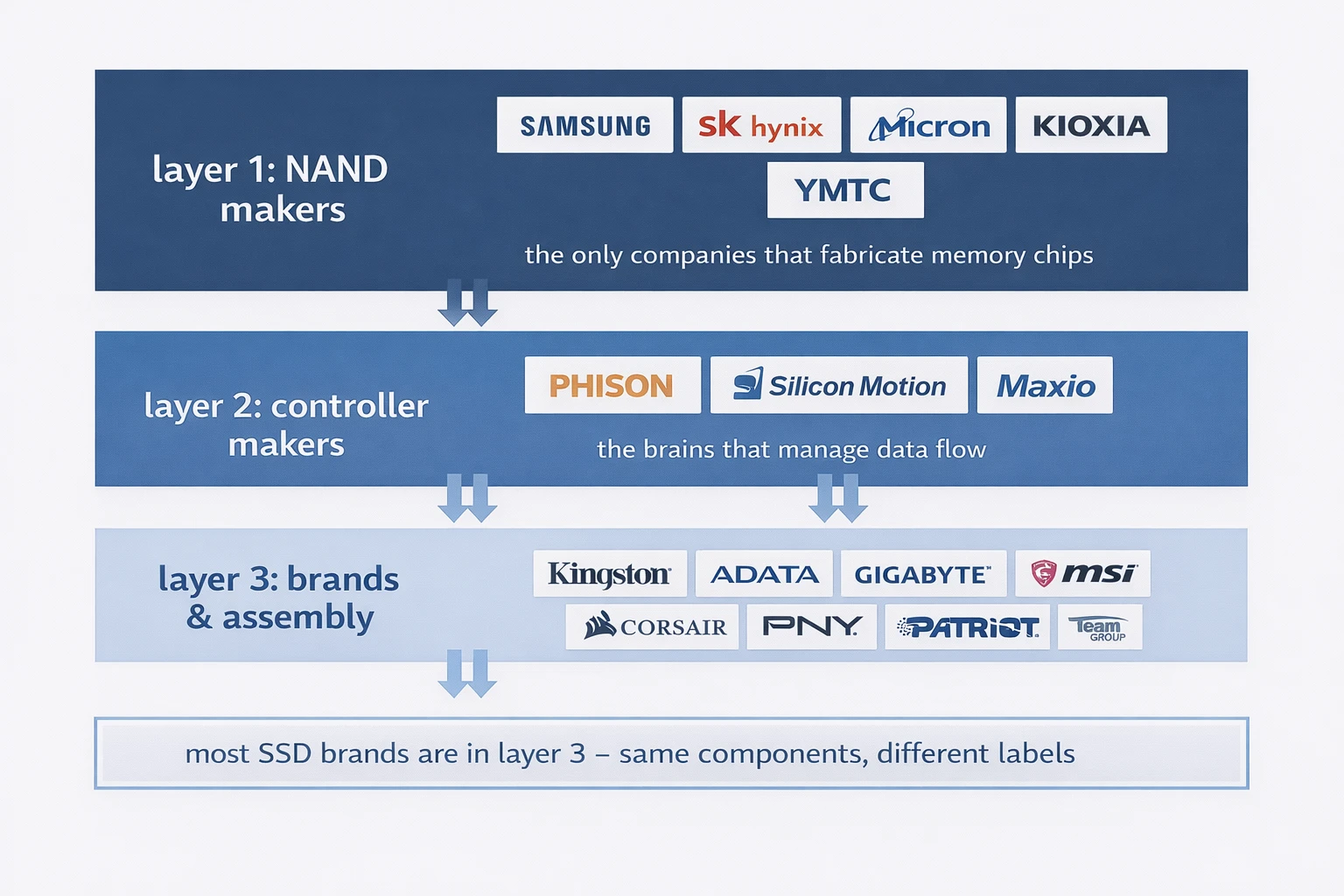
The three-layer model of SSD manufacturing
Layer 2: Controller Chip makers
NAND chips are like engines. Controllers are the transmission – they manage how data flows in and out, handle error correction, and determine real-world performance.
Three companies dominate this layer:
Phison (Taiwan) – Powers Kingston, Corsair, MSI, Patriot, Gigabyte, and dozens more
Silicon Motion (SMI) (Taiwan) – Common in ADATA, Team Group, and budget drives
Maxio (China) – Newer player, increasingly found in ultra-budget SSDs
Samsung makes its own controllers. WD uses in-house controllers from its SanDisk acquisition. But most SSD brands buy controllers off the shelf from Phison or SMI.
Think of it like Qualcomm selling Snapdragon chips to OnePlus, Xiaomi, and fifty other phone brands. Same controller, different brand name on the box.
Layer 3: Assembly and Brand layer
This is where it gets messy – and interesting.
SSD Brands like Samsung and WD are vertically integrated. They make NAND, design controllers, write firmware, and assemble everything under one roof. Full control, premium pricing.
But most SSD brands you see – Kingston, ADATA, etc – are ODMs (Original Design Manufacturers). They don’t make NAND or controllers. They:
- Buy NAND chips from Samsung/Micron/SK Hynix in bulk
- Buy controllers from Phison/SMI
- Assemble them in Taiwanese or Chinese factories
- Add their own firmware tuning and quality control
- Slap on their logo and warranty
Same NAND. Same controller. Different brand name. Different price.
🇨🇳 The Wild Card
YMTC: Disrupting the NAND oligopoly
For years, four companies controlled the global NAND supply. Then China decided it didn’t want to depend on foreign suppliers anymore. Enter YMTC (Yangtze Memory Technologies Corporation), a state-backed Chinese company launched in 2016 with one goal: break the NAND oligopoly.
YMTC has gone from zero to producing competitive three-dimensional NAND in under a decade. They are now mass producing 270-layer 3D NAND technology, putting them technically close to Samsung and Micron’s. That’s a massive leap for a company that didn’t exist ten years ago.
What makes 270-Layer 3D NAND a big deal
First, what does “3D NAND” even mean?
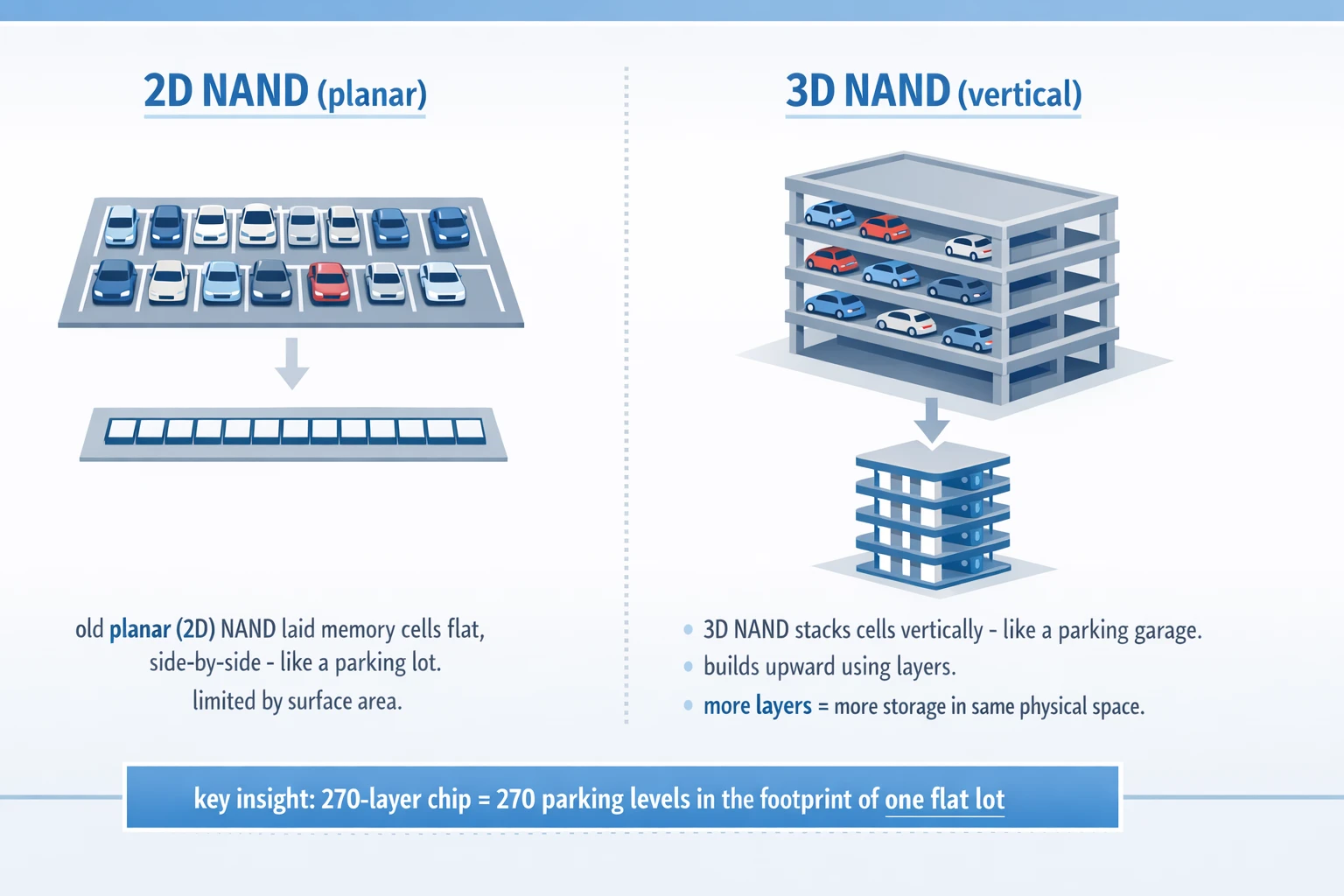
2D Planar NAND vs 3D NAND architecture
Sources: Planar (2D NAND) | 3D NAND
Why layers matter: More layers = more storage in the same physical space. Think of it like this – a 270-layer chip fits 270 parking levels in the footprint of one flat lot.
Who uses YMTC NAND?
• Lexar (now Chinese-owned and heavily YMTC-based)
• HP, Acer, Lenovo (for their branded SSDs)
• Kingston, Team Group, ADATA (selectively, depending on market)
• In China: they sell under their own consumer brand – ZhiTai
Why YMTC matters for Indian buyers
Many budget SSDs now use YMTC NAND – often unlabeled. Quality is decent for everyday use, but:
⚠️ Long-term reliability data is limited (newer player)
⚠️ US export restrictions create pricing volatility
⚠️ SSD Brands rarely disclose YMTC sourcing
If you’re buying an ultra-budget drive from a lesser-known brand, there’s a good chance YMTC NAND is inside. Not necessarily bad – just know what you’re getting.
🔍 Under The Hood
What’s really inside your SSD?
Let’s decode India’s most popular budget SSD: the Kingston A400. It’s everywhere – bundled with laptops, recommended in budget builds. What’s actually inside:
Controller: Phison S11 (Taiwan)
NAND: Micron 3D TLC (USA/Singapore)
Assembly: Taiwan or China
Warranty/Support: Kingston (with India operations)
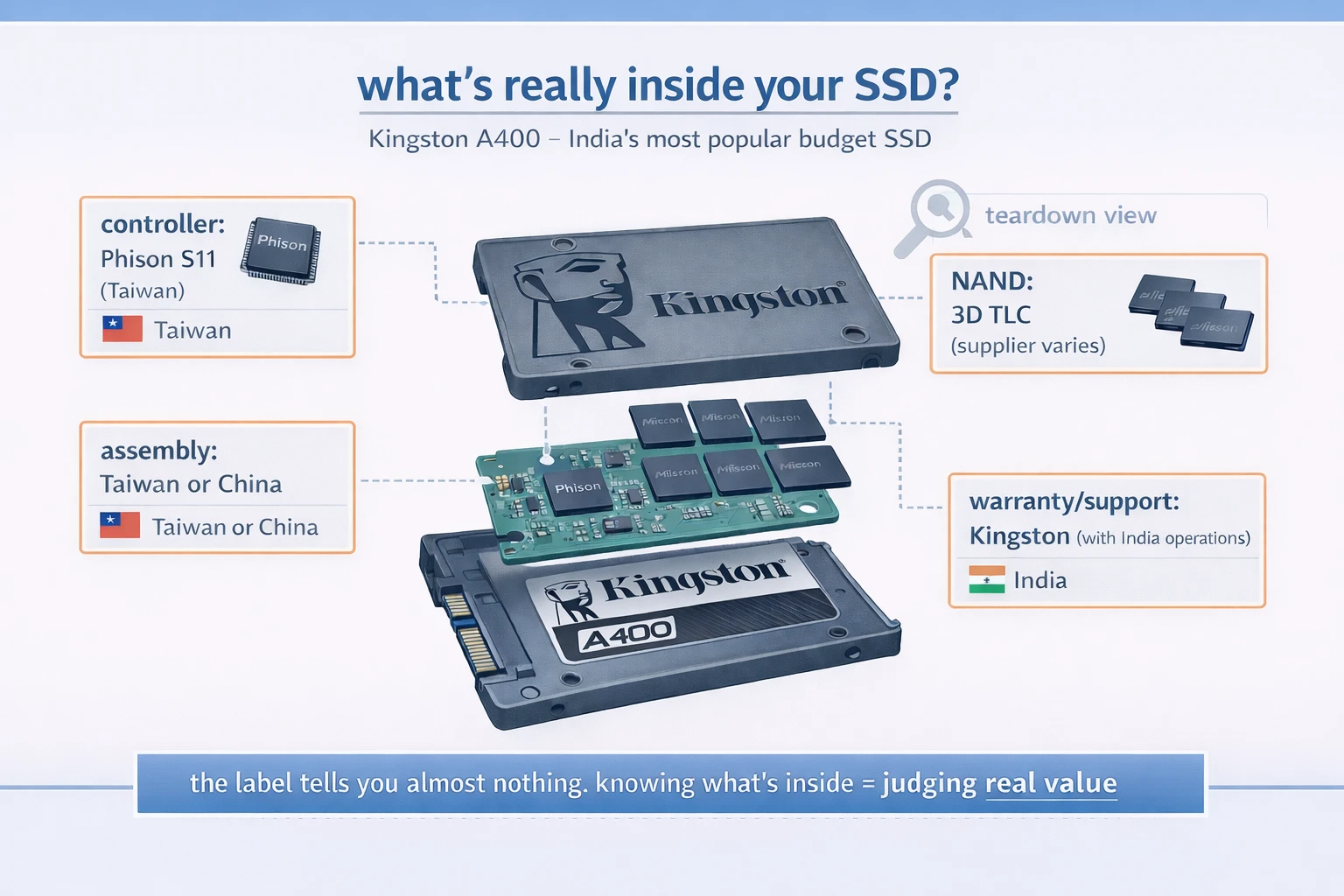
Kingston A400 internal component breakdown
There is a reason why tech reviewers often tear down SSDs and publish component lists. The label on the box tells you almost nothing. You need to know what’s inside to judge real value.
The kicker: SSD Brands swap components mid-production without changing model names. A Kingston NV2 from early 2024 might have Samsung NAND; late 2025 could have YMTC chips. Same box, different internals.
Before you go…
Now that you know your Kingston might contain Samsung or Micron NAND, the obvious question is: should you just buy Samsung-branded drives? Or is the ODM route smarter?
And the bigger question: when will SSD prices finally drop? Should you wait for the next oversupply cycle, or buy now?
We’ll tackle all of this in Issue #6 – including:
• How to verify components before buying
• When pricing will stabilize (and why it matters)
• A simple decision framework: OEM vs. ODM SSD brands
Hit reply and tell us:
Which SSD brand do you currently use?
Have you ever checked what’s actually inside using reviews or teardowns?
New to Tech Tomorrow? Read:
Issue #1: MikroTik hAP ax² Router Review & Small Business Cybersecurity Tips
Issue #2: Starlink in India, PoE Switch Guide & 5G Router Buying Tips
Issue #3: CCTV Storage Guide, AI Analytics & Tirumala Temple Case Study
Issue #4: WiFi 6E Finally Legal in India: Should You Upgrade?
More buying guide: 5G Router Buying Guide: Speed, Coverage & Which One to Buy in India
📦 What we’ve been up to: Over the past two weeks, we expanded our product lineup with two new SSD brands.
1. Lexar – NVMe SSDs, external drives, memory cards
2. Netac – SSDs and RAM modules
3. CP-Plus – Security cameras, DVRs, NVRs, and complete surveillance solutions
4. ASUS – WiFi 6 routers, mesh systems, gaming routers, and network adapters
Whether you’re upgrading storage, securing your premises, or building a high-speed network, we now have more trusted options to meet your tech needs. Take a look.