
 HD Cameras and Webcam
 Projectors and Speakers
 VOIP Phones and Gateway
 Access Control
 LTE and 5G Devices
 Smart Sensors And Automation
 Fiber and SFP Modules
 Firewall & Cloud Controllers
 Network Adapters and Accessories
 Network Switches
 PoE Switches
 Point To Point Wireless Radio
 Routers
 Wireless Access Points
 IP Cameras
 Memory Cards
 NVR
NVR Smart WiFi Cameras
 Storage Devices
 Desktop & Laptop RAMs
 Internal and External Hard Drives
 NAS Storage & Enclosures
 SSD and NVMe Drives
 USB Flash Drives


Tech Tomorrow – Issue #4

By Fgtech Store
Tech Tomorrow
for you, with you
February 1, 2026 • Issue #4 • 8 min read
From our Desk
WiFi 6E is finally legal in India (and we called it)
India just said yes to WiFi 6E – and your 500 Mbps connection might finally deliver what you’re paying for.
Here’s what’s interesting: WiFi 6E isn’t new tech. Over 100 countries have had it since 2020. Your laptop, your phone – they’ve been sitting with 6E chips, waiting. What changed? India finally delicensed the 6 GHz band.
We called this in December 2025 with our 2026 predictions video. Now it’s real.
The question isn’t “What is WiFi 6E?” It’s “Should I upgrade, and which router should I buy?”
Let’s break it down.
– Shailendra Jain
In this issue
- WiFi 6E Explained
- WiFi 6 vs 6E vs 7
- Who should upgrade: ISPs, gamers, and heavy users
- Top 6E Routers to watch out for: Which ones to keep a check on
📡 The Spotlight
What just happened – The big news
On January 21, 2026, India’s Department of Telecommunications (DoT) officially delicensed 500 MHz of the 6 GHz band (5925-6425 MHz) for indoor Wi-Fi use. No license required. No frequency assignment needed.
Your laptop that supports WiFi 6E? It can finally use its 6 GHz radio. That PlayStation 5 Pro Sony delayed launching in India? They might reconsider now.
This isn’t just a technical upgrade – experts estimate this could unlock around $250 billion in value for the digital economy.
One thing to note: In some countries like the US and Canada, WiFi 6E uses the full 5925–7125 MHz range (1200 MHz of spectrum). India has delicensed only the lower half: 5925–6425 MHz (500 MHz) for unlicensed WiFi use. The upper 6 GHz band (6425–7125 MHz) has been reserved for advanced mobile services under India’s National Frequency Allocation Plan. This means router manufacturers need to release India-specific firmware and get WPC approvals before products can officially launch here.
📡 The Spotlight
WiFi 6E Explained: What’s all the fuss about?
Think of WiFi bands like roads. The routers in most homes can deliver great speeds, but they’re stuck fighting for space. For years, we’ve been using two roads: 2.4 GHz (the old, crowded highway everyone uses) and 5 GHz (the faster expressway, but still crowded). It’s like having a fast car trapped in rush-hour traffic.
WiFi 6E gives you an entirely new, uncongested highway – the 6 GHz band. It’s brand new, empty, and much wider than the other two. No legacy devices clogging it up. No microwave ovens interfering. No neighbor’s 15-year-old router bleeding into your signal.
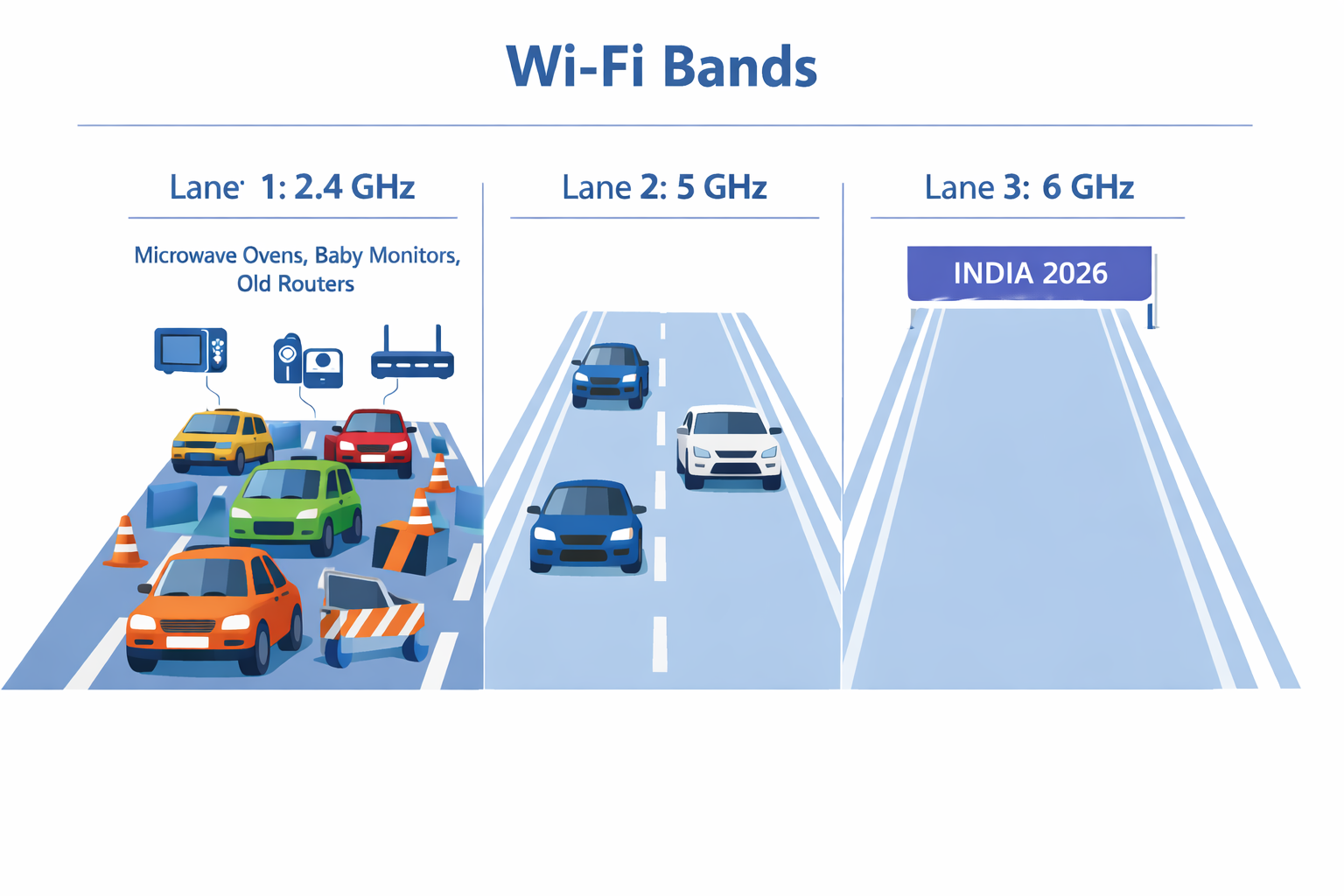
WiFi Bands Explained: The Road Analogy
What does this actually give you?
- More speed: Up to 9.6 Gbps theoretical maximum (real-world: 800-900 Mbps vs 500 Mbps on WiFi 6)
- Lower latency: Critical for gaming, video calls, and real-time applications
- Less interference: The 6 GHz band is clean—no old routers, no Bluetooth, no baby monitors
- More devices: Handle 200+ connected devices without performance drops
The catch (there’s always a catch)
The 6 GHz band is indoor only in India. Maximum power output is limited to 30 dBm (much lower than the 53 dBm allowed on 5 GHz). This means shorter range—great for inside your home or office, but it won’t reach as far through walls as 5 GHz.
Also, you need both your router and your device to support 6E. If your phone, laptop, or gaming console doesn’t have a WiFi 6E chip, you won’t see any benefit.
🔍 The Breakdown
Wi-Fi 6 vs 6E vs 7 – What’s the real difference?
If you’ve seen these terms thrown around and felt confused, here’s the simple breakdown:
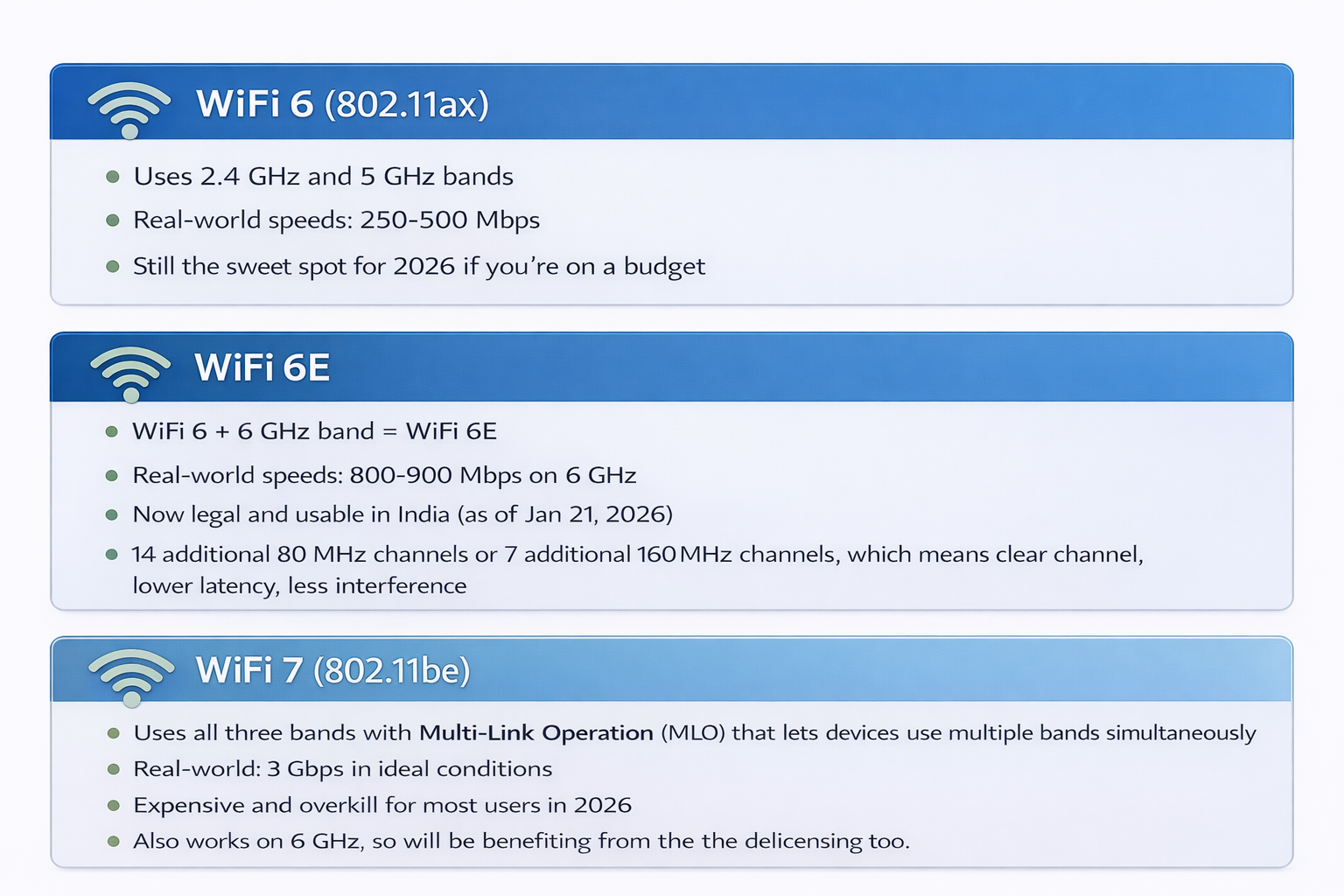
WiFi Standards Comparison: Which One Do You Need?
What this means for you
If you’re currently getting 500 Mbps from your ISP but only seeing 200-300 Mbps on your devices, congestion is likely the culprit. A Wi-Fi 6E router on the 6 GHz band could get you closer to that full 500 Mbps – or even 800-900 Mbps if your ISP supports it – simply because there’s no interference.
🛒 Watch list
Top Wi-Fi 6E routers to watch for:
Home routers: TP-Link Archer AXE75, TP-Link Archer AXE95
Mesh systems: TP-Link Deco XE75 (1-pack, 2-pack, 3-pack), TP-Link Deco XE75 Pro (3-pack)
Enterprise access points: Ubiquiti U6-Enterprise, Grandstream GWN7665
Keep an eye on the FGTech Store website and social channels for launch announcements in the coming weeks.
✅ Who Should Upgrade
Should you upgrade to WiFi 6E?
YES, upgrade if you are:
Business users & dense households: Managing WiFi for cafés, offices, or 10+ devices in apartment complexes where interference matters.
Gamers and Streamers: Lower latency matters. If you’re playing competitive games, streaming 4K, or running video calls where lag costs you money, the reduced latency on 6 GHz is noticeable.
You have 500+ Mbps Internet: If your ISP gives you 500 Mbps or 1 Gbps fiber, WiFi 6 might bottleneck it. WiFi 6E can actually deliver those speeds wirelessly.
NO, stick with WiFi 6 if:
- Your internet is under 200 Mbps; you won’t notice a difference
- Most of your devices don’t support WiFi 6E (check your phone, laptop specs)
- You live in a less congested area where WiFi interference isn’t an issue
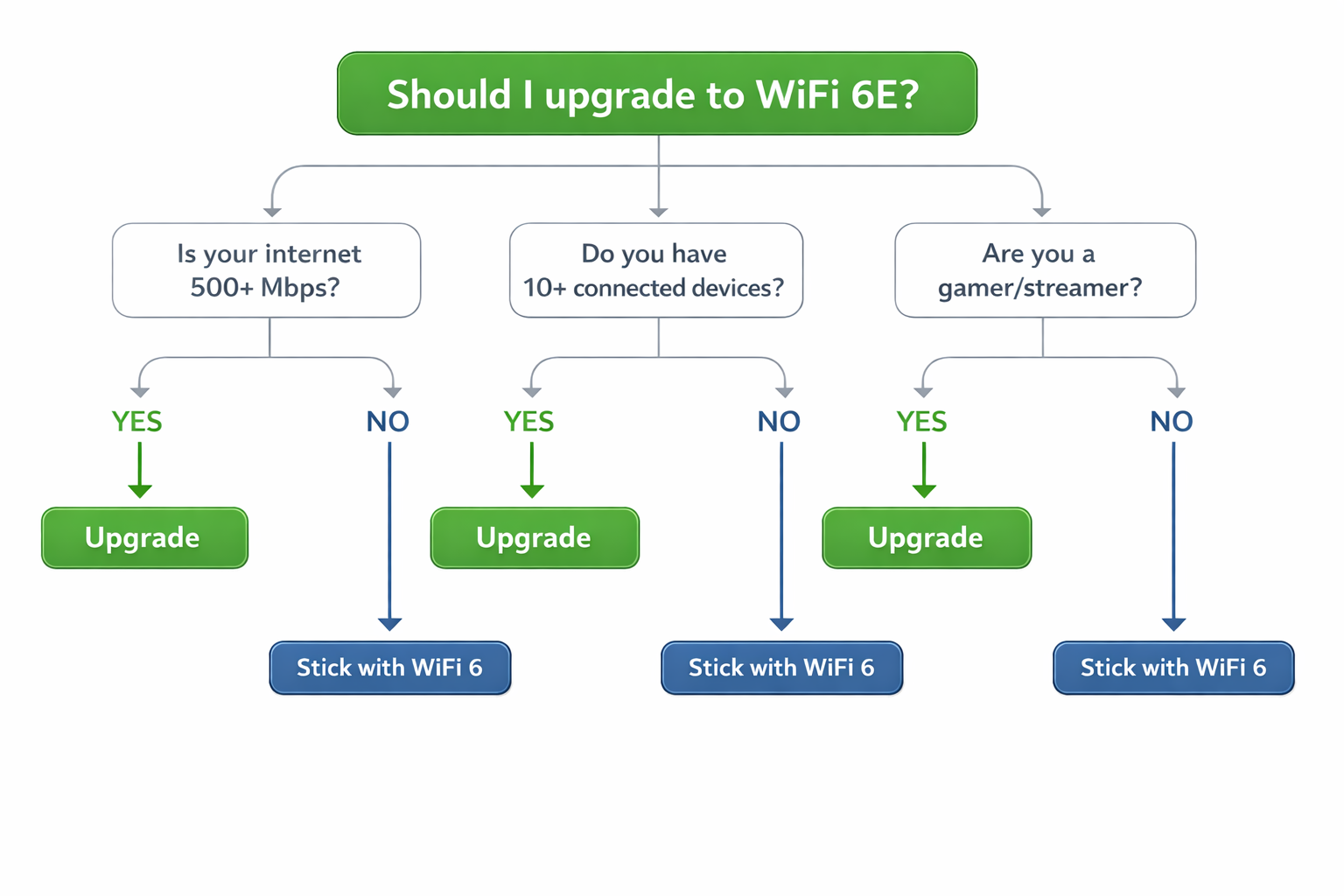
WiFi 6E Upgrade Decision Guide
🔮 The Prediction
What we predicted – and what’s next
In our 2026 predictions video, we said 6 GHz delicensing would happen this year – and it did. This is just the beginning. Over the next 6-12 months, expect:
- Official 6E router launches from major brands
- More affordable 6E options as competition increases
- ISPs starting to bundle 6E routers with premium plans
- Wi-Fi 7 routers are also entering the Indian market (they use 6 GHz, too)
Before You Go…
WiFi 6E is here, but we want to know: are you actually upgrading?
Hit reply and tell us:
- What router are you using right now?
- What’s your internet speed?
- Are you planning to upgrade to WiFi 6E this year?
We’ll feature the most interesting upgrade story in Issue #5 with specific router recommendations for your setup.
Give us your honest feedback
How did you feel about the 4th issue of Tech Tomorrow?