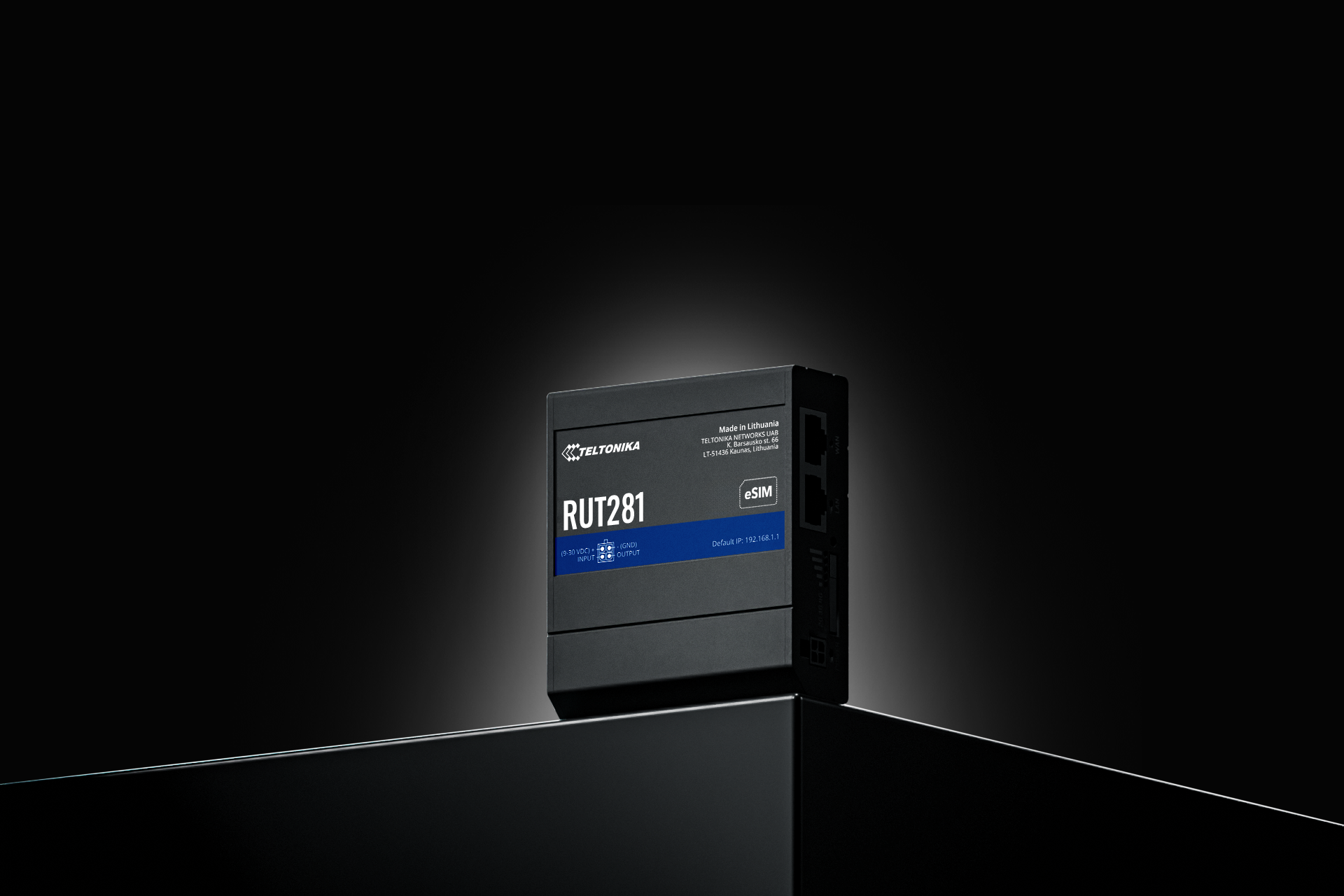
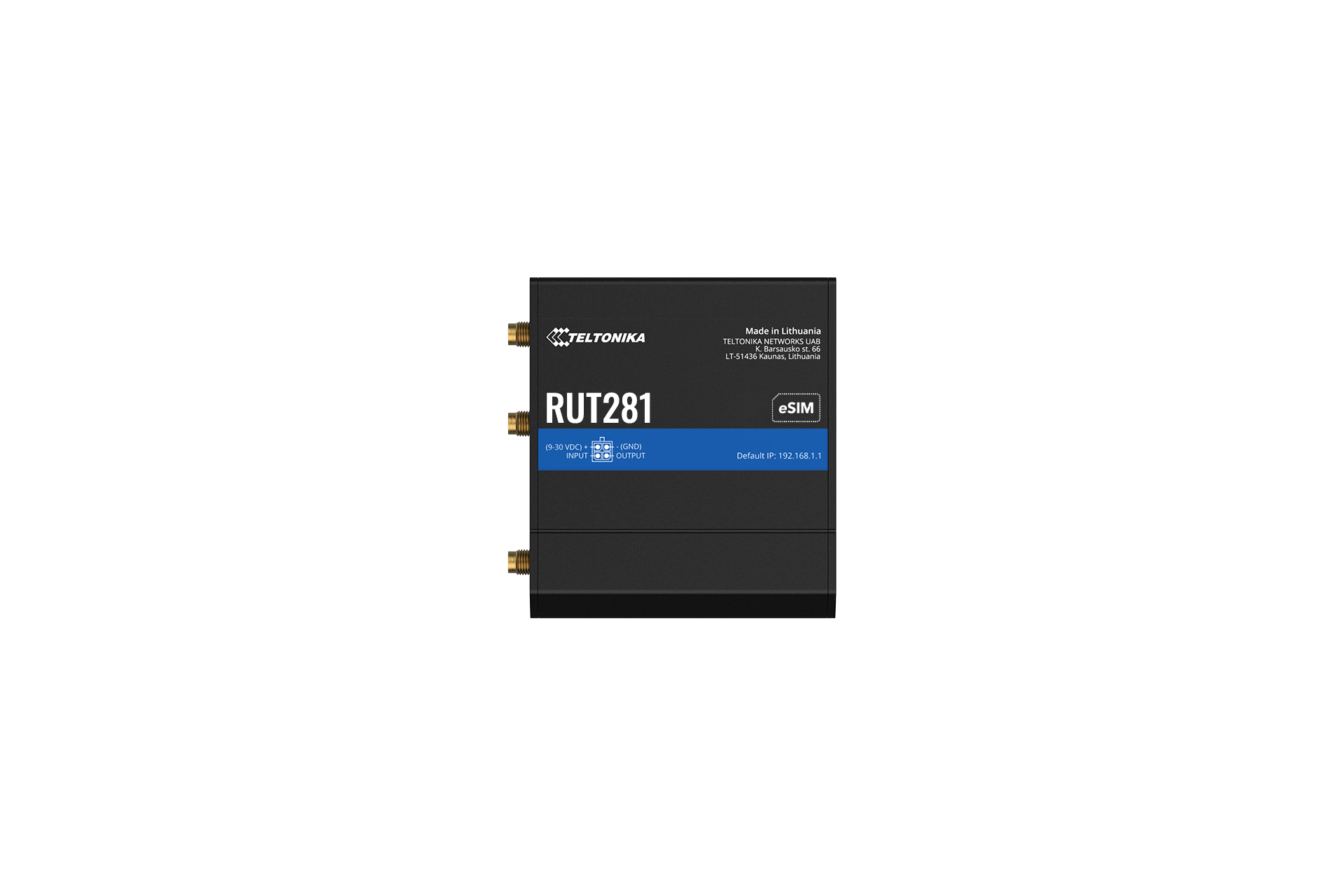
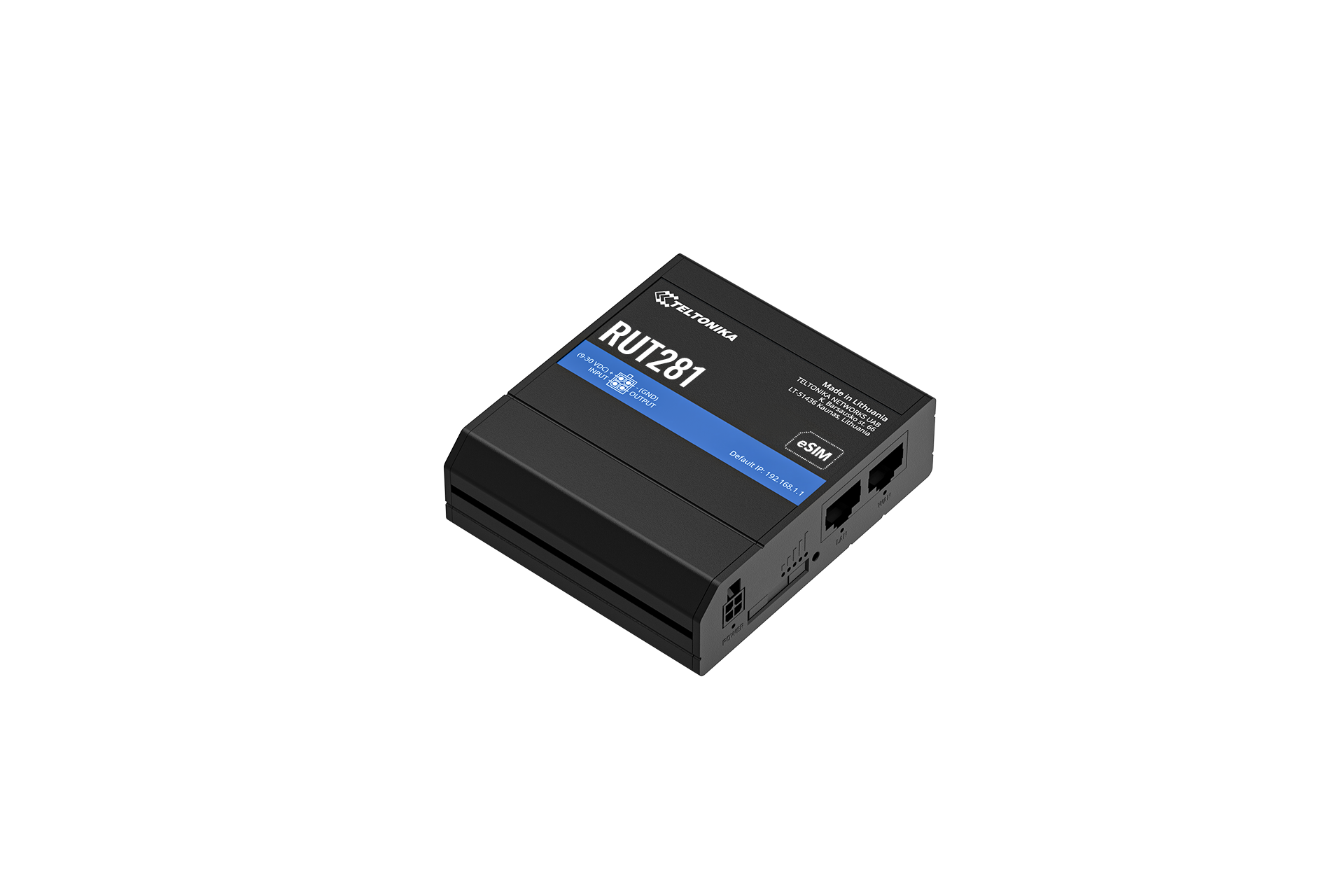
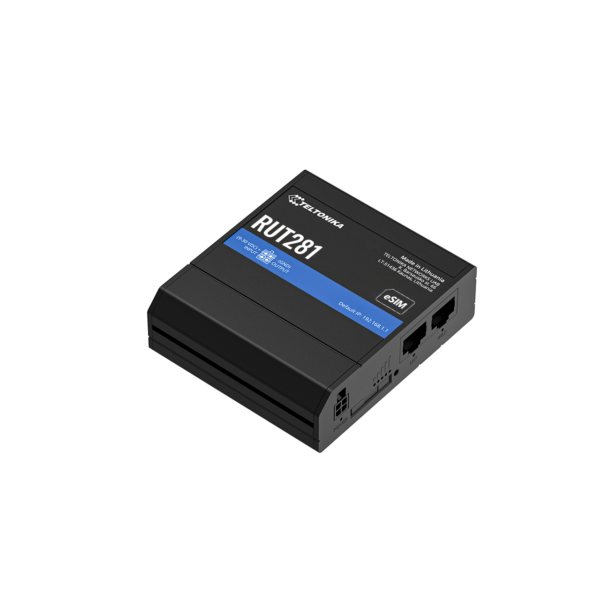
The Teltonika RUT281 is a compact industrial 4G LTE Cat 4 router designed for IoT, automation, and remote connectivity. Teltonika RUT281 it supports download speeds up to 150 Mbps and upload speeds up to 50 Mbps, with 3G and 2G network compatibility.
Teltonika RUT281 it features Wi-Fi 4, one Mini SIM slot with consumer-type eSIM support, and two 10/100 Mbps Ethernet ports. Digital input/output and passive PoE provide flexible connectivity for industrial applications.
Advanced VPN, firewall, routing, load balancing, and automatic network failover support reliable network operation. Running on RutOS, Teltonika RUT281 it offers remote monitoring through Teltonika RMS and supports industrial protocols such as Modbus, BACnet, OPC UA, DNP3, and DLMS/COSEM. Its aluminium housing with plastic panels provides IP30 ingress protection.
Key Features
4G LTE Cat 4 Connectivity: Supports download speeds up to 150 Mbps and upload speeds up to 50 Mbps, with 3G and 2G compatibility.
SIM and eSIM Support: Includes one Mini SIM slot and consumer-type eSIM support with up to seven downloadable profiles.
Wi-Fi 4 Wireless Connectivity: Supports 802.11b/g/n Access Point and Station modes, with up to 50 simultaneous users.
Dual Ethernet Connectivity: Provides one WAN and one LAN port, both supporting 10/100 Mbps, along with digital input/output and passive PoE.
Advanced Network Management: Supports VPN, firewall, VLAN, hotspot, load balancing, automatic failover, and RMS remote management.
Best Suited For
Industrial IoT and connected device applications.
Remote monitoring and automation systems.
Cellular WAN backup and failover connectivity.
Smart infrastructure and industrial networking.
Applications requiring flexible SIM and eSIM connectivity.
Not Suited For
Applications requiring 5G cellular connectivity.
Networks requiring Gigabit Ethernet ports.
Installations requiring more than two physical Ethernet ports.
Outdoor installations requiring waterproof or higher ingress protection.
Applications requiring integrated GNSS or RS232/RS485 serial interfaces.

 HD Cameras and Webcam
 Projectors and Speakers
 VOIP Phones and Gateway

 Access Control
 5G routers and 4G LTE Devices
 Smart Sensors And Automation

 Fiber and SFP Modules
 Firewall & Cloud Controllers
 Network Adapters and Accessories
 Network Switches
 PoE Switches
 Point To Point Wireless Radio
 Routers
 Wireless Access Points

 IP Cameras
 Memory Cards
 NVR
 Smart WiFi Cameras
 Storage Devices

 Desktop & Laptop RAMs
 Internal and External Hard Drives
 Storage Accessories and Enclosures
 SSD and NVMe Drives
 USB Flash Drives



 Pick up from the FGTECH Store






 Pick up from the FGTECH Store
 Courier delivery