
 HD Cameras and Webcam
 Projectors and Speakers
 VOIP Phones and Gateway
 Access Control
 LTE and 5G Devices
 Smart Sensors And Automation
 Fiber and SFP Modules
 Firewall & Cloud Controllers
 Network Adapters and Accessories
 Network Switches
 PoE Switches
 Point To Point Wireless Radio
 Routers
 Wireless Access Points
 IP Cameras
 Memory Cards
 NVR
NVR Smart WiFi Cameras
 Storage Devices
 Desktop & Laptop RAMs
 Internal and External Hard Drives
 Storage Accessories and Enclosures
 SSD and NVMe Drives
 USB Flash Drives


Smart Home and Office automation you can set up in India today – Tech that runs your home and your office

In this issue of Tech Tomorrow, we walk you through the tech that can run your home and your office today, what it costs, and what's become available only in the last couple of years.
Before we dive in, if you're someone who enjoys understanding how technology, business, policy, and infrastructure shape the products and services you use every day, join the community if you haven't already. We publish one in-depth edition every two weeks. And if you're already a subscriber, thank you. Consider forwarding this to someone who'd enjoy thoughtful deep dives into the forces powering the country around them.
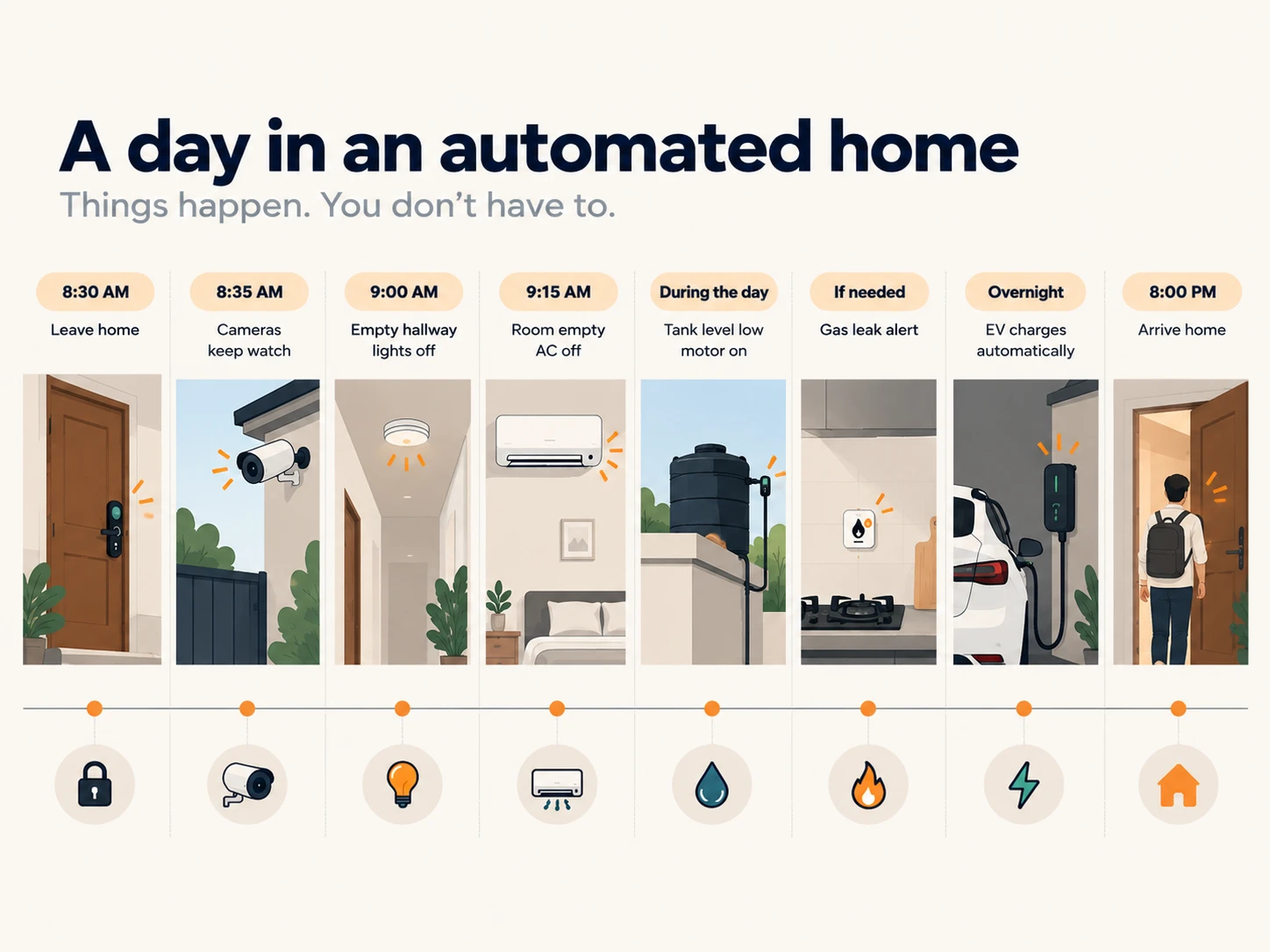
You leave for work at 8:30 in the morning. You pull the front door shut on your way to work. The smart lock latched and logged the time. Three cameras, one at the gate, one covering the driveway, one inside the living room, continue recording while you're gone. But they're not just recording. They know nobody's supposed to be home right now, and if someone walks in, they'll send a clip to your phone within seconds.
The lights in the hallway you just walked through switch off behind you. Not because you pressed anything. Because a presence sensor noticed the hallway was empty and a smart switch acted on it.
The AC in the bedroom will turn itself off 15 minutes after the room empties. Newer smart models do this natively over Wi-Fi, taking commands from Alexa, Google Home, or their own app. If it's an older unit, a small IR blaster plugged in nearby does the same job, talking to the AC the way its remote does, except on a 'Scene' or an automation you set once and forgot about.
Your home, at this point, is running five or six systems without anyone operating them. Security cameras watching the perimeter. Smart locks on the main door and the back gate, both logging every unlock.
A couple of access points wired back to the router, giving every corner of the house a stable connection. Wired backhaul beats wireless mesh every time for speed and coverage, and everything else in this list depends on that connection being solid.
A smoke detector in the kitchen. A gas leak sensor next to the stove that will send an alert to your phone before you smell anything. A water tank level sensor on the roof that turns the motor on when the tank drops below 30% and off when it's full, a problem every Indian homeowner has solved with jugaad for decades and can now solve permanently for under ₹3,000/-
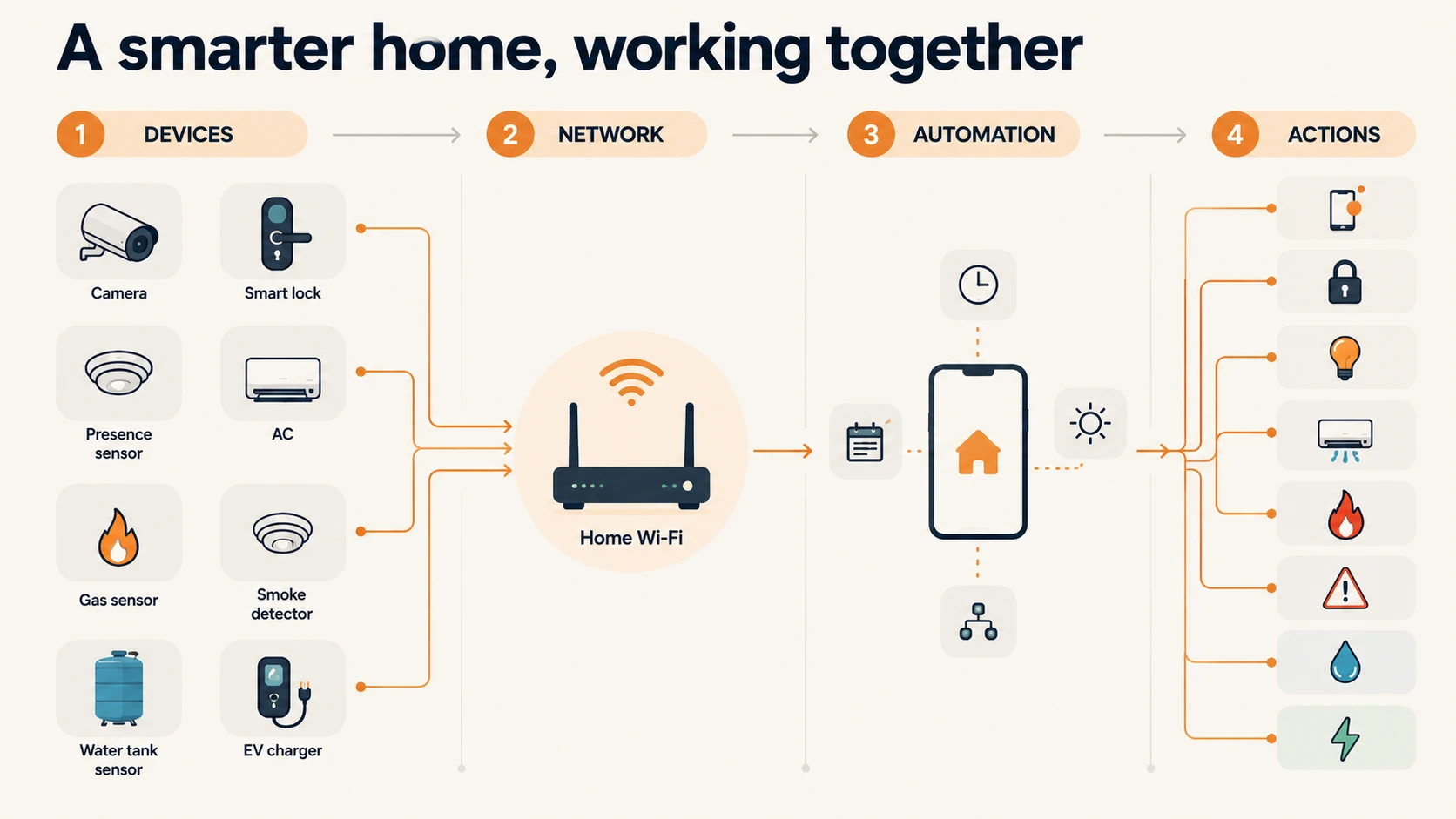
If there's an EV in the driveway, a smart charger handles the logistics seamlessly. After a simple manual plug-in, the automation handles the rest: it tracks when you're home, reads the battery level, and initiates a slow overnight charge during off-peak electricity hours. If you ever park with less than 40% battery, it sends a proactive notification to your phone, turning a daily chore into and set and forget automation.
None of this is luxury hardware. A smoke detector is ~₹1,500. A gas sensor is ~₹1,200. The presence sensor that turns your hallway lights off is ~₹800. The Wi-Fi system that connects it all is the most expensive piece, and it's still under ~₹15,000 for most homes.
The total cost of making a home meaningfully aware of itself, not just remotely switchable but actually responsive, has dropped to a point where the real barrier is no longer price. It's knowing what to ask for.
Now you arrive at work.
You walk into the office and tap your phone against a reader at the entrance. An RFID access control system logs your entry, your name, the time, and the door you used. If something goes missing from the building at 2:47 AM on a Tuesday, this system knows exactly who was inside and when.
That record needs to hold up with insurance, with the police, sometimes in court.
The cameras in the corridors and the parking lot feed into a Network Video Recorder (NVR) that stores footage locally on hard drives.
Most offices keep 30 to 90 days of continuous recording, driven by policy, insurance, sometimes legal mandates. The NVR sits in a server closet, quietly writing to disk, and nobody thinks about it until the day someone needs footage from last Thursday at 3 PM.
The meeting room you walk into has a conferencing system that would have cost ₹3-4 lakh five years ago.
A wide-angle camera, a ceiling microphone array, and a display that connects to your laptop over a single USB-C cable or wirelessly.
Today, a single video bar from Poly, Logitech, or Yealink does the same job for under ₹80,000, sometimes under ₹40,000, and mounts on the wall in 20 minutes.
The phones on the desks, if the office still uses desk phones, are IP phones running over the same infrastructure as the computers.
The old model was a separate phone system, separate wiring, separate maintenance contract. An IP PBX, either a small box on the network rack or a cloud-hosted service, replaced all of that. Intercom between floors, call routing, voicemail to email, all running over the same Ethernet cables that carry everything else.
Somewhere in a small server closet or under someone's desk sits a NAS, a network-attached storage box holding the company's files locally. Shared folders, project archives, CCTV backups. Control over where the data sits, no recurring per-user fees that scale with headcount, and no dependency on an internet connection to access your own files. That's why offices keep a NAS even when cloud storage is cheap.
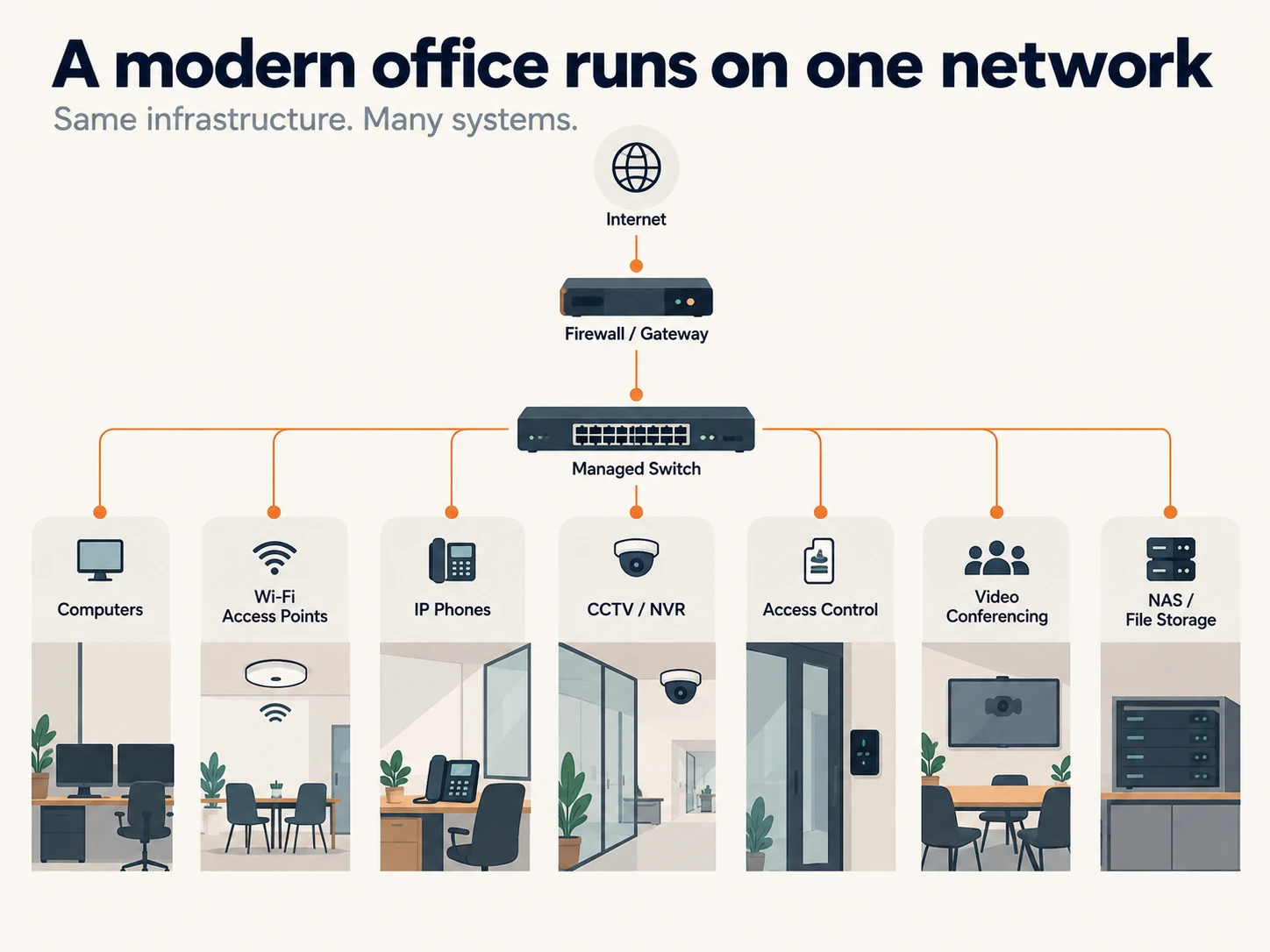
Tying it all together is the network. Managed switches connecting every desk and access point back to a central point. A firewall or gateway between the office and the internet, controlling what comes in and goes out. Ceiling-mounted enterprise access points, centrally managed, so the IT admin can see every connected device from one dashboard.
This is the backbone. When 40 people are on video calls at the same time, this is what keeps the building from grinding to a halt.
A few things have shown up in the last two to three years that didn't exist before, or existed only as expensive, specialist-grade systems.
At home, the most meaningful shift is happening inside the camera. Cameras with on-device AI can now tell the difference between a person, a car, a package, and an animal, and they do it on the camera itself, without uploading your footage to a server.
A few years ago, this processing happened in the cloud. Now the chip inside the camera handles it locally. Faster alerts, no cloud subscription fee, and your footage stays on your property.
Whole-home energy monitors are another recent arrival. A device that sits inside your distribution board and tracks power consumption per circuit, showing you exactly which appliance or room is drawing electricity, through an app, in real time.
This existed as industrial equipment for years. As a consumer product you can order online and have an electrician install it in an hour, it's genuinely new. For anyone who's stared at a ₹6,000 electricity bill wondering where it all went, this answers that question.
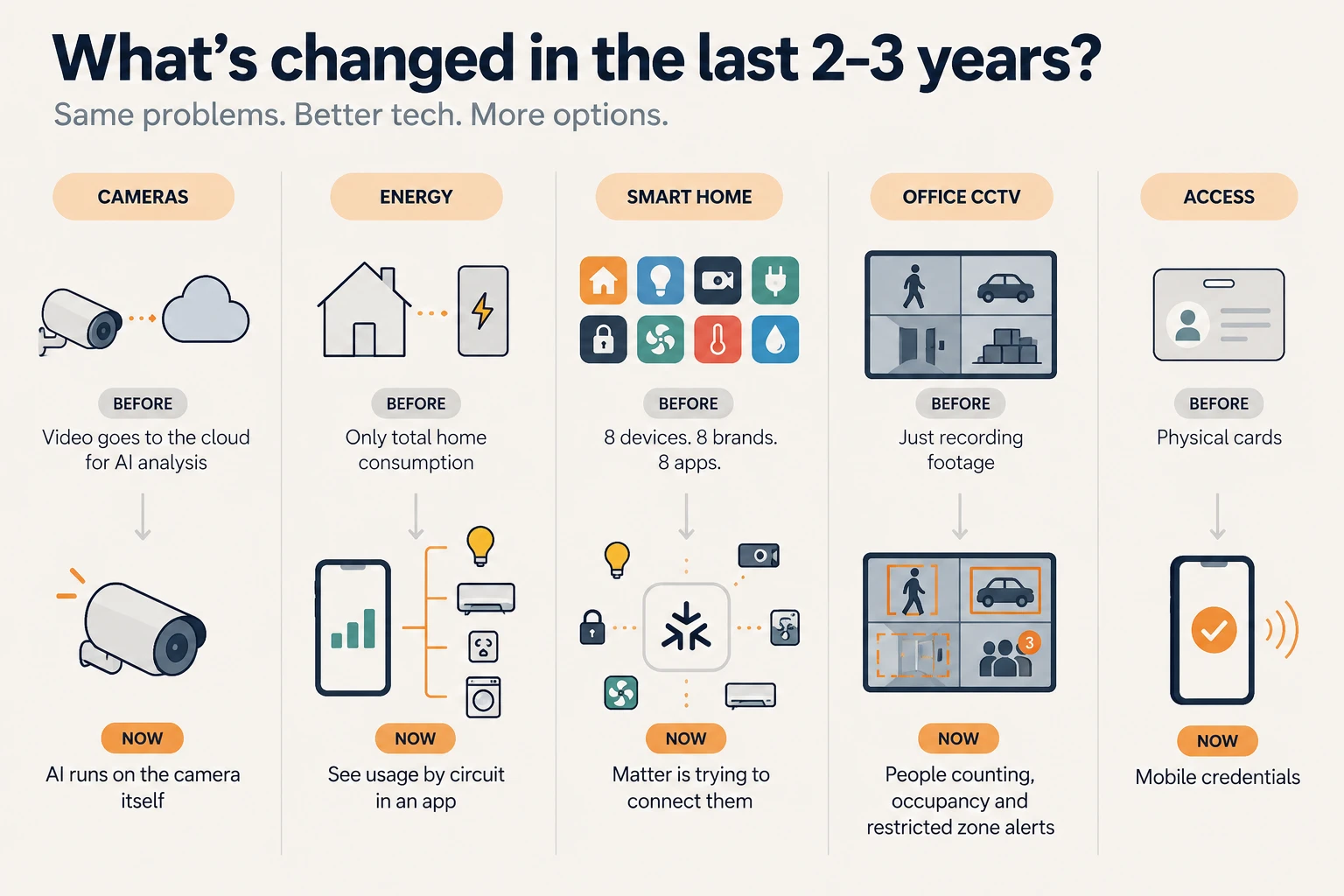
And the fragmentation problem, eight apps to run eight devices from eight brands, is finally starting to get a fix.
Matter, a connectivity standard backed by Apple, Google, Amazon, and Samsung, lets devices from different manufacturers talk to each other natively, without needing a shared cloud or a shared app. We covered the fragmentation problem in detail earlier. Matter is the protocol-level answer.
It's still early, and the adoption is uncertain.
Existing smart home devices are not getting firmware upgrades to support it. Going 'Matter' means replacing components. And the current catalogue of Matter-certified products in India is thin, with prices higher than their non-Matter equivalents. For now it's an interesting standard to watch.
At the office, the most interesting shift is in what existing cameras can now do with AI-based video analytics.
People-counting, occupancy tracking, detecting someone loitering in a restricted area. None of this requires replacing cameras. It's a software layer that runs on the NVR or on a connected server, analyzing footage the office already records. For a retail store, it means knowing peak foot traffic hours without manually counting. For a warehouse, automated alerts when someone enters a zone they shouldn't be in.
Mobile-based access credentials are replacing the physical access card. Instead of issuing a plastic card that can be lost, cloned, or shared, the office provisions a credential to your phone. Revocation is instant. There's no card to collect when someone resigns.
It's 8 PM. You're back home.
The AC hasn't turned on yet. It will, a few minutes after the presence sensor picks you up in the bedroom. The same way it turned off behind you this morning. The porch light is already on, triggered by sunset, not by your arrival. Inside, the living room is set to the lighting scene your family uses in the evening, warm, dim, no overhead glare.
Five years ago, most of this was either unavailable or unaffordable. Five years from now, it won't be called a 'smart home' or a 'smart office.' It'll just be how spaces are built. The technology is already here. The shift is in how many people know it exists.
Five years from now, it won't be called a 'smart home' or a 'smart office.' It'll just be how spaces are built.
If this changed how you think about the spaces you live and work in, share it on WhatsApp or LinkedIn.
This story was shaped by feedback from Bhanu Sharma, whose contribution sharpened several sections of this piece.
Give us your honest feedback
|
😍 Loved it, more like this!
|
🙂 Good, could be better
|
😕 Not relevant to me
|