
 HD Cameras and Webcam
 Projectors and Speakers
 VOIP Phones and Gateway
 Access Control
 LTE and 5G Devices
 Smart Sensors And Automation
 Fiber and SFP Modules
 Firewall & Cloud Controllers
 Network Adapters and Accessories
 Network Switches
 PoE Switches
 Point To Point Wireless Radio
 Routers
 Wireless Access Points
 IP Cameras
 Memory Cards
 NVR
NVR Smart WiFi Cameras
 Storage Devices
 Desktop & Laptop RAMs
 Internal and External Hard Drives
 Storage Accessories and Enclosures
 SSD and NVMe Drives
 USB Flash Drives


How Smart Home devices work in India and the infrastructure behind it

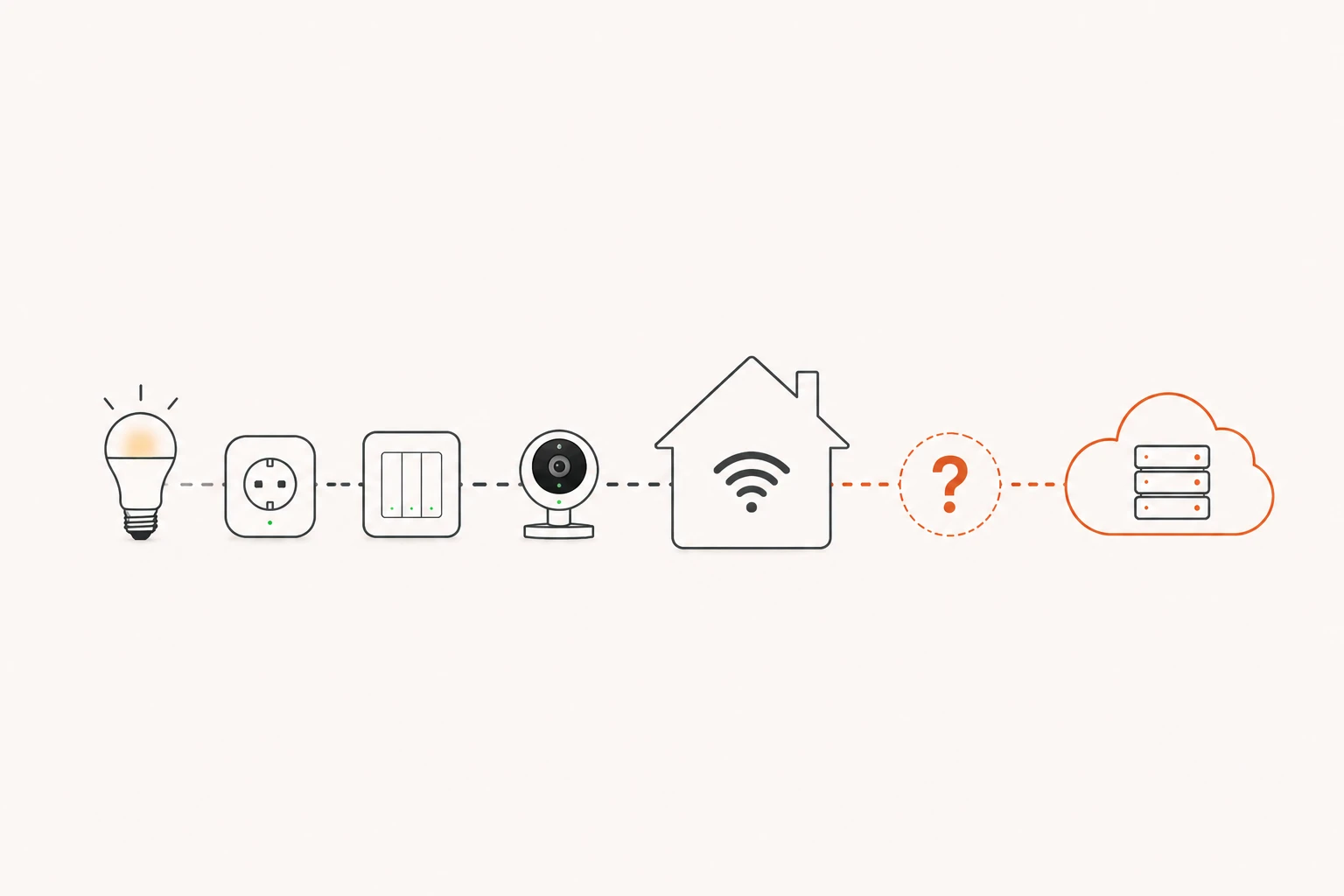

In this issue of Tech Tomorrow, we unpack who's running the Big Boss set your smart home has become, how the infrastructure underneath it actually works, and what it takes to buy smart instead of just buying cheap.
Before we dive in, if you're someone who enjoys understanding how technology, business, policy, and infrastructure shape the products and services you use every day, join the community if you haven't already. We publish one in-depth edition every two weeks. And if you're already a subscriber, thank you. Consider forwarding this to someone who'd enjoy thoughtful deep dives into the forces powering the country around them.
On to the story.
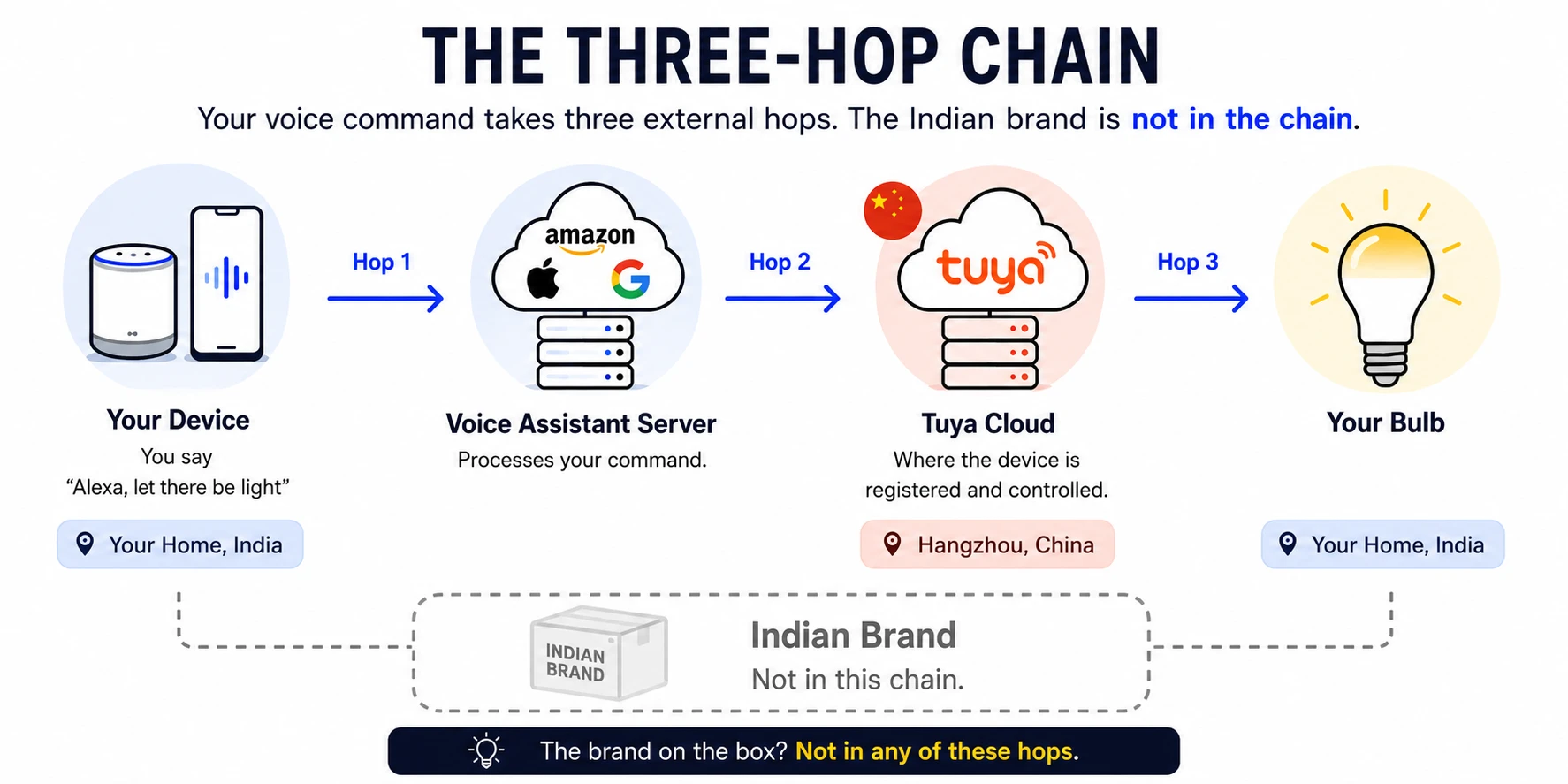
You buy a budget smart bulb with a ‘Make in India’ logo. Indian brand. Indian packaging. You download the app, connect the bulb, and tell Alexa to turn on the light.
What you don't see is the chain of events that fires underneath. Here’s how it works:
And this isn't just one brand. Pert.me was one of the first companies to bring IoT devices to India's retail market. When that didn't scale, they pivoted to becoming an OEM, building smart products on Tuya's stack for brands including Wipro, Havells, Syska and Polycab, according to Tuya's own case study notes.
Dixon Technologies, India's largest home-grown electronics manufacturer, uses Tuya for its smart lighting line.
If you've bought a budget smart plug, a smart switch, or a WiFi-connected LED light from an Indian brand, there's a strong chance it runs on Tuya's cloud, Tuya's firmware, and a white-labelled version of Tuya's app.
It's a legit business model. And understanding it is the first step to making better decisions about what you put inside your walls.
Tuya Smart was founded in 2014 by Alibaba veteran Jerry Wang. The company doesn't make smart home devices. It provides a one-stop IoT platform, hardware modules, cloud and app, for manufacturers to create their own smart devices.
As of March 2026, Tuya's developer platform had nearly two million registered developers across more than 200 countries, according to the company's about page. Brands can clone and rebrand Tuya's app in days.
For a small Indian manufacturer, this is irresistible. Tuya built the entire stack once. Certified modules, firmware, cloud backend, white-label app. All sunk costs, paid once. Then it licensed the bundle to factories. A brand picks a module, gets a firmware license, puts its logo on the app, ships. What used to take a manufacturer years of engineering now takes weeks. The barrier to being a "smart home brand" collapsed.
That's why India's smart home market looks the way it does. Dozens of brands that appear independent on the shelf are running on the same backend underneath. The apps look almost identical because they are almost identical.
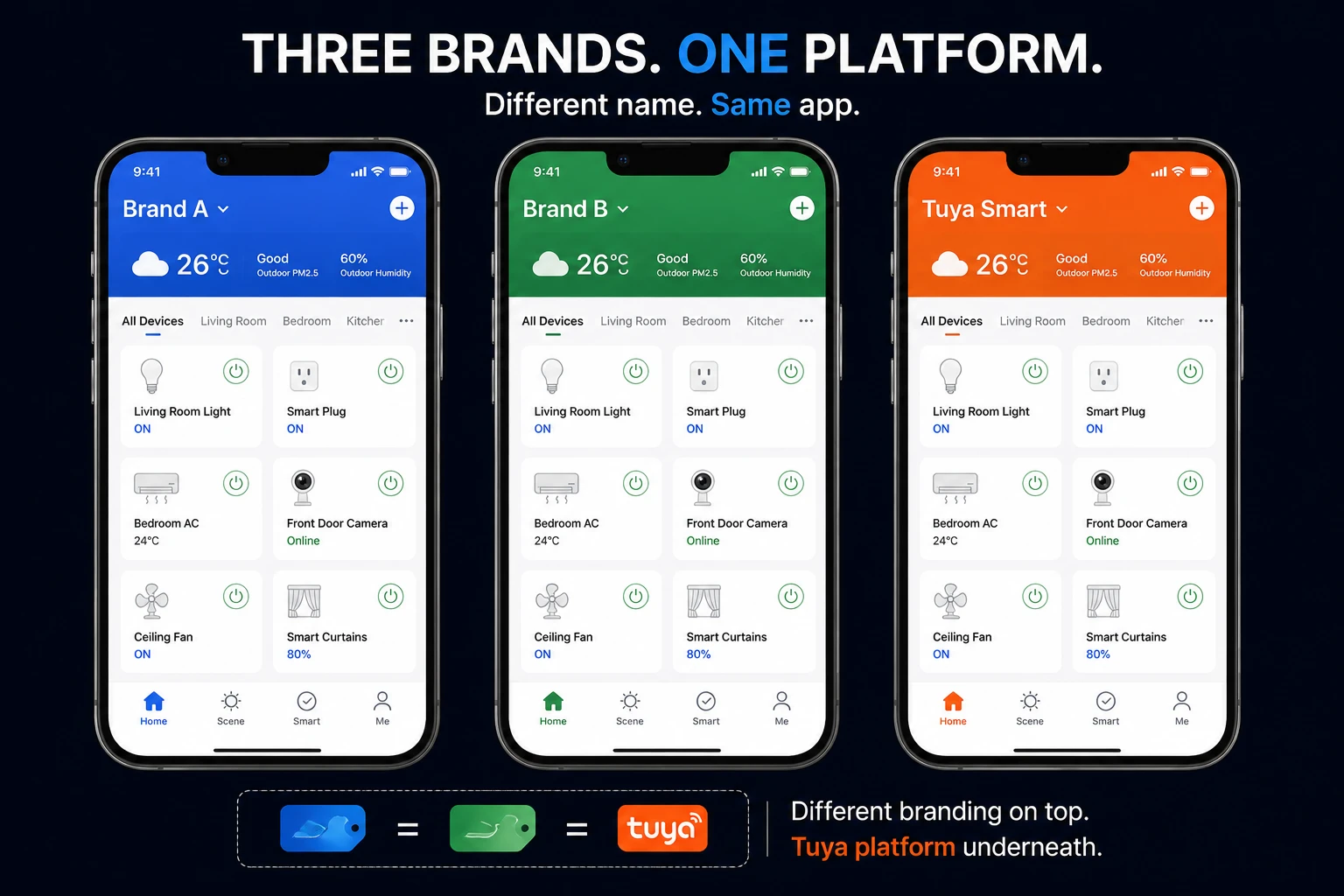
Before Tuya, smart home in India meant Philips Hue or SmartThings, where a single bulb cost ₹2,000 to ₹3,000 and a starter kit ran above ₹10,000. Tuya-powered devices brought that down to ₹500 for a plug, ₹800 for a switch.
And it isn't just individual buyers driving adoption.
A large chunk of Indian smart homes are wired by integrators, builders and interior designers before the owner moves in. Their incentive is simple: the cheaper the device stack, the higher the margin on the project. They're not choosing what's best for the homeowner's privacy or reliability. Most homeowners never know they had an alternative, because nobody offered them one.
The price collapse is why adoption exploded. But it also created three problems that nobody explains at the point of sale.
The first is how these devices work, or don't work, when your internet drops.
Smart home devices broadly fall into two camps. Cloud-dependent devices, where every command travels from your phone to a server and back before the device responds. And local-first devices, where a hub inside your home handles communication directly, and the internet is only needed for remote access.
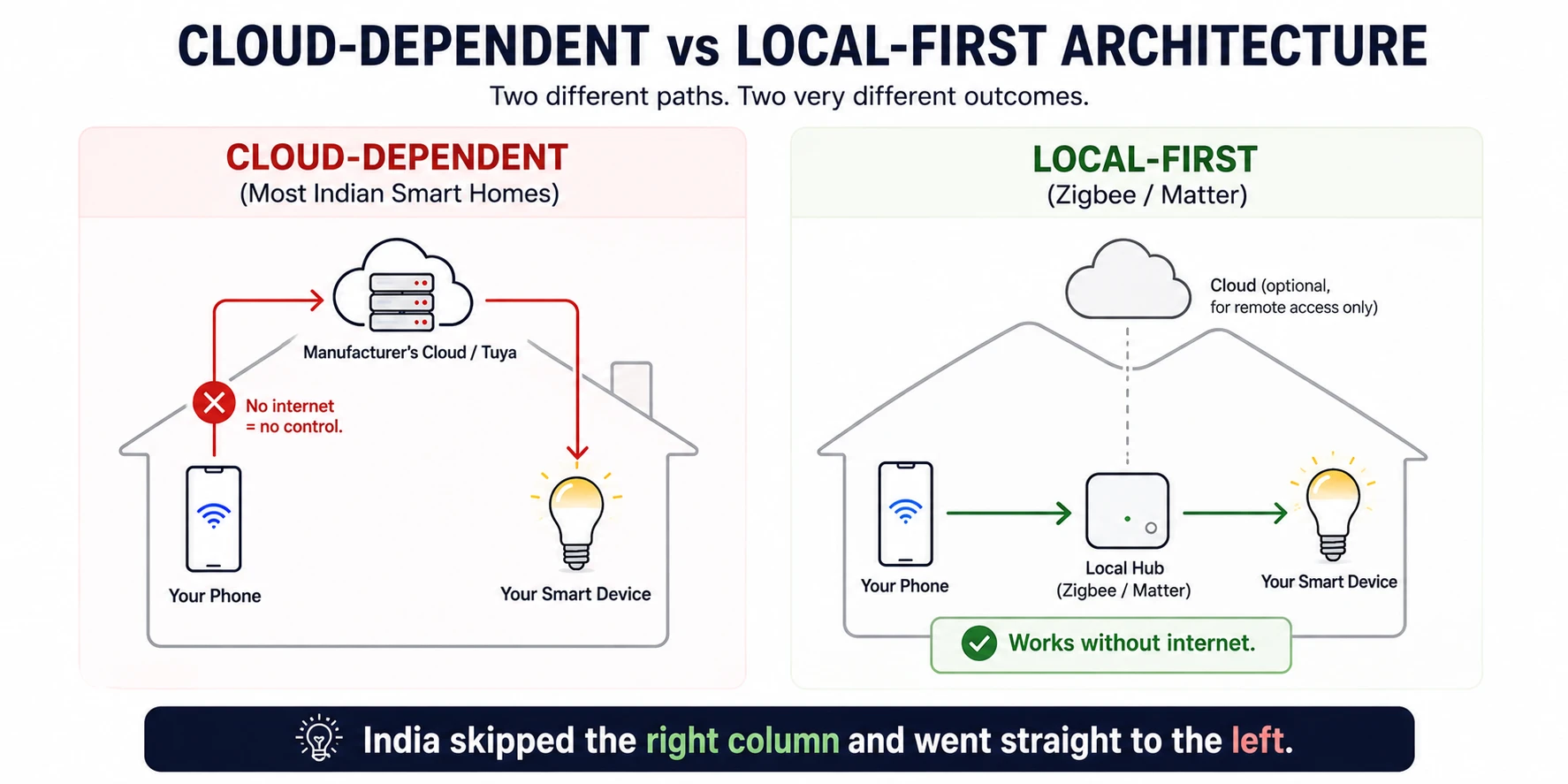
Many early Western smart-home systems (e.g. Philips Hue, SmartThings) used local mesh protocols like Zigbee and Z-Wave via a hub, enabling lights and sensors to work without constant internet access.
India skipped this entirely. The market mainly went straight to WiFi-based, cloud-dependent devices because they're cheaper and need no hub. The tradeoff is real: many cloud-dependent smart switches lose app and automation control during an outage, and some retrofit installations also lose convenient manual operation.
The second problem is fragmentation.
TP-Link makes great smart bulbs but doesn't make ACs. Samsung makes smart ACs but runs them on its own SmartThings app. Your doorbell is on a third app. Your smart plug is on a fourth. Nothing talks to anything else because each brand operates as its own island.
The result in a fully automated Indian home can look like this: 8-10 apps on your phone, each controlling a different device or brand, none of them aware that the others exist.
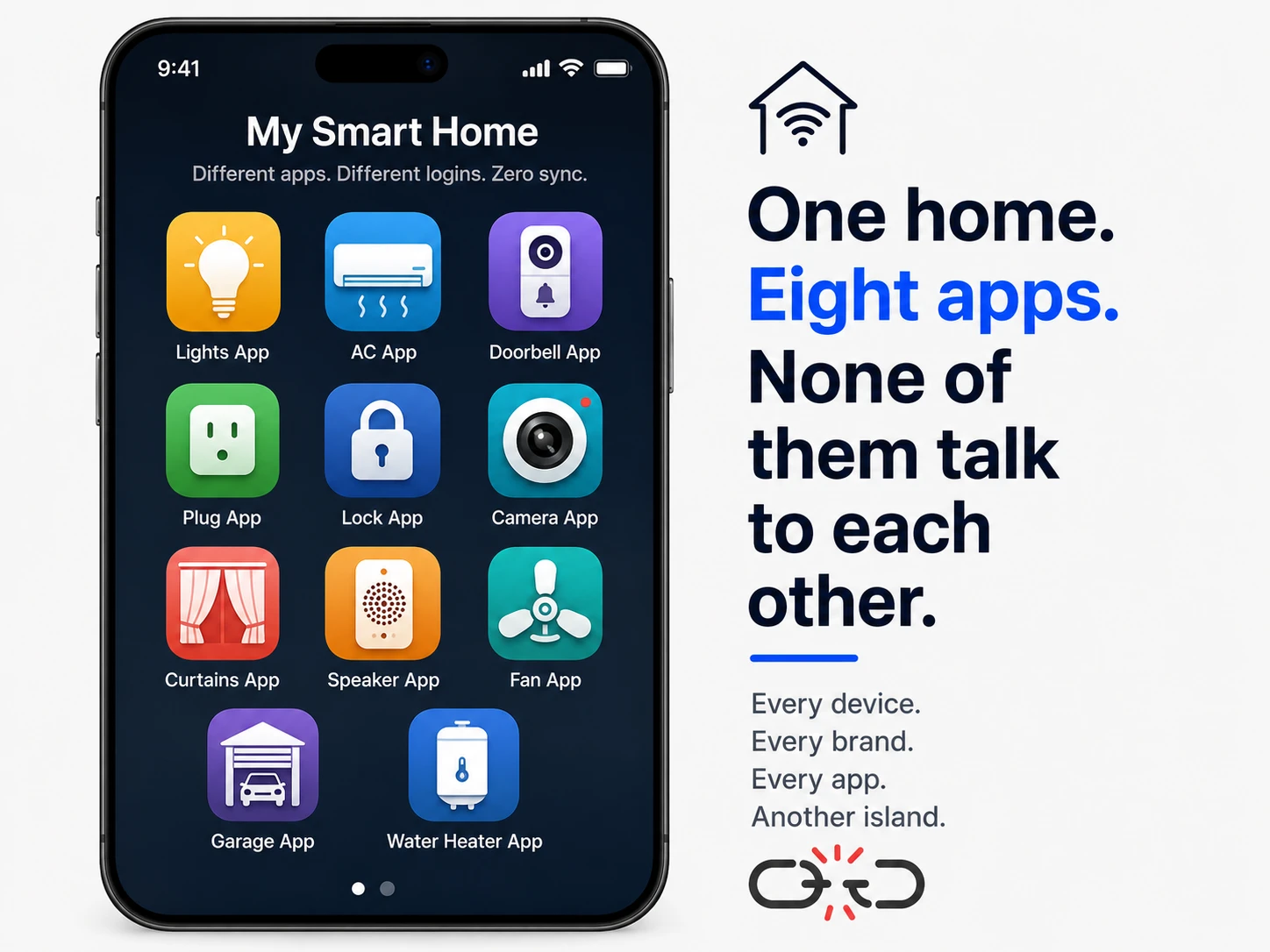
Mr. Bhanu Sharma, who's been building and living with smart home setups for close to a decade, puts the fragmentation problem simply: try teaching your 65-year-old parents to use eight different apps just to run their own home.
"Automation is supposed to make life simpler. In practice, in India, it fragments it".
The third problem is where the data goes.
All Tuya-powered devices report back to Tuya's cloud. According to Tuya's own app privacy policy, the data collected when you connect a device includes your WiFi information (SSID, BSSID, MAC address), device IDs, IP addresses, and approximate geographical location. Usage data, including when devices are activated, how they're used, and how often, is collected continuously. For smart cameras, surveillance footage is uploaded to the cloud automatically.
The concern isn't that Tuya is doing something illegal. The concern is structural. Tuya is headquartered in Hangzhou, China. China's Data Security Law, enacted in June 2021, legally requires Chinese companies to cooperate with government data requests on matters of national security. As cybersecurity researcher Klon Kitchen of the American Enterprise Institute told VOA News, "Tuya doesn't have to be incompetent or malicious to be a threat; it only needs to be compliant with Chinese law."
Mr Akshay Mishra of DSPworks.in, another OEM in the Indian IoT stack, trying to do it the right way, frames the problem differently: "You inherit a security posture. You don't choose one." You can't audit the firmware, can't choose where data routes, and can't run the device without accepting both.
Tuya maintains that user data is assigned to regional data centres operating independently. But the legal obligation remains. And for a household running a dozen Tuya-powered devices, the behavioural data being generated- when you wake up, when you leave, which rooms are occupied- is the kind of pattern data that, aggregated across millions of homes, has value far beyond switching a light on and off.
This is a similar structural concern that drove the Indian government to push STQC and BIS certification for CCTV cameras. Chinese infrastructure embedded in Indian homes, with data flowing through Chinese-controlled servers. The smart home market is walking the same path, just a few years behind the surveillance industry.
Take a step back and look at the pattern. The ecosystem that serves Indian smart homes is optimised for exactly one thing: price. Not reliability, not interoperability, not security. Just price. Every device reporting to the same cloud, every command leaving the country, every routine logged on servers you didn't choose. It's a Big Boss set, except nobody told the contestants they were on the show.
"That's not smart home automation. That's cheap home automation dressed up as smart.".
The obvious fix is to buy more expensive, better-quality devices. But that only tells part of the story. The deeper problem is the protocol and not the price. The architecture of these devices determines whether they work locally or rely on a cloud server in another country. And that's where a standard called ‘Matter’ enters the picture.
So what does "using good tech" look like?
A protocol called Matter, that's designed to fix both fragmentation and cloud dependency. It was started in 2019 as Project Connected Home over IP, (Project CHIP) and was renamed/ rebranded as Matter in 2021. Matter is an open IoT standard backed by Apple, Google, Amazon, and Samsung through the Connectivity Standards Alliance. It lets devices from different brands communicate natively with each other in any compatible app, without a shared cloud. And it's built for local-first control: a Matter device connected to a Thread or WiFi network, you can control the data, its flow, and its location. You can choose if it is shared or not.
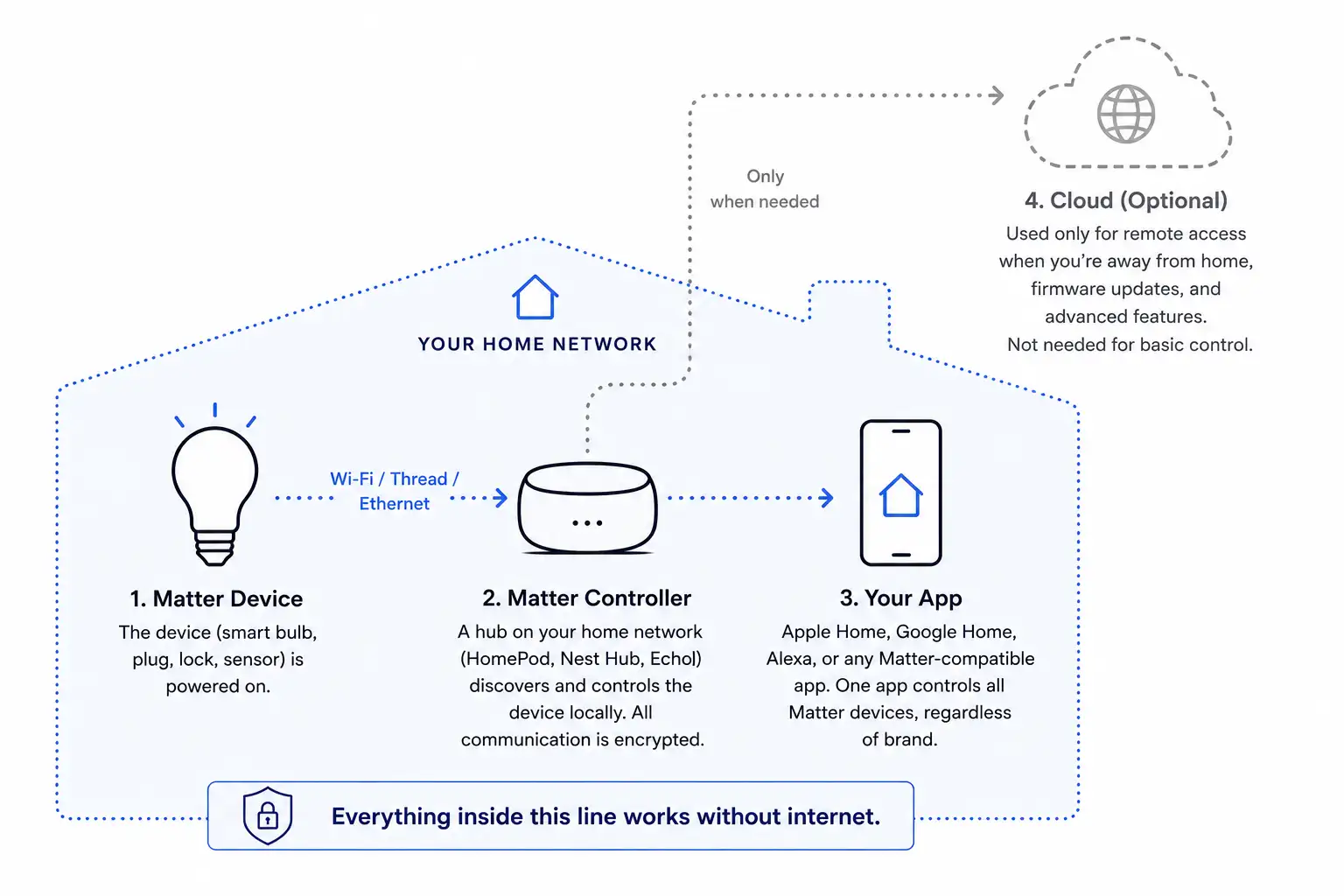
By mid-2026, well over 750 devices had earned Matter certification globally. In India, Matter-enabled plugs are positioned as premium devices at roughly ₹2,000 to ₹2,500, whereas generic Tuya plugs retail for under ₹1,000 (₹500 to ₹800).
That price gap is real. But the cheaper plug is hiding its costs in places you can't see on the box.
Price sensitivity in India is structural, not irrational. People will keep buying the cheapest option. That won't change overnight. But the direction is clear. Companies will face pressure to make devices Matter-compatible as Apple, Google, and Amazon start requiring it for their ecosystems. The question is how long that takes to reach the Indian market at price points that work here.
India's smart home market is growing fast. The devices are getting cheaper, the voice assistants are getting better, and the convenience is hard to argue with. But most of it runs on borrowed infrastructure, optimized for price over resilience or privacy. It’s built to be affordable first and smart second.
That doesn't mean you have to buy it that way. The next time you pick up a smart plug or call an integrator to wire up your home, you'll know the right questions to ask: does it work without internet, where does the data go, and whose server is your home answering to? Whether you ask them is up to you.
If this made you think about home automation and how it works, share it on WhatsApp or LinkedIn.
This story was created with inputs from Mr. Akshay Mishra (Founder & CTO, DSPworks.in) and Mr. Bhanu Sharma, whose experience with smart home systems in India shaped much of this story.