
 HD Cameras and Webcam
 Projectors and Speakers
 VOIP Phones and Gateway
 Access Control
 LTE and 5G Devices
 Smart Sensors And Automation
 Fiber and SFP Modules
 Firewall & Cloud Controllers
 Network Adapters and Accessories
 Network Switches
 PoE Switches
 Point To Point Wireless Radio
 Routers
 Wireless Access Points
 IP Cameras
 Memory Cards
 NVR
NVR Smart WiFi Cameras
 Storage Devices
 Desktop & Laptop RAMs
 Internal and External Hard Drives
 Storage Accessories and Enclosures
 SSD and NVMe Drives
 USB Flash Drives


PM-WANI: Six Years Later, Is India’s Public Wi-Fi Experiment Broken?

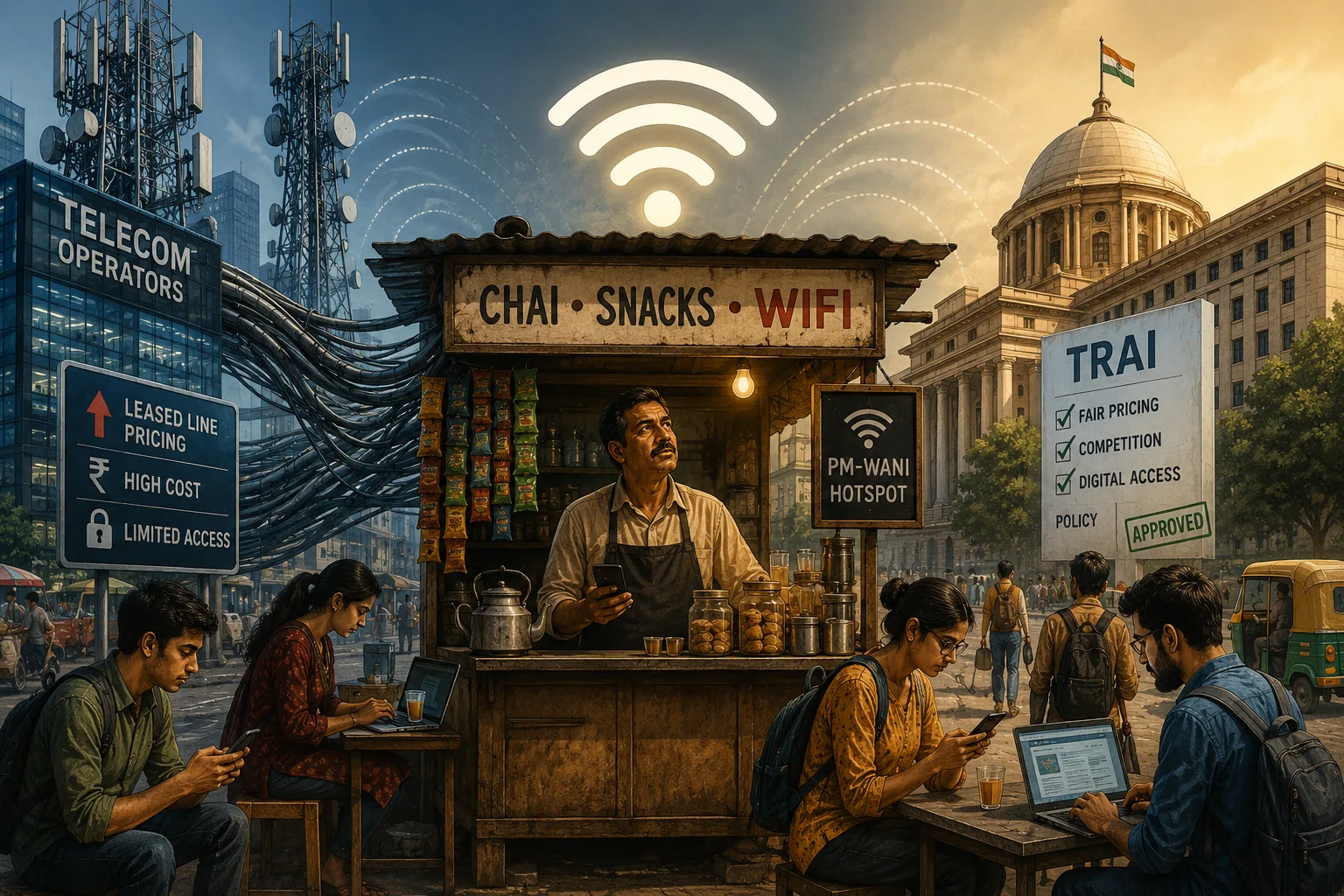
In this issue of Tech Tomorrow, we look at a government scheme PM-WANI, designed to turn every chai stall and kirana store into a public Wi-Fi hotspot, the telecom industry's efforts to undermine it, why TRAI is making another aggressive push to revive it in 2026 and what the ground level reality looks like.
Before we dive in, if you're someone who enjoys understanding how technology, business, policy, and infrastructure shape the products and services you use every day, join the community if you haven't already. We publish one in-depth edition every two weeks. And if you're already a subscriber, thank you. Consider forwarding this to someone who'd enjoy thoughtful deep dives into the forces powering the country around them.
Here's what we have for you in this edition.
You're standing in a mall basement trying to make a UPI payment and your phone has no signal. No cellular fallback, no Wi-Fi. You're at a tourist monument trying to book tickets online and the page won't load. You're at a bus stand trying to book a cab and nothing connects. These aren't rare situations. Anyone who has spent time in large malls, basement retail areas, railway stations, or tourist spots has hit these dead zones. India has had a government scheme since 2020 that was supposed to fix exactly this. It hasn't.
The scheme is called PM-WANI, and it was modelled on a simple precedent: the PCO.
In the 1990s, India turned neighbourhood shops into Public Call Offices and brought telephone access to millions who couldn't afford a landline. The logic was the same: use existing physical infrastructure, remove licensing barriers, let micro-entrepreneurs handle the last mile.
The original target was 10 million hotspots by 2022. There are currently around 410,000. Those hotspots have served over 58 petabytes of data, so the ones that exist get real use. But 410,000 against 10 million is a 96% shortfall, and the reasons are more tangled than they first appear.
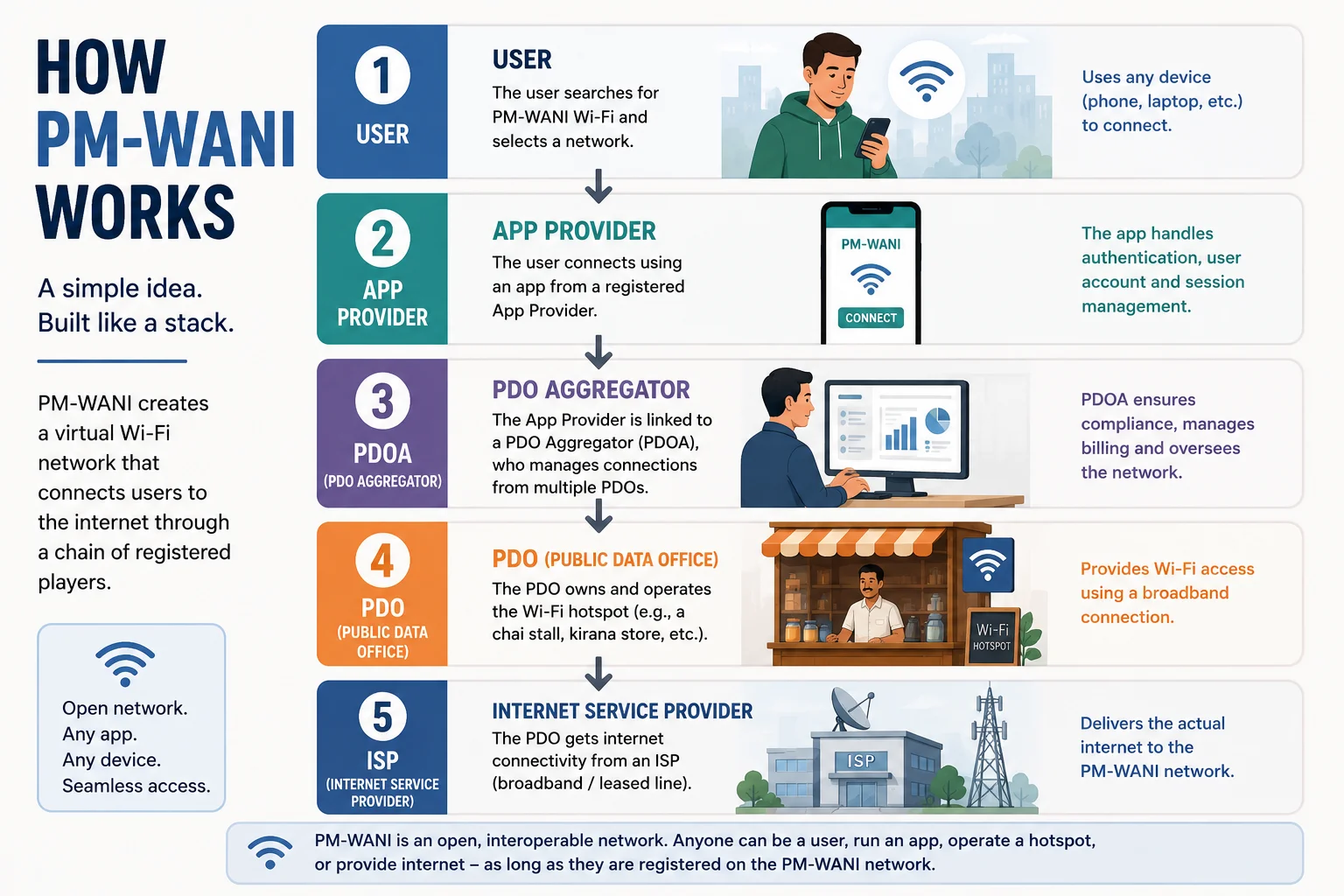
The scheme's architecture is straightforward. A local shop, called a PDO, buys a broadband connection, sets up a router, and sells data sachets to anyone nearby for as little as ₹5 or ₹10. A platform layer called the PDOA handles authentication, billing, and compliance. A phone app lets consumers find nearby hotspots and connect.
No government licence needed, no registration fees, no spectrum charges. Wi-Fi runs on unlicensed spectrum, so there are no spectrum charges either. On paper, an elegant low-cost last-mile solution.
One of PM-WANI's biggest hurdles was the high cost of backhaul, with many PDOs reportedly forced onto expensive leased lines instead of retail broadband. To fix this, TRAI capped FTTH pricing in June 2025, leading to unlimited 40 Mbps PDO plans at around ₹799/month. Yet the penetration hasn't increased noticeably.
Let's first analyze the real problem and what the possible solutions are.
Telecom companies Airtel, Jio have solved a significant part of connectivity issues with the world's most affordable 4G/5G data per dollar cost and have enabled India to become a Digital Nation especially with UPI success.
Public Wi-Fi connectivity needs to work in areas where 4G/5G fails miserably e.g. Airports, Railway Stations, Bus Stands, Basement Areas, Retail Malls, Shopping Centres, Hotels, Tourist Spots, where the need for connectivity is paramount to book online tickets, pay by UPI at shops, browse maps for locations, or book Ola/Uber.
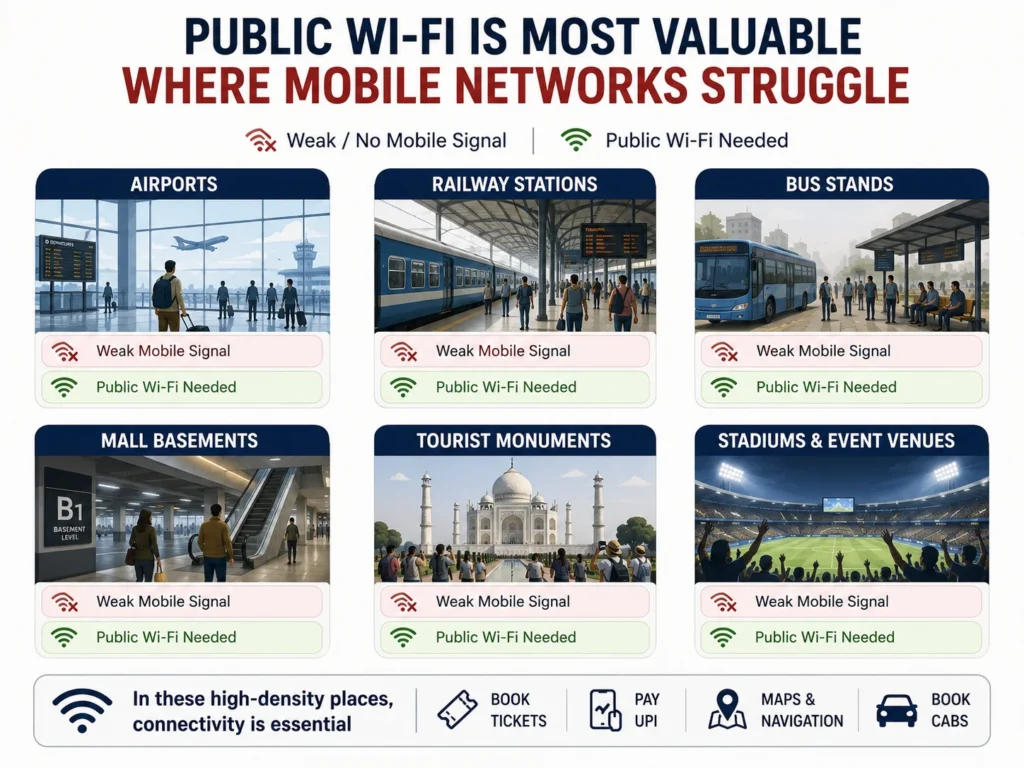
Also, for international travellers who visit India and expect accessible internet to be available starting with Airports to wherever they go (Free or paid).
For example, mobile networks inside the Taj Mahal are well-documented as congested and weak, the consequence of dense marble walls and thousands of people hitting the same towers. Around 6 million people visited in 2024, and ASI has moved ticket booking online. A visitor who can't load the ticketing page because there's no signal can't use the Wi-Fi to solve that problem, because getting on the Wi-Fi requires an OTP that the same congested network can't deliver. You need the network to get the Wi-Fi, and you need the Wi-Fi because you don't have the network.
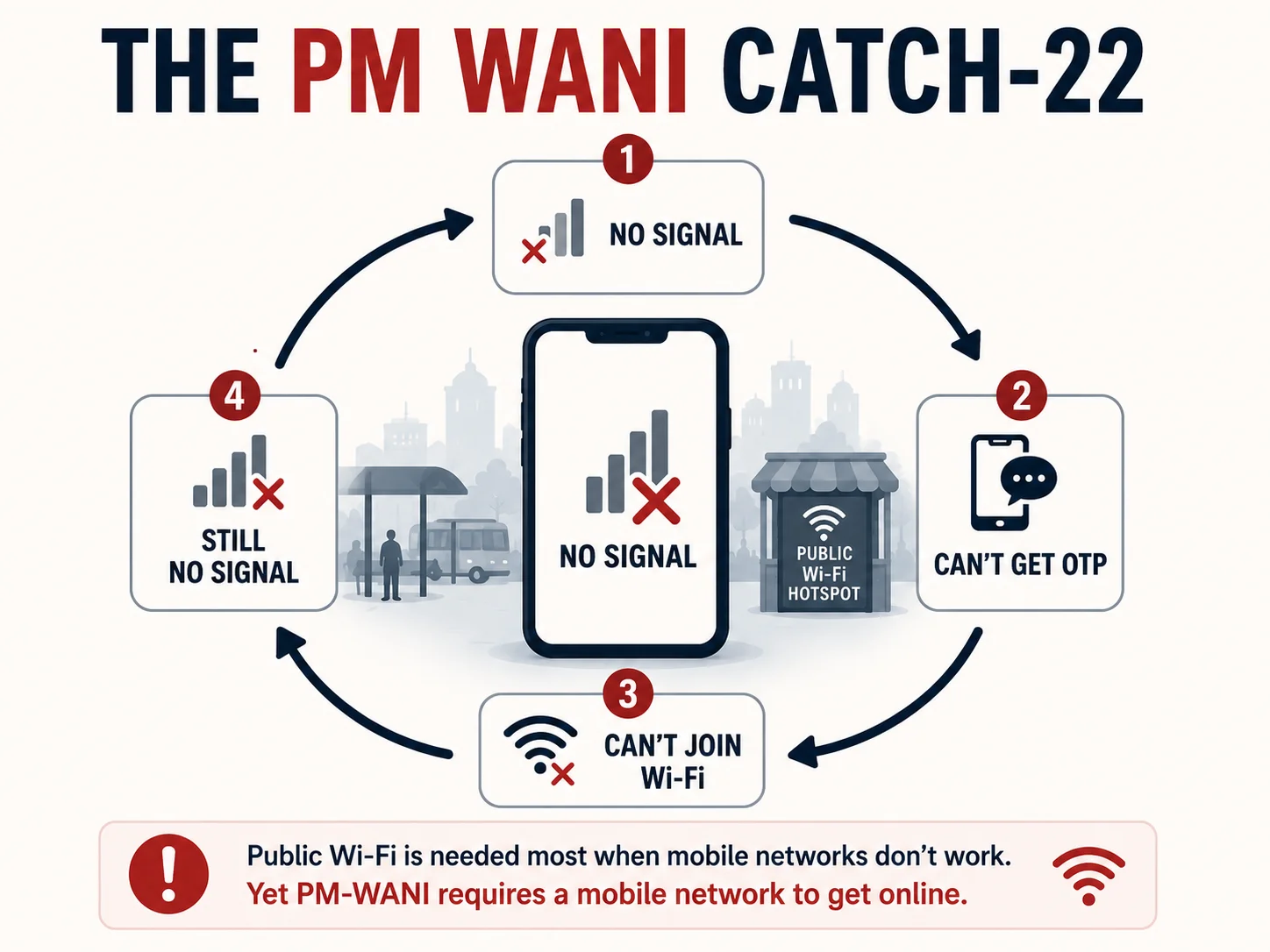
This loop plays out at any high-density public location: a railway station during a festival, a stadium during a match, a busy market on a weekend.
The core OTP-based authentication approach dates back to policy responses introduced after the 2008 terror investigations and has remained largely intact despite repeated changes elsewhere in the public Wi-Fi ecosystem.
The problem is that authentication doesn't prevent misuse. It just documents it. What OTP reliably does is add friction for every legitimate user (and yet dependent on existing 4G/5G active sim to receive OTP in the first place). And in the locations where public Wi-Fi matters more than 4G/5G, that friction becomes a wall.
If you travel abroad, you will find almost all cafes, hotels, or even retail shops providing free internet to their users so that they can connect, browse, pay online, or even if nothing, just connect, book your cab, and move to the next location.
Since the OTP mandate is still the law, Indian cafes/shops are hesitant to provide free internet because in return of helping their customers, there can be some legal scrutiny for not following the mandates.
So the true problem is that public wifi needs to work seamlessly in the right places and connect effortlessly, rather than going through multiple phases of OTP authentication, which itself requires a basic connection on your phones.
Recently, TRAI's April 2026 consultation paper finally puts authentication reform on the table. It proposes replacing OTP with Passpoint and OpenRoaming, standards that work like cellular roaming: you enroll once, and your device connects automatically to any participating hotspot after that, no login screen, no OTP.
But this is a consultation paper, not a policy change. TRAI is asking the industry whether this direction makes sense. The responses feed into recommendations, which then go to the DoT, which may or may not act on them.
Until then, the 2009 OTP mandate is still the law. And even if Passpoint is eventually adopted, every one of the 410,000 existing hotspots would need compatible hardware. Seventeen years after the OTP policy was set, the question of whether it still makes sense is at least being asked. But asking and fixing are very different timelines.
The PCO model worked in the 1990s because the need was obvious and the alternative was walking to the nearest telephone exchange.
PM-WANI's challenge is harder. It's trying to build a parallel distribution network for something most urban Indians feel they already have in their pocket.
The economy has improved. The regulations are moving. But a scheme that depends on millions of shopkeepers voluntarily becoming internet resellers only works if those shopkeepers believe the math adds up and the risk is worth it.
The difference is where the burden sits. In many successful public Wi-Fi programs, governments and institutions build the network first, and businesses participate around it. PM-WANI largely asks millions of shopkeepers to make the economics work themselves.
Petrol pumps in India are required under Marketing Discipline Guidelines issued by IOCL, HPCL, and BPCL to provide free toilets, drinking water, and air filling to any road user. Not to paying customers. To ANYONE.
The government decided these are public amenities and mandated them accordingly. Nobody asked oil companies to build a business model around free water or toilets.
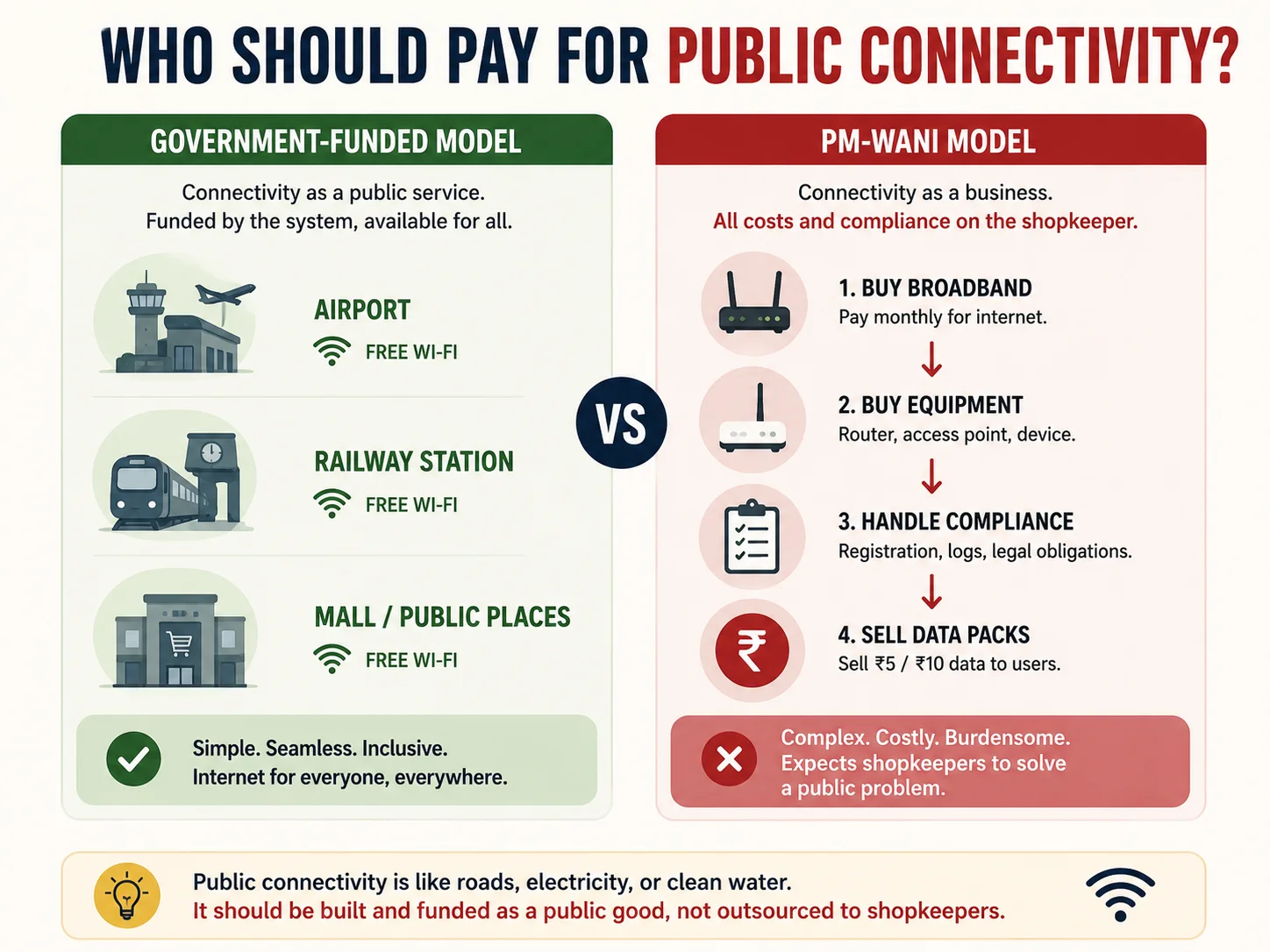
Instead of encouraging individuals to build businesses around selling small amounts of bandwidth, policymakers should mandate that key public and commercial establishments, including High Courts, airports, railway stations, bus terminals, municipal offices, retail malls, hotels, restaurants, cafés, and similar venues, provide free and fast internet access to anyone who needs it, not just their customers.
The economics can be made sustainable through multiple mechanisms: incorporating connectivity costs into parking fees at retail malls, platform tickets at railway and bus stations, government subsidies for public institutions, or discounted broadband tariffs for businesses that agree to share their internet infrastructure with the public.
The objective should be simple: make internet access ubiquitous, non-discriminatory, and readily available wherever people gather.
Our recommendation is not theoretical. It is based on more than a decade of experience building and operating public Wi-Fi infrastructure in India.
Through our venture, FreeG WiFi, we have been involved with public Wi-Fi deployments long before PM-WANI and were also part of the ecosystem during its early stages. Over the past decade, we have provided Wi-Fi authentication, user onboarding, analytics, and monetization solutions to more than 1,000 brands across retail, hospitality, healthcare, education, and public venues. We have helped organizations recover software and infrastructure costs through marketing campaigns, customer engagement programs, data insights, and loyalty incentives.
Based on this experience, we believe the government's focus should shift from attempting to create millions of micro-entrepreneurs selling Wi-Fi sachets to ensuring universal access to free, high-quality internet in public spaces.
Right now, the telecoms say the demand isn't there, the privacy advocates say the architecture is flawed, and TRAI is running its third public consultation in a decade trying to make a paid model work in a country where every comparable success story is built on a free one.
Six years of extensions, interventions, and missed targets haven't killed PM-WANI. But they haven't proved it works at scale either. And perhaps the most telling detail: TRAI's own consultation paper acknowledges that consumer awareness of PM-WANI remains critically low.
Most shopkeepers who could run a PDO and most consumers who could use one still don't know it's an option. Hard to win a race nobody knows they're running. TRAI's consultation closes this month. Whether what comes out of it changes is something only the next few quarters will answer.
We will see you in the next one
If this made you think about India's public Wi-Fi problem differently, share it on WhatsApp or LinkedIn.