
 HD Cameras and Webcam
 Projectors and Speakers
 VOIP Phones and Gateway
 Access Control
 LTE and 5G Devices
 Smart Sensors And Automation
 Fiber and SFP Modules
 Firewall & Cloud Controllers
 Network Adapters and Accessories
 Network Switches
 PoE Switches
 Point To Point Wireless Radio
 Routers
 Wireless Access Points
 IP Cameras
 Memory Cards
 NVR
NVR Smart WiFi Cameras
 Storage Devices
 Desktop & Laptop RAMs
 Internal and External Hard Drives
 Storage Accessories and Enclosures
 SSD and NVMe Drives
 USB Flash Drives


How India’s Telegram ban revealed how the internet really works?

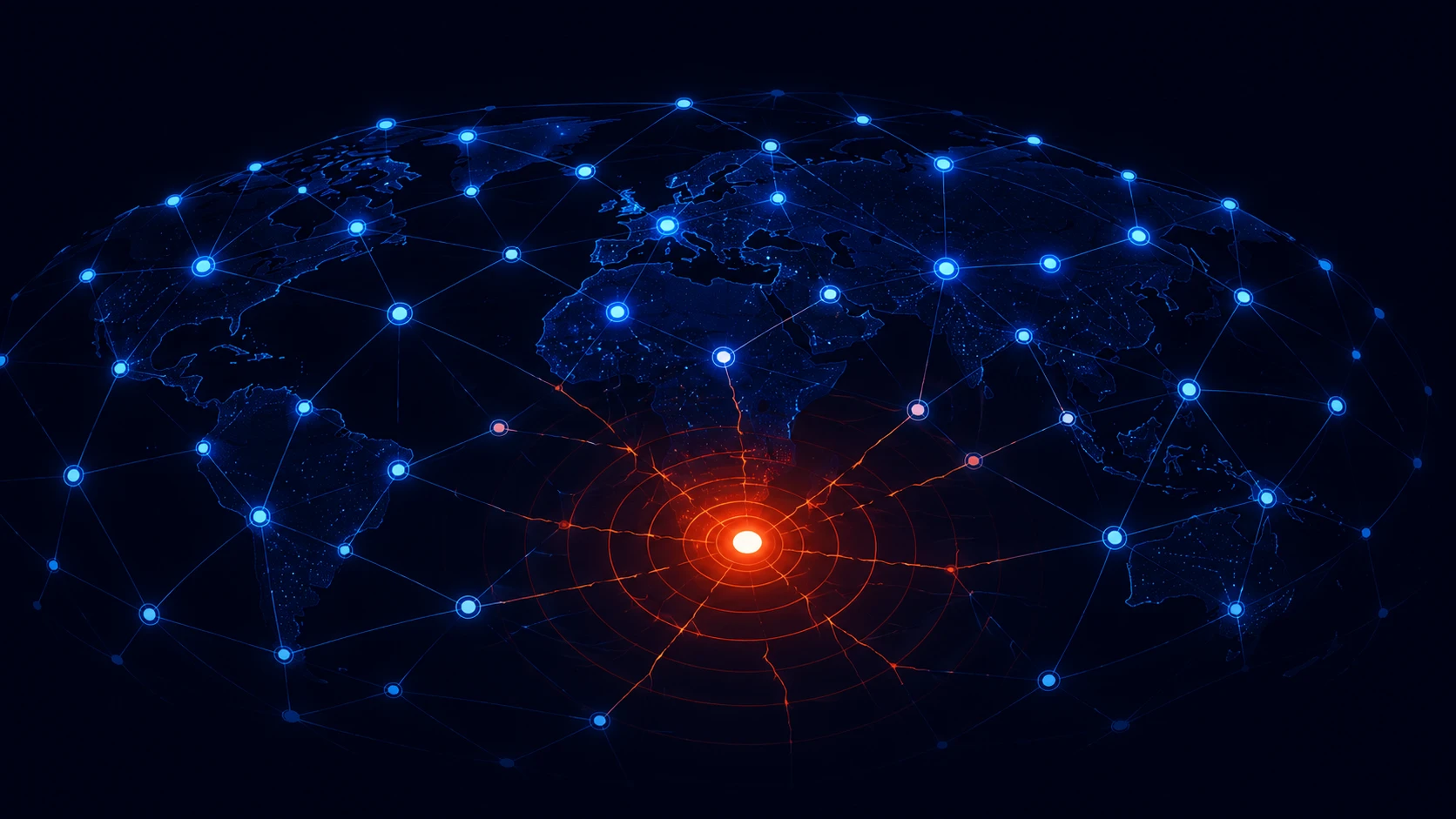

In this issue of Tech Tomorrow, we cover what happened when India blocked Telegram and accidentally broke it for users in other countries, how blocking actually works at the network level, and what this reveals about the trust system holding the entire Internet together.
Before we dive in, if you're someone who enjoys understanding how technology, business, policy, and infrastructure shape the products and services you use every day, join the community if you haven't already. We publish one in-depth edition every two weeks. And if you're already a subscriber, thank you. Consider forwarding this to someone who'd enjoy thoughtful deep dives into the forces powering the country around them.
Now, let's get to the story.
On June 16, 2026, the Indian government ordered a temporary ban on Telegram. Fraudulent channels were selling students access to what they claimed were leaked NEET-UG 2026 question papers. The ban was supposed to last until June 22, 2026
Within hours, Telegram started going down for users in the Middle East and parts of Asia. Countries that hadn't blocked anything.
Telegram's CEO Pavel Durov went on X and accused Reliance of deliberately disrupting the app globally. Jio denied involvement, stating it operates a separate network (AS55836) and had nothing to do with the incident.
The network where the hijack originated, AS18101, is registered to Reliance Communications, the old Anil Ambani telecom comapny that has been in insolvency since 2019.
But the line between these two entities isn't as clean as the denial suggests.
Jio acquired most of Rcom's spectrum, fiber, and towers between 2017 and 2018. Technology researcher Pranesh Prakash flagged this infrastructure overlap and noted the question of who actually operated the routers behind AS18101 needs further reporting.
The routing anomaly is documented. The identity of whoever triggered it is not.
But forget the blame game. There's a more interesting question underneath: how can one Indian telecom accidentally break a messaging app for someone sitting in Dubai?
The answer lives in a layer of infrastructure that runs the entire Internet.
Start with a fact that changes how you think about the Internet. It's not one network. It's roughly 80,000 independent networks, each run by a different organization.
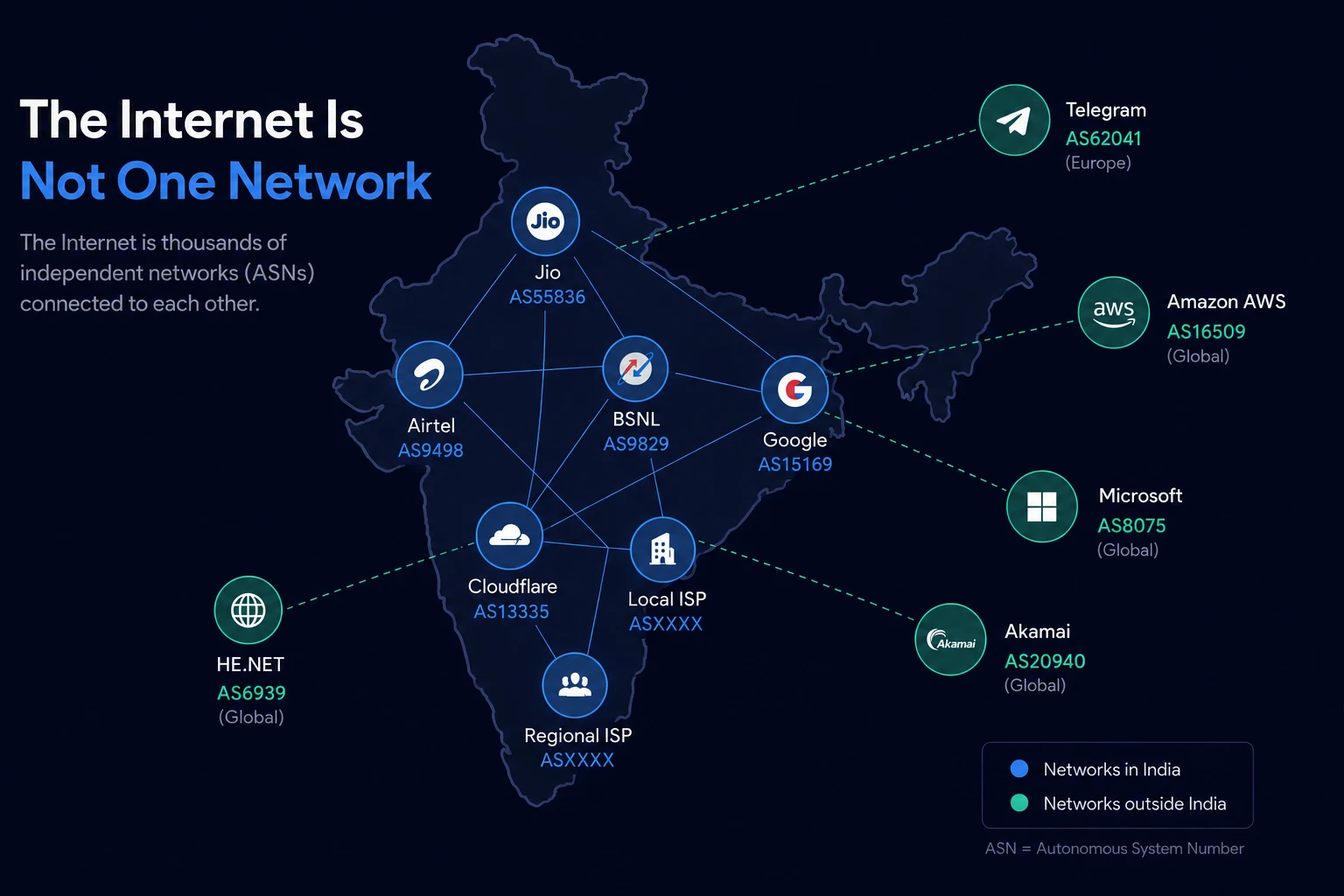
Jio runs one. Airtel runs another. Google, Amazon, Cloudflare, they each run their own. India alone has over 6,000.
Every one of these networks is called an Autonomous System and gets a unique ID number called an ASN, like a PAN card for a network. Jio's is 55836. Rcom's is 18101. Telegram's is 62041.
For the Internet to function, every major ISP must continuously maintain a 'BGP (Border Gateway Protocol) routing table', which is essentially a dynamic, master map of the entire world's connected networks. If an ISP fails to maintain an accurate table, or drops its connections, its users instantly lose the directions required to reach millions of websites.
Keeping these tables updated in real-time is the only way a network provider can guarantee that a data packet meant for Dubai or New York actually finds the fastest path across the globe, rather than hitting a dead end
Think of each Autonomous System as a city, and BGP as the global postal network linking them together.
So when you open Telegram on your phone in Mumbai, your request doesn't fly straight to Telegram's server in Europe. It can't. No single network connects to every other network on Earth directly. That would be like one airline trying to fly direct routes to every airport in the world.
Instead, networks make agreements with each other. Two networks in the same region might agree to exchange traffic directly; this is called peering.
A smaller network that needs to reach the rest of the world pays a larger one to carry its traffic; that's called transit.
These agreements form the chain your data travels through. Jio hands your request to a transit partner, who passes it to another network, who passes it further, until it reaches Telegram's network in Europe. Three, four, sometimes five handoffs before your message arrives.
Each network along this chain needs to know one thing: where do I send this next?
That's what BGP does. It is the Internet's navigation system.
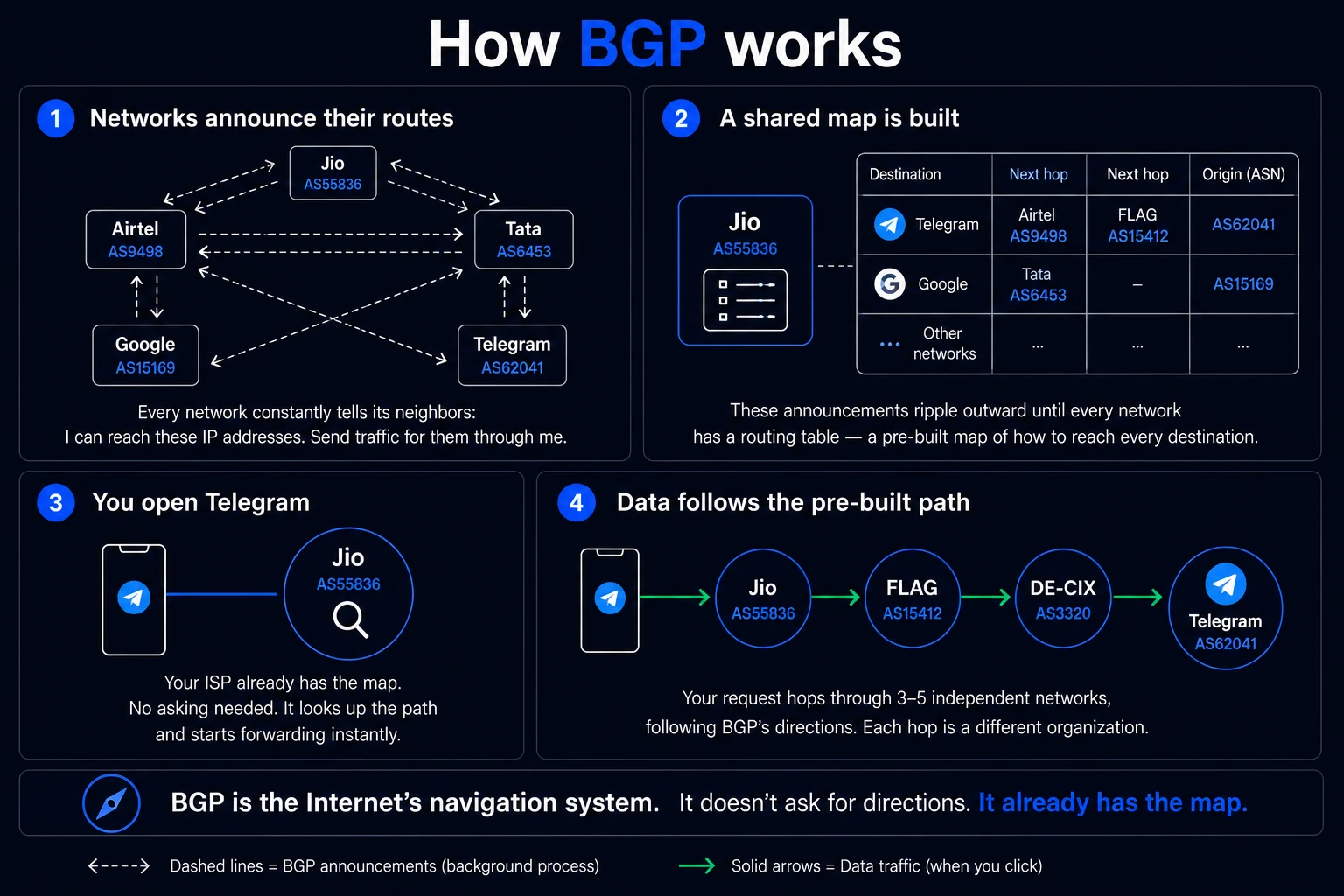
Every network constantly announces to its neighbours: "Here are the IP addresses I can reach. If you have traffic for any of them, send it through me." Those announcements ripple outward, from one network to the next, until every network on the Internet has a shared map of how to reach every destination. Your data follows that map.
If the Internet were a highway system, IP addresses are the destinations, routers are the intersections, and BGP is the navigation app deciding which road everyone takes.
Now here's what makes this system both beautiful and fragile.
BGP was built in the late 1980s, when the Internet was a small club of academic and military networks. Everyone knew everyone. So the protocol was designed on pure trust.
When a network says "I can reach these IP addresses," other networks just believe it. No verification. No central authority checking. No approval process.
That trust is what broke with Telegram.
When the government ordered the block, every telecom in India had to comply. Most implemented it the way blocks are normally done, by dropping Telegram traffic inside their own networks.
Some used DNS filtering, where your phone asks the ISP for Telegram's IP address and the ISP simply returns no answer.
Others went further and blackholed traffic at the router level, silently discarding any packets headed for Telegram's servers. Either way, the block stayed contained. It only affected users on that ISP's network. Nobody outside India noticed.
What happened on AS18101 was different.
That network ID is registered to Reliance Communications, a company in insolvency since 2019, with no consumer mobile business. But its network infrastructure - the ASN, the IP blocks, the routing equipment - still exists. And Jio has owned most of Rcom's physical telecom assets for years.
The technical consequence is clear regardless of who was behind it.
Think of it as a post office in Mumbai declaring to every other post office in the world: "Telegram's address? That's here. Send all the mail to us."
Any network that accepted this announcement would start sending Telegram-bound traffic to AS18101, where it got dropped into nothing. A technique called blackholing.
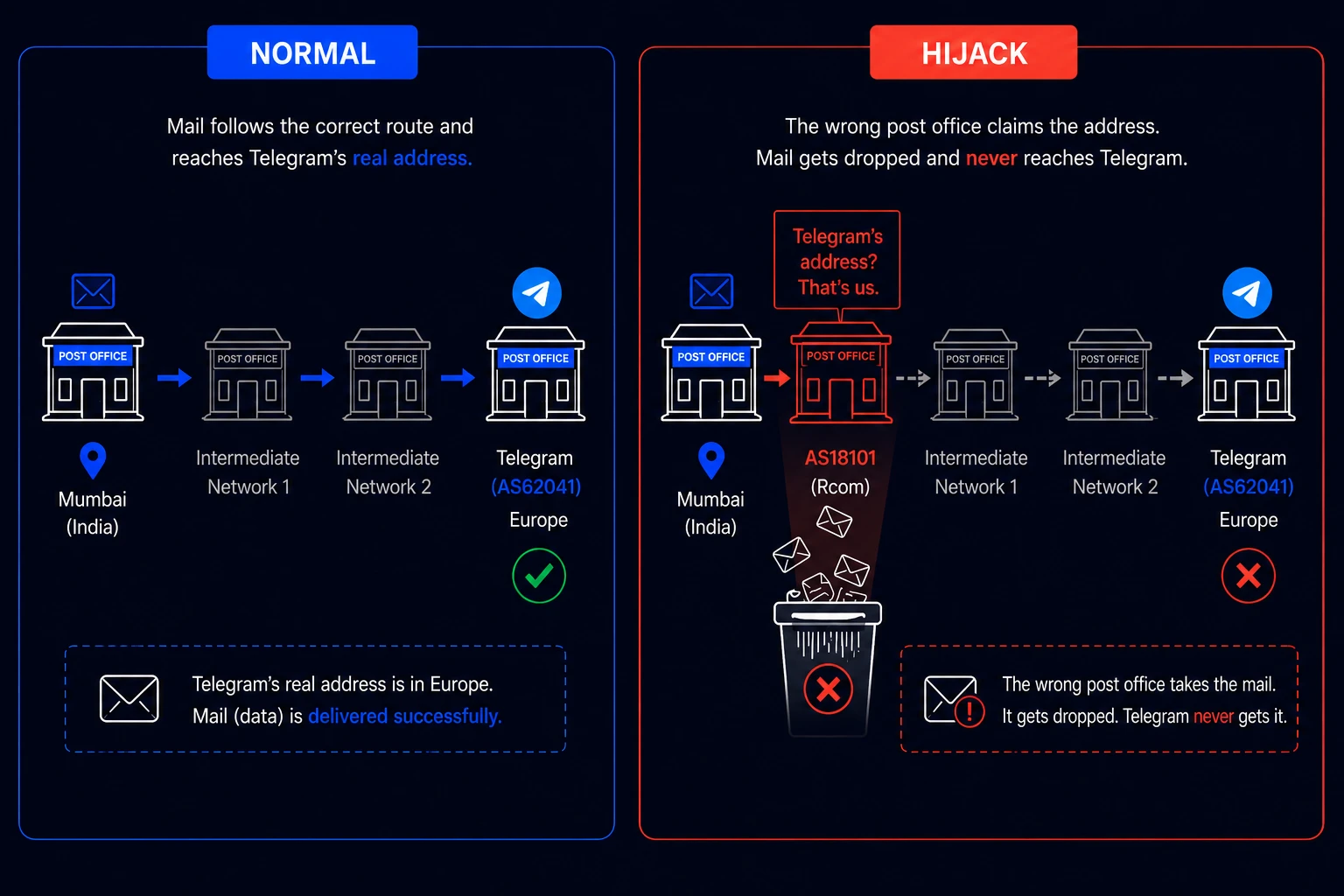
Indian networks that accepted the route lost access to Telegram. And if the announcement had stayed within India's borders, that would have been the end of the story.
But here's the problem with lying in a trust-based system.
The lie doesn't stay where you put it.
Rcom's network doesn't exist in isolation. It's connected to larger international networks called upstream providers, the backbone carriers that move traffic between countries.
Every day, Rcom shares its BGP announcements with these upstream providers as part of normal operations. And the false Telegram announcement went along with them.
The announcement was never supposed to leave Rcom's network, but it did.
FLAG Telecom (AS15412), the upstream transit provider connected to AS18101, received the announcement and treated it like any other routine update. "Rcom says it can reach Telegram's addresses? Fine. I'll add that to my map and pass it along." No questions asked. No verification. Just trust.
From there, the false announcement spread to networks in other countries. Routers in the Middle East, in parts of Asia, now had a bogus entry in their routing maps: to reach Telegram, send traffic to Rcom in India. So they did. And Rcom dropped everything into the same black hole.
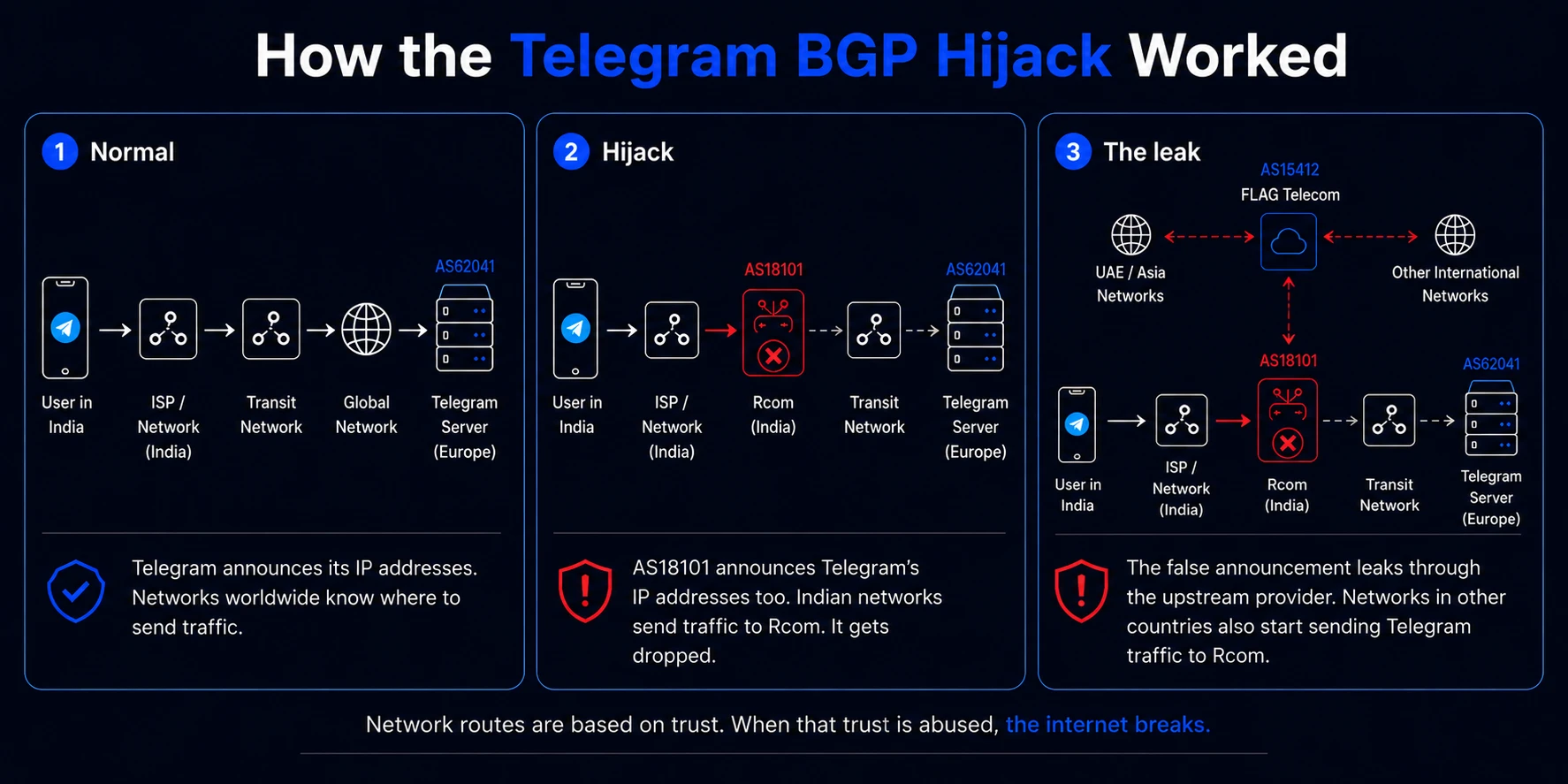
Telegram's engineers noticed. They fought back using a BGP rule: smaller, more specific route announcements always override broader ones. Telegram broke its IP address block into narrower pieces and re-announced them. Networks worldwide started preferring Telegram's real announcements over Rcom's fake ones.
Then Rcom hijacked those narrower blocks too.
That's the detail that tells you the original block was intentional. You don't accidentally counter the counter-move. But the global leak? That was the accident.
Kentik, a global Internet routing monitoring firm, calls this category of incidents "intentional, but also accidental."
And this isn't new.
In 2008, Pakistan ordered YouTube blocked. Pakistan Telecom used the same BGP approach. Their upstream provider in Hong Kong didn't filter the announcement. YouTube went dark globally for nearly two hours. That incident is still studied as one of the most dramatic routing failures in Internet history.
The same pattern repeated during Myanmar's military coup in 2021 with Twitter, during Russia's crackdown after the Ukraine invasion in 2022, and Iraq's Telegram block in 2023.
Every time, the same script: a domestic BGP block escapes through an upstream provider that didn't verify.
So why doesn't this happen more often since the ISPs send BGP announcements everyday?
The reason the Telegram disruption was limited, not catastrophic, is something called RPKI.
Think of it as a verified badge for route announcements. Telegram had pre-registered with Internet authorities confirming that only their network (AS62041) is authorized to announce their IP addresses.
When Rcom made its false announcement, any network running RPKI checks could see the mismatch instantly: "AS18101 (Rcom) is not authorized to announce these addresses. Reject."
Because most major international carriers now run RPKI checks, only about 1.6% of the BGP vantage points Kentik monitors worldwide saw the hijacked route. The rest threw them out automatically. Without RPKI, the outage would have been global.
And the broader reason?
Cooperation. 80,000 independent networks choose to trust each other every day, and the system is more valuable intact than broken. Cooperation. 80,000 independent networks choose to trust each other every day, and the system is more valuable intact than broken.
RPKI is adding a verification layer on top of that trust, but adoption is still uneven. As of early 2026, more than half of all routes in the global routing table are now covered, according to the NIST RPKI Monitor, which tracks adoption.
Had FLAG Telecom, along with Indian carriers like BSNL (AS9498) and Tata Communications (AS4755), filtered RPKI-invalid routes, this entire incident would have stayed inside India, and nobody outside would have noticed.
The Internet has no CEO. No single company. No government controls it. It works because thousands of networks agreed on a common routing protocol decades ago, and for the most part, follow it honestly.
That's the hidden engineering behind every page you load, every message you send, every video you stream. And it's the same engineering that, two weeks ago, let one telecom in India accidentally break a messaging app in other parts of the world
If this made you think about the internet and how it works, share it on WhatsApp or LinkedIn.