
 HD Cameras and Webcam
 Projectors and Speakers
 VOIP Phones and Gateway
 Access Control
 LTE and 5G Devices
 Smart Sensors And Automation
 Fiber and SFP Modules
 Firewall & Cloud Controllers
 Network Adapters and Accessories
 Network Switches
 PoE Switches
 Point To Point Wireless Radio
 Routers
 Wireless Access Points
 IP Cameras
 Memory Cards
 NVR
NVR Smart WiFi Cameras
 Storage Devices
 Desktop & Laptop RAMs
 Internal and External Hard Drives
 Storage Accessories and Enclosures
 SSD and NVMe Drives
 USB Flash Drives


How AI Voice-Cloning Scams Turn a Familiar Voice Into a Financial Trap


In this issue of Tech Tomorrow, we look at how AI voice cloning is being used to scam people across India, why almost nothing exists yet to catch it, and what little actually works right now.
Before we dive in, if you're someone who enjoys understanding how technology, business, policy, and infrastructure shape the products and services you use every day, join the community if you haven't already. We publish one in-depth edition every two weeks. And if you're already a subscriber, thank you. Consider forwarding this to someone who'd enjoy thoughtful deep dives into the forces powering the country around them.
In February 2026, a 65-year-old woman in Delhi received a phone call from her daughter. The voice was crying, panicked, saying she'd been in an accident and needed money immediately. The mother transferred Rs 2 lakh within minutes.
Her daughter was sitting safely at home this entire time.
The voice on the call was an AI-generated clone, built from a few seconds of audio scraped off social media. The scammers didn't need to hack anything. They didn't need to steal a password. They just needed her daughter's voice, which was already public.
This isn't a one-off case. We traced 12 separately reported cases of suspected AI voice-cloning fraud in India between July 2023 and June 2026, ranging from Rs 40,000 to over Rs 14 crore.
The true number is almost certainly higher, as India doesn't track voice-cloning fraud as a separate category, and most cases are filed under general cybercrime.
A gang cloned the voice of a Mumbai company's Managing Director, called the Deputy General Manager, and got over ₹10 crores transferred across 63 separate bank accounts.
That case was significant enough for SEBI, India's securities market regulator, to issue a formal "Boss Scam" advisory to every listed company in India in July 2026.
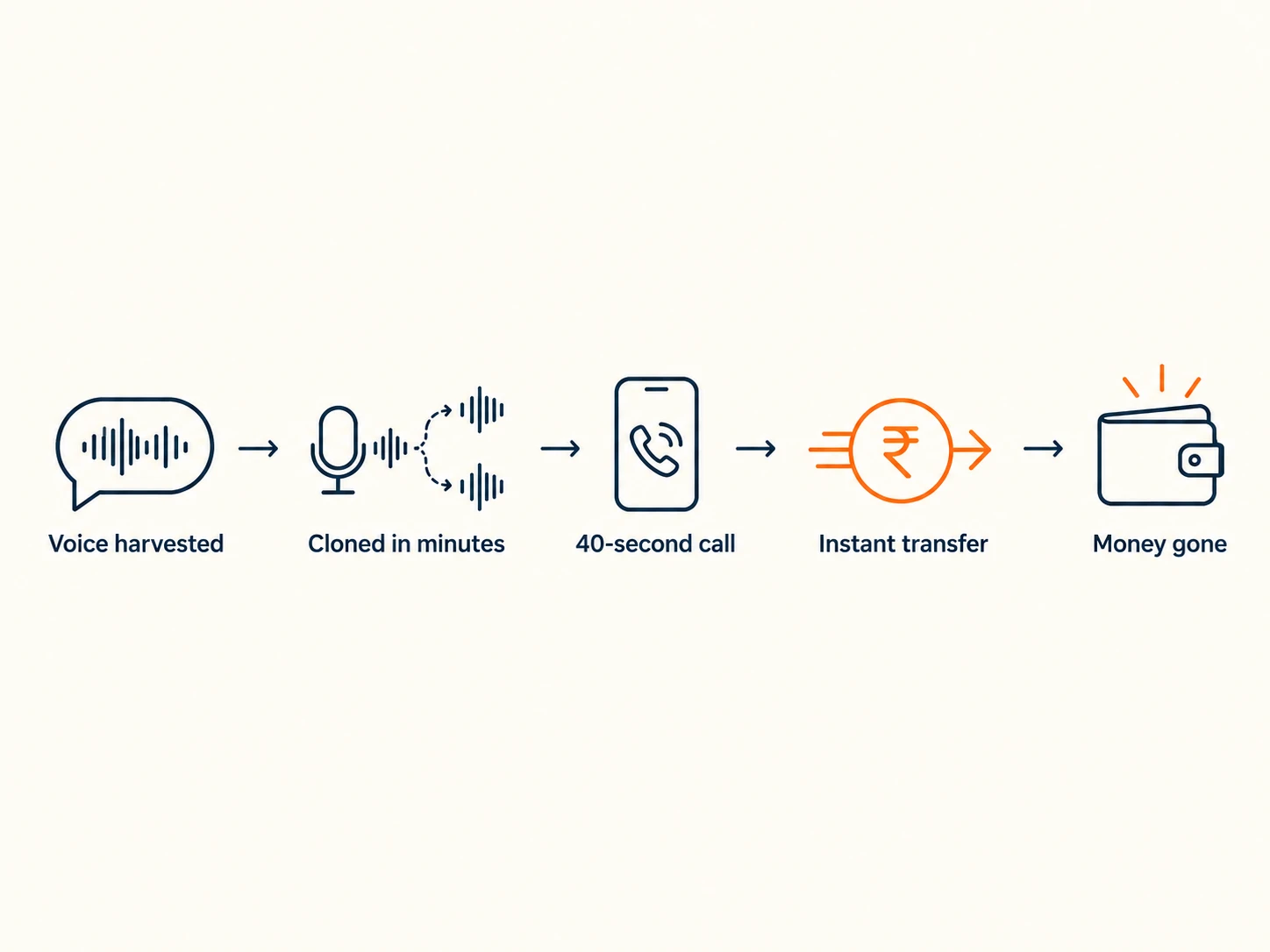
The pattern across all 12 cases is almost identical.
The scammer grabs a voice sample. A WhatsApp voice note, an Instagram reel, a LinkedIn video introduction. Tools like ElevenLabs (a commercial voice-cloning platform used by podcasters and dubbing studios) or RVC (a free, open-source voice converter that runs on any decent laptop) can build a convincing clone from as little as 3 seconds of audio.
Then the call. Almost always from an unknown number, explained away as "my phone broke." The cloned voice delivers about 40 seconds of emotional distress. A daughter crying. A son saying he's been in an accident. A nephew claiming he's been arrested abroad. Then a second person takes over, posing as a doctor, a police officer, or an embassy official, and directs the money.
The victim transfers via UPI. And that's where the structural problem begins.
UPI settles transactions instantly. There's no recall window, no cooling-off period.
Countries like the UK, Singapore, and Sweden build mandatory delays into large or first-time transfers specifically to catch fraud before it clears.
The RBI floated the idea in a discussion paper earlier this year: a one-hour delay on UPI transfers above Rs 10,000 to first-time recipients, a kill switch allowing banks to freeze suspicious accounts, and extra authentication for vulnerable users. None of it has been implemented yet.
The recovery rate on UPI fraud sits at roughly 6%. Once the money moves, it's gone.
And India doesn't just have a payments problem. It also has a voice problem.
Indians share voice data online at the highest rate of any country surveyed. A McAfee study found that 86% of Indians share their voice online at least once a week, compared to 52% in the US and 56% in the UK. WhatsApp alone has 535 million monthly active users in India. Every voice note in a family group chat is a potential sample.
India also records the world's highest voice-call usage: 963 minutes per subscriber per month according to TRAI data from March 2024, driven by Jio making voice calls essentially free.
A phone call is perfectly normal here. Targeting voice calls is not suspicious. It blends in.
And the people most likely to pick up, most likely to panic, and least likely to verify are the ones being targeted.
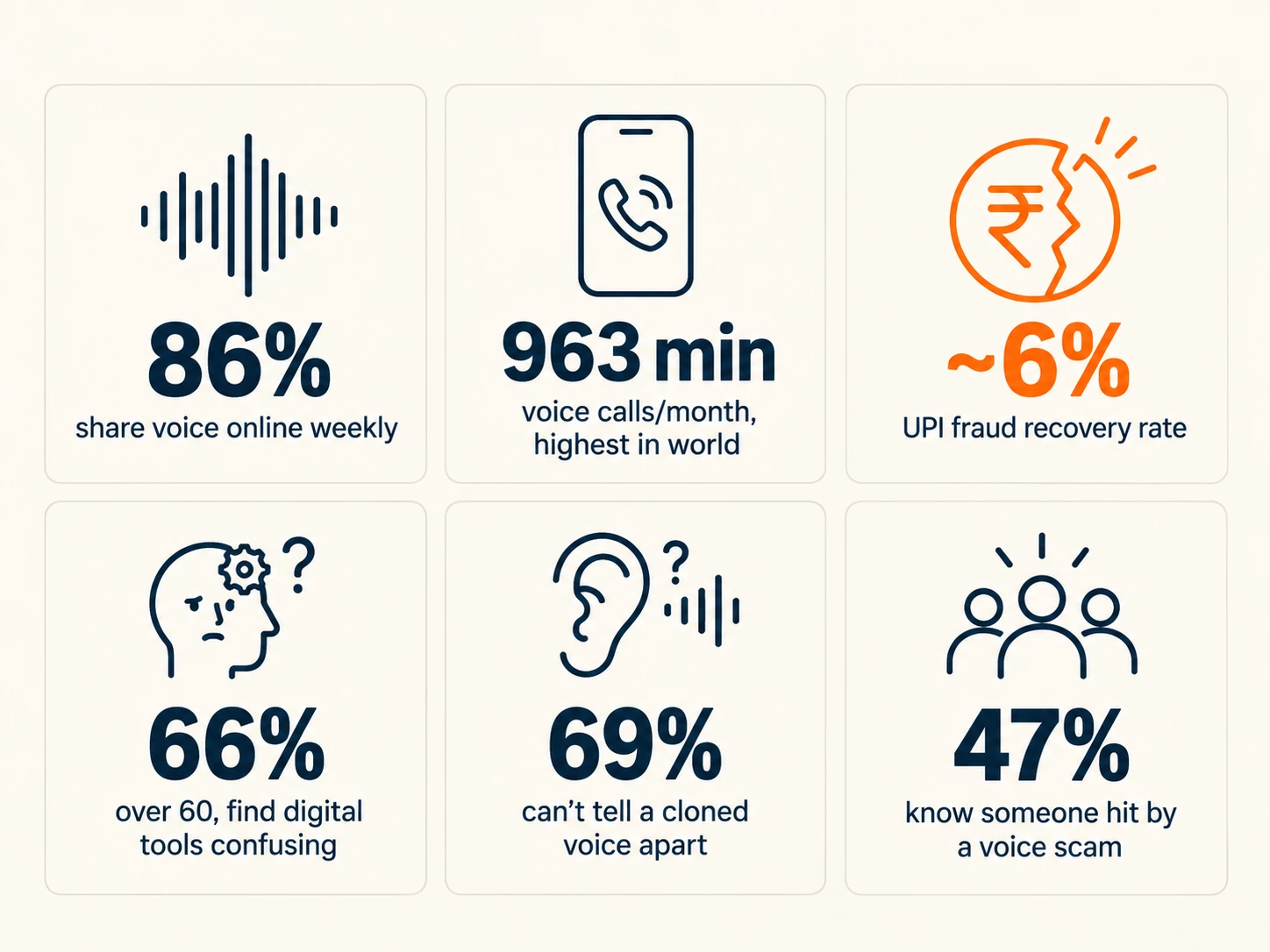
A HelpAge India survey of nearly 6,000 elderly Indians found that 66% of those over 60 find digital tools "too confusing." These are people who can use UPI to send money because a family member set it up for them, but who wouldn't know how to check a transaction or reverse it. In the McAfee study, 69% of Indians said they weren't confident they could tell a cloned voice from a real one.
Scammers have figured out the NRI angle too. Children abroad, parents in India, a time-zone gap that makes it impossible to physically check. One elderly Delhi couple, both retired doctors, lost Rs 14.85 crore in a digital arrest scam, where fraudsters posing as police or CBI officers told them they were under investigation and kept them on a continuous video call for days, isolating them from anyone who could snap them out of it.
So what's the defence, you ask?
Currently, it barely exists.
Pindrop, a US-based company that analyses call-centre audio for banks, claims 99% deepfake detection accuracy on its benchmark. But that benchmark tests 32 known voice-synthesis engines. Real-world accuracy against newer models, over compressed phone audio, is substantially lower. No independent real-world benchmark exists.
India has its own detection efforts. The IndiaAI Mission funded projects at IIT Kharagpur (real-time voice deepfake detection), IIT Jodhpur and IIT Madras (a multi-agent detection framework called Saakshya), and IIT Mandi (audio-visual forensics). All are in the research stage without a deployment timeline.
Cloning a voice costs under Rs 2,000 and takes minutes. Detecting one requires enterprise-grade audio analysis, the kind companies like Pindrop build for banks and call centres, that costs real money and real integration work to deploy.
That's the asymmetry at the centre of this problem. The tools to attack are easy to use and cost almost nothing, while the tools to defend are expensive, experimental, and available to almost nobody who actually picks up the phone.
Telecom hasn't plugged the gap either. TRAI's CNAP (Calling Name Presentation), which rolled out starting March 2026, shows the KYC-verified name of the person calling. It solves caller ID spoofing, where a scammer makes their number look like someone else's. It does not solve voice cloning.
The legal picture is no better. The MeitY IT Amendment Rules, notified in February 2026, cover AI-generated audio, require labelling of synthetic content, and bar platforms from enabling voice impersonation. But they regulate platforms and content, not phone calls. When someone is scammed, prosecutors still fall back on Section 66C of the IT Act (identity theft, up to 3 years) and Section 319 of the BNS (cheating by personation, up to 5 years).
The result: zero convictions for AI voice-cloning fraud in India. A cybercrime conviction rate below 18%.
The Supreme Court stepped in. In a suo motu hearing in July 2026, the bench called on Parliament to pass dedicated legislation covering both deepfake fraud and digital arrests. Justice Joymalya Bagchi said plainly: "We have deepfakes now. It can be used for cheating and impersonation." Solicitor General Tushar Mehta confirmed a draft bill is being prepared. No text, no timeline, no provisions have been published.
For context, China enacted dedicated deep-synthesis regulations back in January 2023: consent before cloning anyone's voice, mandatory labelling of all synthetic content, real-name registration of users. The EU's AI Act (August 2024) requires anyone deploying AI to generate audio deepfakes to disclose it. India has neither.
Sunil Bharti Mittal, Airtel's chairman, had his own voice cloned and used to call an executive requesting a fund transfer. The executive caught it only because the request didn't fit Mittal's usual behaviour, not because the voice sounded wrong.
Mittal later said publicly: "We'll have to protect our societies from the evils of AI, and yet we have to use the goodness of AI.".
That executive got lucky, which will not be the case for most of us.
It's also worth separating the scam from the science here, as the voice cloning itself isn't the villain.
ElevenLabs, the same company whose technology can clone a stranger's voice in seconds, signed an MoU with the Karnataka Government in October 2026 to help citizens who've lost the ability to speak get their voice back.
It's the same category of tool that dubs YouTube videos into Hindi, Tamil, or Telugu for creators who can't afford a studio, narrates audiobooks and video-game dialogue without re-recording actors, and runs call-centre and customer-support lines in voices that sound less robotic.
The technology exists because it solves real problems. The fraud is what happens when the same tool ends up in the wrong hands.
The defences against these frauds that exist today are all low-tech, which tells you something about how far the technology has outrun the response.
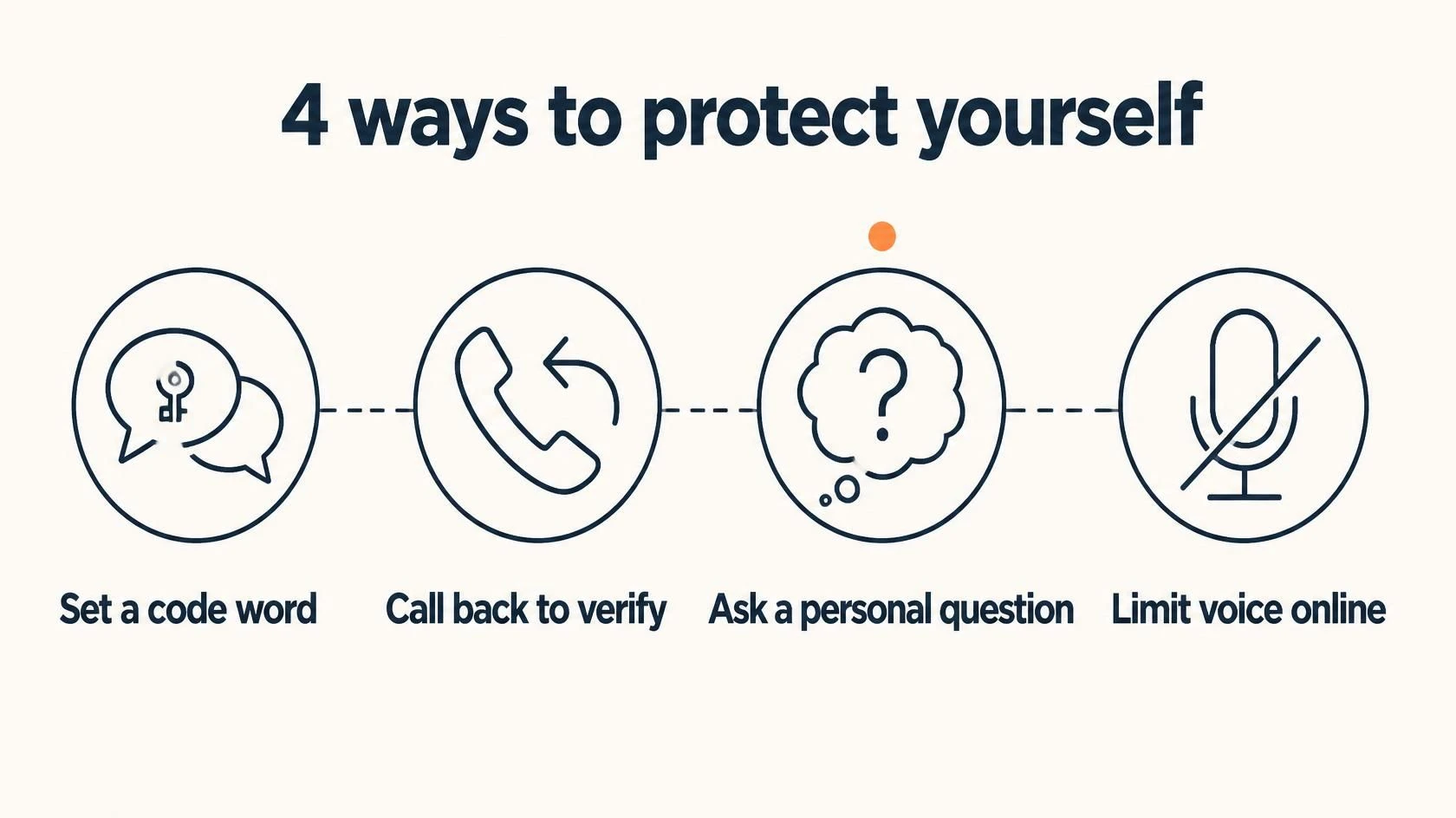
Cybersecurity experts and police officials across the country are recommending the same handful of things: a family code word agreed on in advance, calling the person back on their saved number instead of trusting the incoming call, asking a personal question only the real person would know, and limiting how much voice you put online because every public voice note is raw material. The FBI, the FTC, McAfee's CTO, and Tamil Nadu's ADGP for Cyber Crime Sanjay Kumar are all saying the same things.
UPI doesn't leave much room to undo a transfer. But the money doesn't disappear the instant it lands either. It usually sits in a receiving account before getting split further or withdrawn, and that's the only window anyone has.
If you or someone you know realises something's wrong, the first hour is the most crucial. File a complaint at cybercrime.gov.in, call 1930, and ask your bank to flag the receiving account before the funds move again. Lock your Aadhaar at uidai.gov.in if you shared it anywhere.
The woman in Delhi did none of this, because she had no reason to. She was just saving her daughter, who sat safely at home the entire time, while her mother's Rs 2 lakh was already on its way out.
It took three seconds of her daughter's voice to make that call convincing, and under forty seconds for her to decide.
The tools behind it cost less than a dinner out. Whatever replaces them next will likely cost less still, need less of her daughter's voice to work, and take even less time to convince her.
Whether the defence catches up to that is still an open question to be answered.
If this changed how you think about AI voice fraud, share it on WhatsApp or LinkedIn.
Give us your honest feedback
|
😍 Loved it, more like this!
|
🙂 Good, could be better
|
😕 Not relevant to me
|