
 HD Cameras and Webcam
 Projectors and Speakers
 VOIP Phones and Gateway
 Access Control
 LTE and 5G Devices
 Smart Sensors And Automation
 Fiber and SFP Modules
 Firewall & Cloud Controllers
 Network Adapters and Accessories
 Network Switches
 PoE Switches
 Point To Point Wireless Radio
 Routers
 Wireless Access Points
 IP Cameras
 Memory Cards
 NVR
NVR Smart WiFi Cameras
 Storage Devices
 Desktop & Laptop RAMs
 Internal and External Hard Drives
 Storage Accessories and Enclosures
 SSD and NVMe Drives
 USB Flash Drives


What Changed at M Chinnaswamy Stadium After the 2025 Stampede, and How AI CCTV Systems Now Monitor Crowd Movement

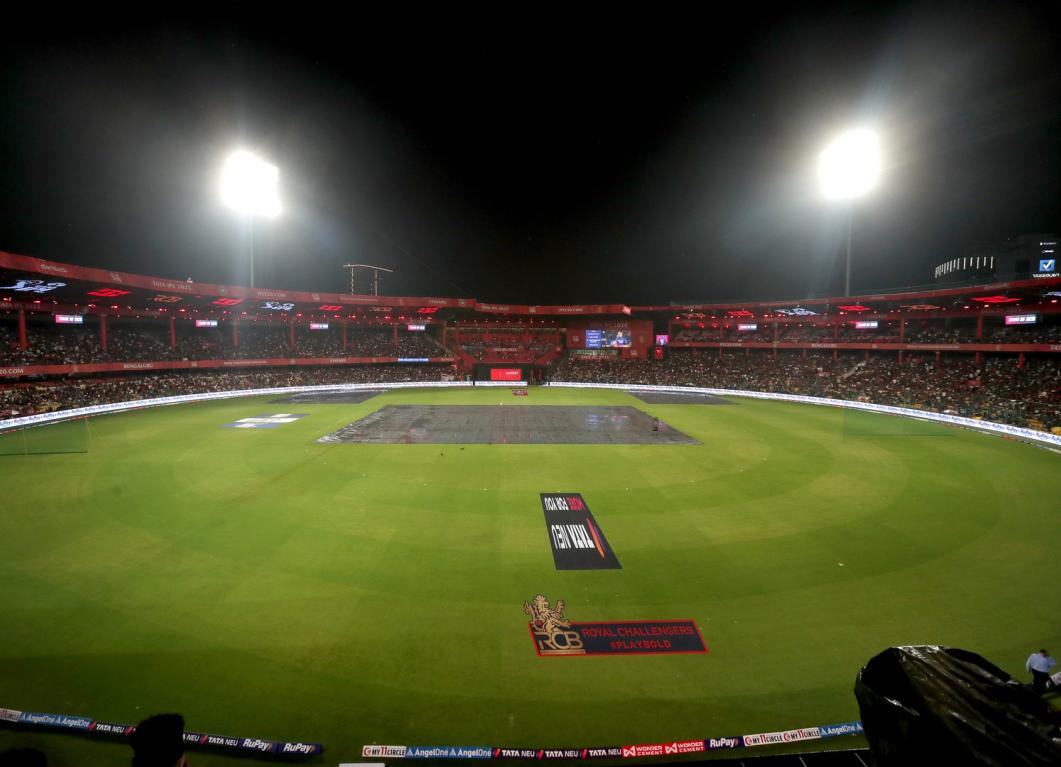
On March 28, 2026, the M. Chinnaswamy Stadium in Bengaluru hosted its first cricket match in ten months. IPL 2026’s opening game. RCB vs Sunrisers Hyderabad. 31,000 fans packed every stand, draped in RCB jerseys, louder than ever.
But in one section, eleven seats stayed empty. No signs. Just eleven seats that nobody sat in, for the entire match, and every match after.
Players from both teams wore black armbands. During warmups, the entire RCB squad wore jerseys with the number 11. Before the first ball, the stadium fell silent for a full minute.
Those eleven seats are for the eleven fans who died here last June.

Source: Screengrab from RCB video on X
In this issue, we tell the story of how a stampede, a government ultimatum, and a ₹7 crore AI CCTV surveillance system changed match day at the M Chinnaswamy Stadium.
The story
On June 4, 2025, a day after RCB lifted their first-ever IPL trophy, the franchise held a victory event at Chinnaswamy. No open-bus parade. Just a felicitation. But Bengaluru showed up anyway. An estimated 1.5 lakh fans converged on the streets around the stadium. The entry gates couldn’t handle it. The crowd outside turned into a crush. Eleven fans died. Over thirty were injured.
Karnataka’s Deputy CM publicly called the crowd “uncontrollable” and apologised. A government-appointed commission investigated and held RCB responsible for encouraging a mass gathering without adequate clearances. Cricket at the Chinnaswamy Stadium was suspended immediately. The venue lost hosting rights for the Women’s ODI World Cup and the Men’s T20I World Cup matches that followed. For months, nobody knew if IPL 2026 would be played there at all.
By January 2026, Karnataka’s state government gave conditional approval for cricket to return. The word "conditional" is the key word here. A government-appointed Expert Committee was set up to inspect every gate, ramp, and corridor. They ran a full-scale mock match day on March 13. Tested crowd flow, evacuation readiness, and gate management. If the stadium didn’t pass, RCB’s home games would shift to Raipur or Pune.
The message from the government was blunt: prove this venue is safe, or you don’t play here.
This is where this stops being a cricket story and becomes an infrastructure one.
RCB’s response wasn’t a press conference or a promise. It was an infrastructure overhaul worth roughly ₹7 crore. The franchise partnered with Staqu Technologies, an Indian AI company whose video analytics platform “JARVIS” already runs surveillance for multiple state police forces, and was deployed at the G20 Summit and the Ram Mandir inauguration.
The result: over 500 AI-enabled CCTV cameras now cover every entry gate, exit ramp, seating stand, concourse corridor, and food court inside the stadium, plus the surrounding roads. Three dedicated video walls feed a command centre where operators can switch between any camera instantly. The live feed also goes directly to the Bengaluru Police Commissioner’s office.
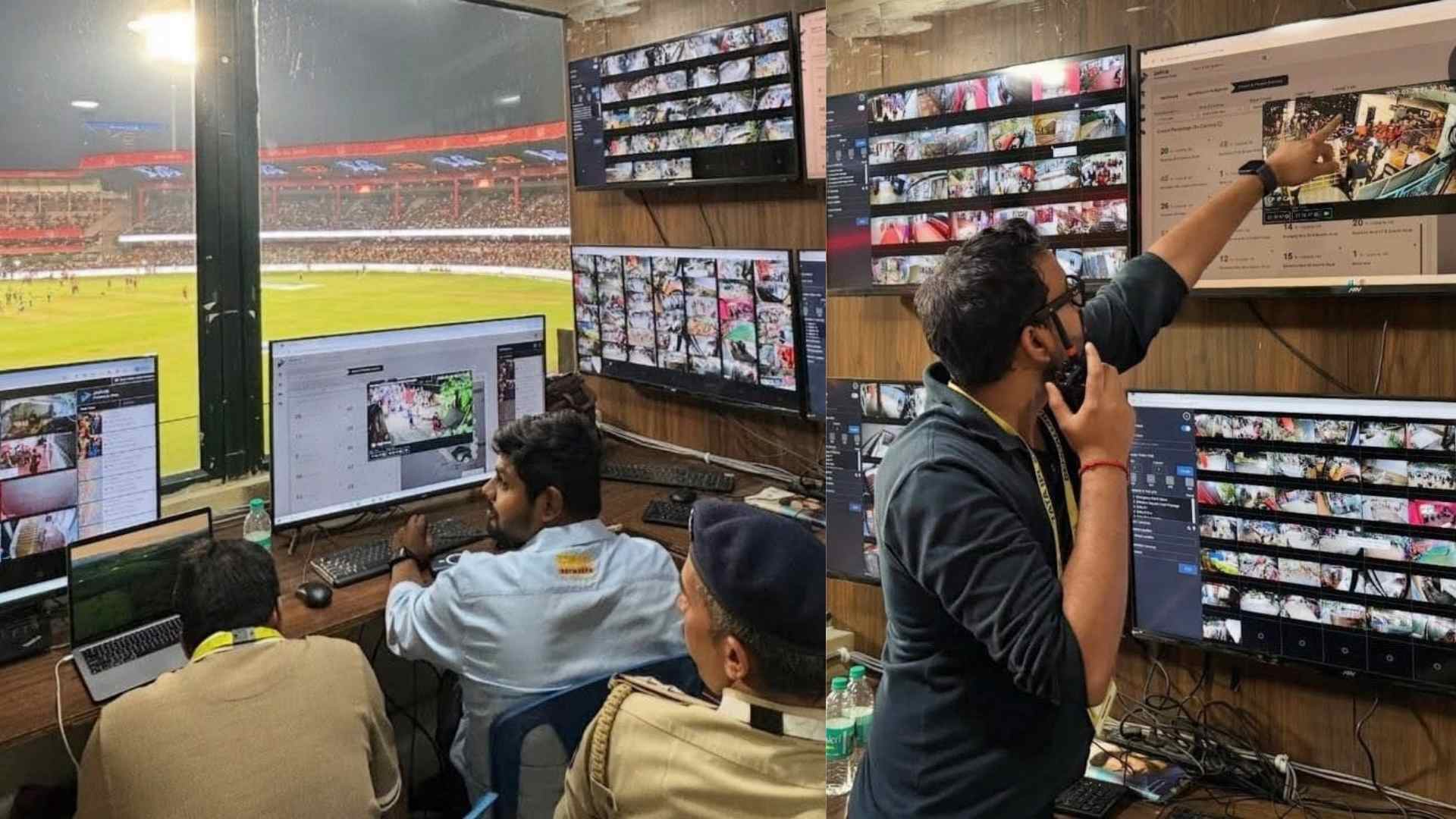
Source: Jarvis by Staqu Instagram account
But cameras were just one layer. The entire match-day operating system was rewritten. Capacity was capped at approx 35,000 (down from 40,000). Tickets went fully digital with QR codes. Gates were colour-coded to match seat assignments, so fans couldn’t cluster at a single entrance. KSCA built six new gates and widened existing ones. Holding areas outside the stadium absorbed pressure before it reached the turnstiles. Bengaluru Metro extended services till 1 AM on match nights, with higher frequency and free rides for ticket holders.
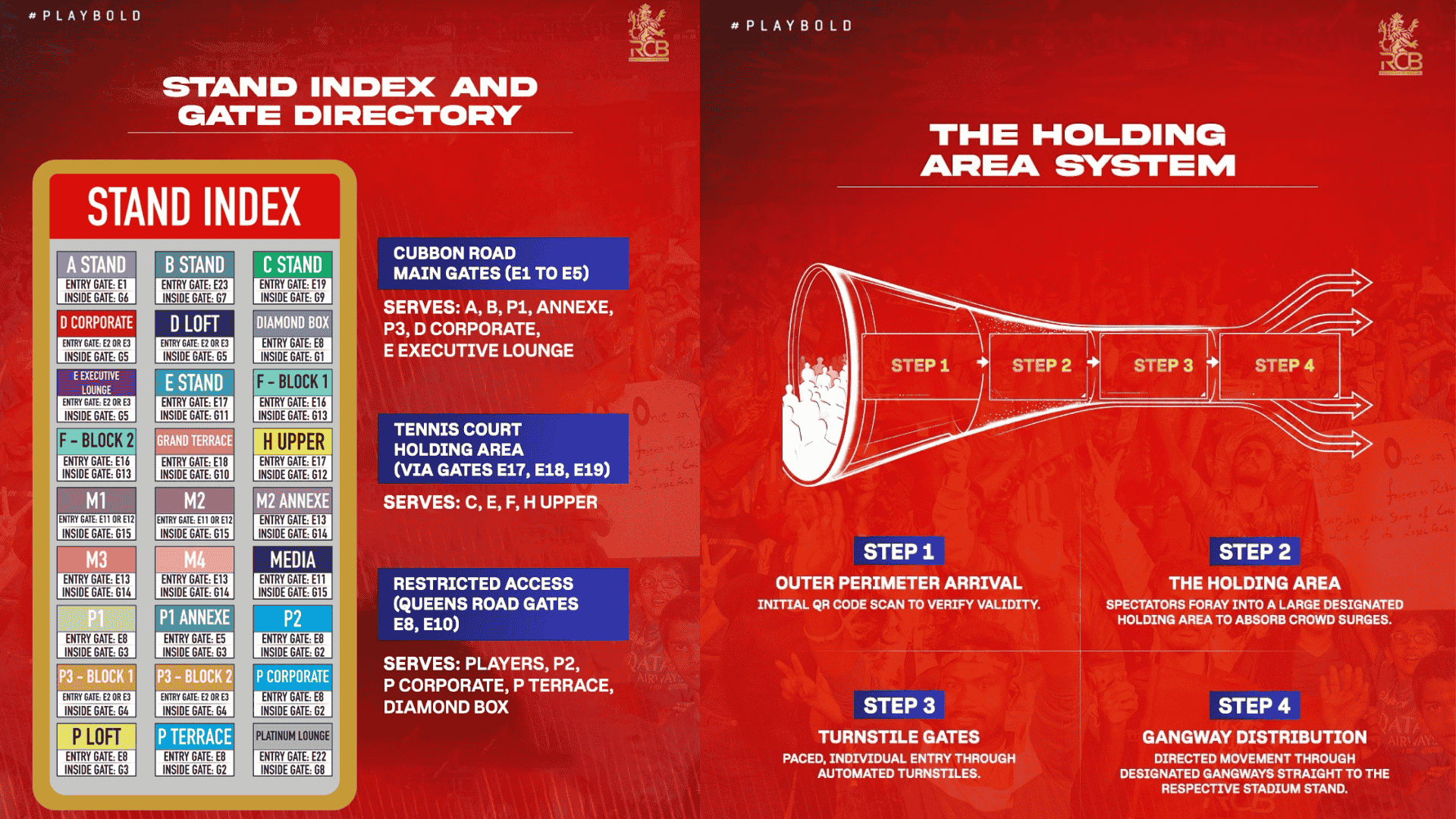
Source: RCB's facebook account
Two of RCB’s seven home games were moved to Raipur anyway, leaving just five at the Chinnaswamy Stadium. On March 16, the Expert Committee finally cleared the stadium. Twelve days later, cricket returned.
When most people hear “500 cameras,” they picture a wall of CCTV screens and a guard watching them with one eye open. That’s not what this is.
Modern AI cameras are less like traditional CCTV and more like sensors feeding a software brain. JARVIS doesn’t just record. It watches, counts, and thinks.
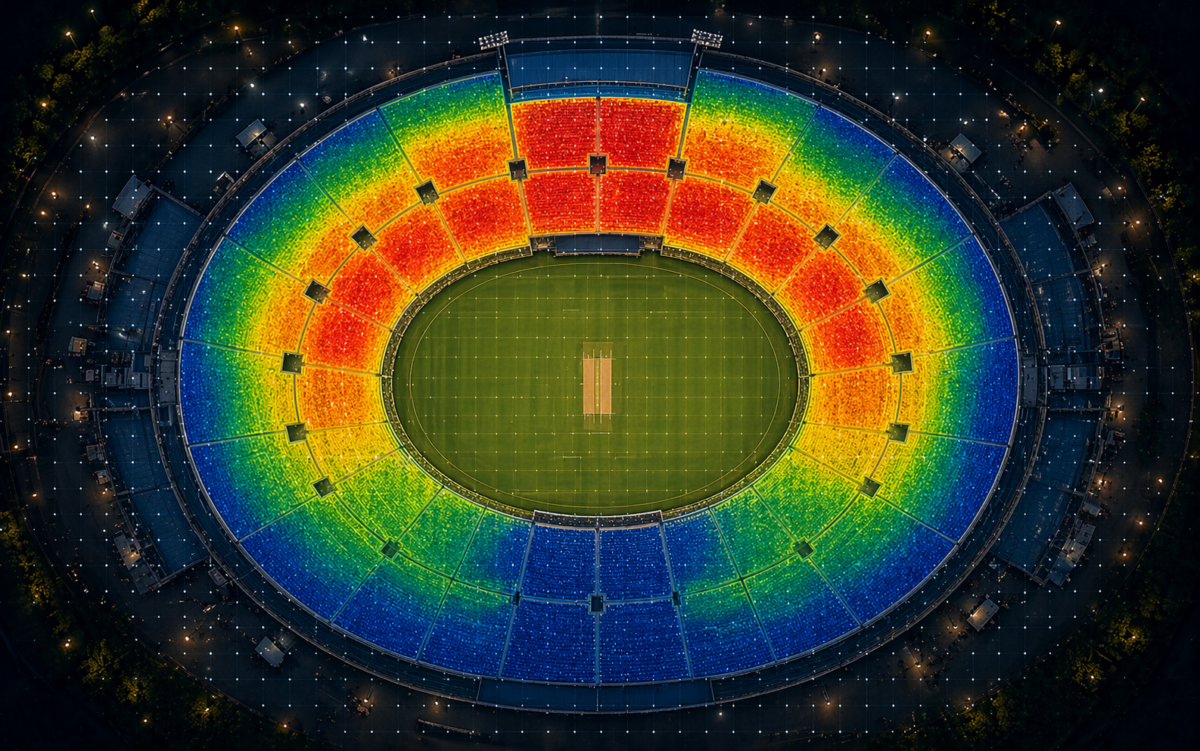
Crowd density, in real time. The system estimates how many people are in each stand, gate zone, and corridor at any given minute. RCB CEO Rajesh Menon confirmed that JARVIS produces stand-specific crowd counts and sends automatic alerts when any zone crosses a threshold.
Bottleneck detection. The AI spots when people are pooling near a ramp or staircase faster than they’re moving through it. That clustering pattern is exactly what precedes a crush. The system flags it before it becomes dangerous.
Behaviour recognition. According to Staqu’s founder Atul Rai, JARVIS has been trained to distinguish between a celebration and a panic. It doesn’t just see a crowd running. It reads the density, the formation, and the direction. A last over win where fans jump out of their seats looks very different, in data, from a surge where people are trying to escape. Only when an unexpected spike in density coincides with running in a confined zone does the system flag a potential emergency.
Automatic alerts, not manual spotting. The most important thing about the system isn’t the cameras. It’s the alert. Instead of a human noticing a problem on screen four minutes too late, the AI raises a flag in seconds. The command centre dispatches police, opens extra gates, or reroutes crowd flow while there’s still time.
In short: 500 cameras aren’t 500 screens. They’re one intelligent system with 500 eyes, watching for the patterns that humans miss when 40,000 people are moving at once.
Has it worked?
Three weeks into the season, early signs are encouraging. Crowd flows through the new colour coded gate system have held up across multiple matches. The AI command centre has been producing real-time density alerts without incident. The police live feed from the Commissioner's office has been active every match night.
And then there's the part nobody planned for. During the March 28 opener itself, an organised gang from Jharkhand stole roughly 50-75 phones from the P3 stand. Bengaluru Police used JARVIS's reverse facial recognition to crack it. They uploaded suspect images, the system traced movement across 500+ cameras, and within 48 hours, 13, including 9 minors and 4 adults, were arrested and 75 phones recovered. The system built to prevent stampedes caught pickpockets on its very first night.
No system is bulletproof, though. On April 24, during the RCB vs GT match, two subcontractor employees used an unauthorized access card to enter restricted areas and damaged NVRs and fibre-optic cables, knocking out roughly 240 camera feeds. Their alleged reason: unpaid dues of about ₹10 lakh. Backup security kicked in, and the match went ahead without any incident, but it's a reminder that AI and software are only as strong as the physical infrastructure and access controls underneath them.
And that's also actually the point. A system like this isn't something you install once and forget. It has to be maintained, secured, and managed just like any other critical infrastructure. The fact that the breach was detected, contained, and led to an FIR within days is itself a sign that the accountability layer is working, even when the hardware layer was compromised.
Chinnaswamy Stadium isn’t inventing something new. It’s catching up with a pattern that’s already standard wherever large crowds gather.
At the FIFA World Cup 2022 in Qatar, the Aspire Command and Control Center ran roughly 22,000 security cameras across eight stadiums, with thousands equipped with facial recognition. AI predicted crowd surges before they escalated, feeding everything into a single platform for safety, security, and facility management. Eight venues. One brain.
Closer to home, the Maha Kumbh Mela in Prayagraj deployed around 2,750 CCTV cameras, including 250 AI-enabled ones, feeding an Integrated Command Centre that measured crowd density per square metre and flow per minute at bathing ghats. When you’re managing tens of millions of pilgrims over weeks, you can’t rely on police whistles and barricades alone.
The pattern is consistent. Whether it’s a stadium, a pilgrimage, or a mega-event, the infrastructure underneath is the same: cameras, AI, networks, storage, and command centres. Chinnaswamy Stadium’s version is smaller in scale. But for Indian cricket, it’s the first time this stack has been deployed at a venue with this level of seriousness.
Cricket did come back to the M Chinnaswamy Stadium. The system ran. The opener went smoothly. The Expert Committee signed off. Fans moved through colour-coded gates, tapped QR codes, and settled into a stadium that looked the same but worked completely differently underneath.
And through every match, those eleven seats stayed empty.
They’re a reminder that stadium safety isn’t really about cameras or AI cameras or command centres. Those are tools. What changed at Chinnaswamy is something harder to build: the acceptance that managing a large crowd is an engineering problem, not just a policing one. That you need infrastructure, not just manpower.
Every mall, temple, metro station, concert ground, and campus with serious footfall is heading toward the same realisation. The question isn’t whether you need cameras. It’s whether your cameras can tell you something is wrong before the crowd does.
Before you go...
If you’ve ever managed a venue, an event, or a space with large crowds, what’s the one thing you wish you’d had? Hit reply and tell us.
If you are looking for a surveillance system or have questions, please reach out to us on WhatsApp or at [email protected]