
 HD Cameras and Webcam
 Projectors and Speakers
 VOIP Phones and Gateway
 Access Control
 5G routers and 4G LTE Devices
 Smart Sensors And Automation
 Fiber and SFP Modules
 Firewall & Cloud Controllers
 Network Adapters and Accessories
 Network Switches
 PoE Switches
 Point To Point Wireless Radio
 Routers
 Wireless Access Points
 IP Cameras
 Memory Cards
 NVR
NVR Smart WiFi Cameras
 Storage Devices
 Desktop & Laptop RAMs
 Internal and External Hard Drives
 Storage Accessories and Enclosures
 SSD and NVMe Drives
 USB Flash Drives


TP-Link Archer AXE75 vs Archer BE550: is upgrading from Wi-Fi 6E to Wi-Fi 7 worth it?

Yes, the Archer BE550 is a meaningful upgrade over the AXE75. It brings Wi-Fi 7 with MLO and 4K-QAM, 320 MHz channels on 6 GHz, and all 2.5G Ethernet ports. The AXE75 is a Wi-Fi 6E router capped at 160 MHz channels, 1024-QAM, and mostly Gigabit LAN ports. If you are buying new today, the BE550 is the better investment.
Table of contents
Side by side comparison of the specs
| Feature | Archer AXE75 | Archer BE550 |
|---|---|---|
| Wi-Fi standard | Wi-Fi 6E (AXE5400) | Wi-Fi 7 (BE9300) |
| Ceiling speed | ~5400 Mbps | ~9250 Mbps |
| 6 GHz speed | 2,402 Mbps | 5,760 Mbps |
| 5 GHz speed | 2,402 Mbps | 2,880 Mbps |
| 2.4 GHz speed | 574 Mbps | 574 Mbps |
| Max channel width | 160 MHz | 320 MHz (6 GHz) |
| Modulation | 1024-QAM | 4K-QAM |
| MLO | No | Yes |
| Ethernet ports | 1x Gigabit WAN + 4x Gigabit LAN | 1x 2.5G WAN + 4x 2.5G LAN |
Reading the wireless speed ratings correctly
Treat AXE75's 5,400 Mbps and BE550’s 9,250 Mbps as the ceiling speed - which is the speed rating across three bands added together, not a number any single device will ever hit. Reaching the 6 GHz speeds mentioned above, still requires a Wi-Fi 7 client and a 320 MHz-capable connection on both the routers. India's January 2026 de-licensing of the lower 6 GHz band (5925–6425 MHz) makes this legal now, but the block is narrower than in the US, so you can expect fewer channel options even at full width.
Difference in the ports and daily performance
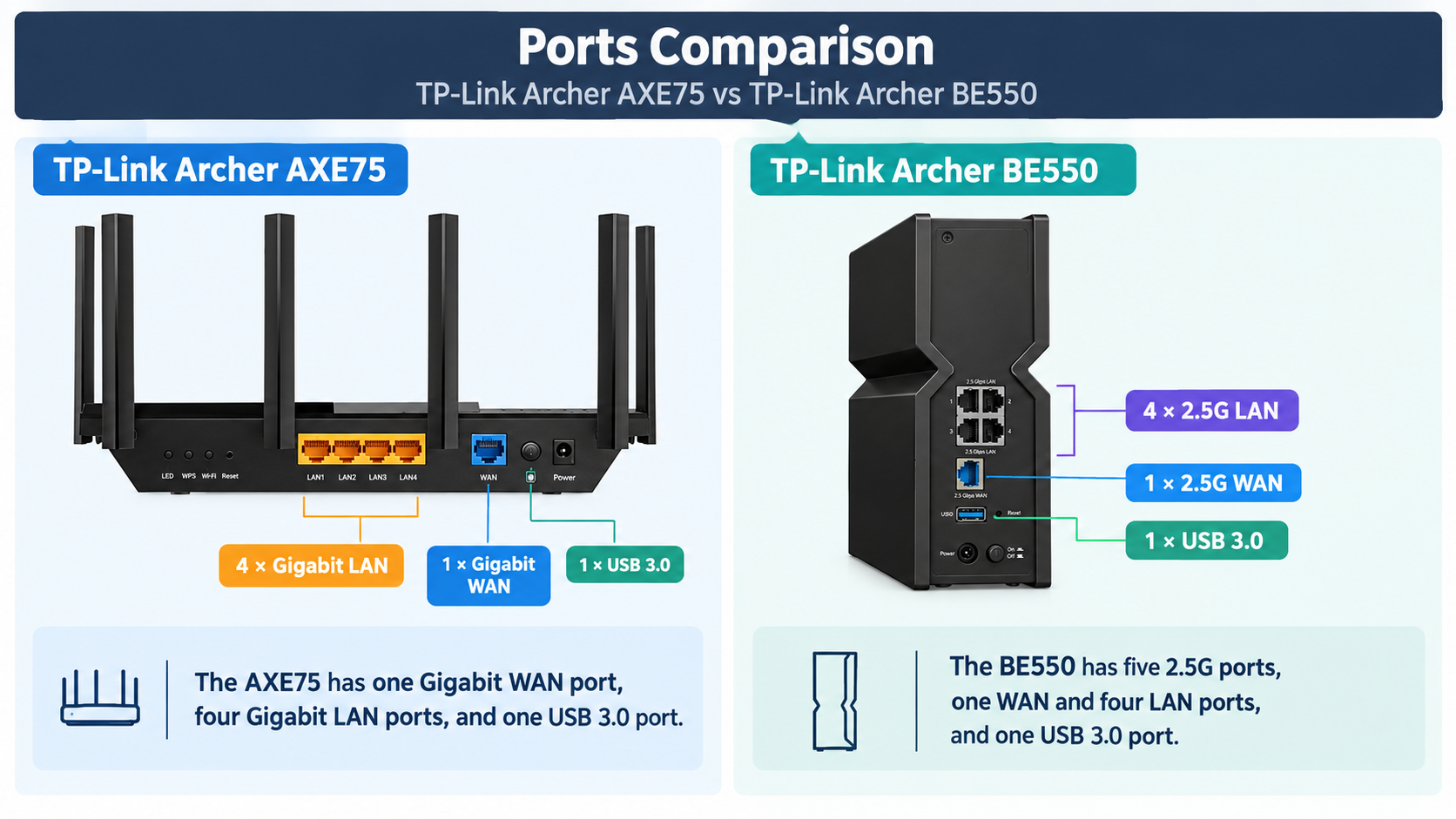
The AXE75 has one Gigabit WAN port, four Gigabit LAN ports, and a USB 3.0 port. It has no multi-gig Ethernet and no link aggregation, so wired throughput is capped at 1 Gbps.
The BE550 has five 2.5G ports, one WAN and four LAN. It easily reaches the maximum link speed of its 2.5G WAN port, suggesting it can genuinely sustain 2 Gbps wired traffic. This matters directly if your internet plan is faster than 1 Gbps, since the AXE75's WAN port would bottleneck it regardless of what your ISP delivers. If you're on a 500 Mbps or 1 Gbps plan, this advantage mostly sits unused.
Wi-Fi 7 for day to day MLO and 4K-QAM
The BE550 comes with the core Wi-Fi 7 toolkit - MLO, 320 MHz channels on 6 GHz, Multi-RUs, and 4K-QAM. MLO lets a compatible device use more than one band at once, which can reduce latency spikes, and the wider channels raise peak throughput. The gains show most clearly on 6 GHz-capable phones and laptops — older devices still connect fine but won't see the difference.
Expert Reviews (expertreviews.co.uk) noted that the BE550 doesn't fully deliver on Wi-Fi 7's performance ceiling in practice. A common opinion is that Wi-Fi 7 doesn't help much unless you already have a very fast internet connection, with MLO offering some benefit. It lines up with the logic that without Wi-Fi 7 clients and a fast enough plan, you'll pay for headroom you're not using yet. Recent reviews put the BE550 around INR 22,000 and the AXE75 around INR 16,000.
Which will fit your requirement better by use case
- ISP plan is up to 1 Gbps, with mostly Wi-Fi 6/6E devices - AXE75 is cheaper, and its Gigabit ports won't become a bottleneck
- ISP plan is above 1 Gbps - Get the BE550, as the AXE75's Gigabit WAN port would cap your plan
- Plan to run NAS or desktop with 2.5G Ethernet - The BE550 is the only one with multi-gig ports
- Have several Wi-Fi 7 phones or laptops active today - You'll be using MLO and the wider channels, so go for BE550
- Buying for the long term - BE550 will give you the headroom as devices upgrade
- Already own a working AXE75 - Stay with it, unless your plan or wired gear outgrows it
Best for / Not for
Best for - If you're buying fresh, upgrading from Wi-Fi 5/6, or your plan and wired gear already exceed 1 Gbps, the BE550 is the right pick. The AXE75 is recommended if your devices are Wi-Fi 6E or older.
Not for - The AXE75 is not for new purchases or faster more capable devices starting today. The BE550 is a no-go, for existing Wi-Fi 6 or lower devices, if you have a below 1-Gbps plan, or no plans to upgrade devices or internet plan soon.
If you have made the decision checjk the current price for the Archer BE550