
 HD Cameras and Webcam
 Projectors and Speakers
 VOIP Phones and Gateway
 Access Control
 LTE and 5G Devices
 Smart Sensors And Automation
 Fiber and SFP Modules
 Firewall & Cloud Controllers
 Network Adapters and Accessories
 Network Switches
 PoE Switches
 Point To Point Wireless Radio
 Routers
 Wireless Access Points
 IP Cameras
 Memory Cards
 NVR
NVR Smart WiFi Cameras
 Storage Devices
 Desktop & Laptop RAMs
 Internal and External Hard Drives
 Storage Accessories and Enclosures
 SSD and NVMe Drives
 USB Flash Drives


Review of the TP-Link Archer AXE95. What two years of daily use taught one of our customers about it?

Two years of daily use by one of our customers showed that the Archer AXE95 got the big things right - coverage across large homes, clean 6GHz speeds at close range, and stable performance with 30-50 devices. But it also exposed hard limits that even a flagship Wi-Fi 6E router can't escape: 512MB RAM, a single 2.5G port, CPU bottlenecks under heavy load, and 6GHz range that drops fast through Indian concrete walls. What fixes these isn't just a jump to Wi-Fi 7 - it's more processing power, more multi-gig ports, and better thermal design.
The TP-Link Archer AXE95 (AXE7800) was one of TP-Link's strongest Wi-Fi 6E routers, tri-band, 6GHz, a 1.7 GHz quad-core Broadcom CPU, and eight-antenna beamforming. It launched before the WiFi 7 router lineup hit India, and at the time, it was the best you could get without going enterprise
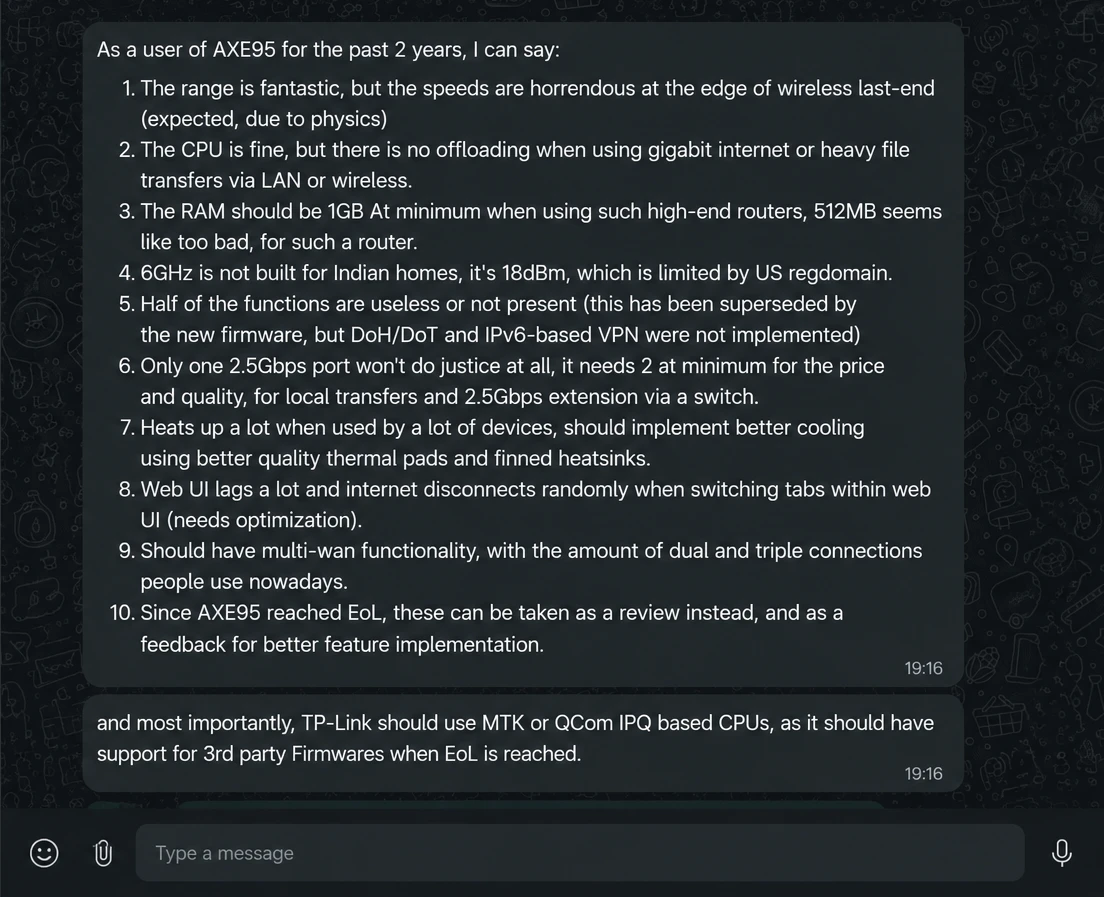
One of our customers - who purchased the router from FGTech Store and has been using it daily for over two years - sent us a detailed 10-point teardown of where it delivered and where it didn't.
The AXE95 has since reached end-of-life, so this isn't a buying recommendation. It's a practical look at where flagship Wi-Fi 6E hit its ceiling, and what fixes that.
What the AXE95 got right?
Coverage. With eight external antennas and beamforming, the AXE95 held signal across large apartments and duplex homes with 30-50 devices. Multiple customers confirmed this was its strongest point. The 6GHz band also delivered noticeably faster speeds for devices close to the router, especially in apartment buildings where 2.4GHz and 5GHz channels overlap with neighbours.
Where does AXE95 (AXE7800) fall short?
The complaints group into three areas that apply to most Wi-Fi 6E routers, not just this one.
Hardware that can't keep up with the spec it advertises. The AXE95 has 512MB RAM and no hardware NAT offloading (per WikiDevi teardown - Broadcom BCM6756 with Realtek RTL8367S switch). During heavy LAN transfers or sustained gigabit WAN use, the CPU handles packet processing in software while also managing Wi-Fi clients, NAT, firewall, and the web interface. Our customer reported web UI lag and random disconnects when switching admin panel tabs - a direct symptom of CPU contention under load. The router also runs hot during heavy use, with only passive venting and no finned heatsinks. In Indian summer conditions (35°C+ ambient), passive cooling gets pushed hard.
Ports that bottleneck the connection. One 2.5G port (WAN/LAN), three gigabit LAN, one gigabit WAN/LAN. If you're connecting a NAS, a 2.5G switch, and a multi-gig ISP uplink, one port can't serve all three. No multi-WAN either - dual ISP failover and load balancing don't exist in Archer consumer routers.
6GHz range limited by regulatory power, not just physics. Consumer Wi-Fi 6E routers sold in India were shipped with FCC (US) regulatory domain firmware. Under FCC Low Power Indoor rules, 6GHz is capped at roughly 5 dBm/MHz power spectral density - around 18 dBm EIRP for a 20 MHz channel, well below 5GHz's allowance. Combine that with Indian concrete-and-brick construction, and 6GHz coverage drops sharply past one wall.
India formally delicensed the lower 6GHz band (5925-6425 MHz) in January 2026 for LPI and VLP use, with LPI capped at 30 dBm EIRP - the same ceiling as FCC. So while the regulatory barrier is now cleared, the indoor power limits haven't actually increased, and Standard Power mode (which would allow higher output via AFC) hasn't been enabled in India yet. Whether consumer routers will receive India-specific firmware updates remains to be seen.
Upgrade paths that fix these specific problems
TP-Link Archer BE550 (BE9300)
Fixes the core AXE95 gaps: 1GB RAM (double), quad-core MediaTek/Qualcomm at 1.8 GHz, and five 2.5G ports (one WAN, four LAN). Wi-Fi 7 with MLO, 320 MHz channels. Real-world 6GHz speeds around 1,300-1,400 Mbps at close range (per TweakTown's review). Best fit for most AXE95 users with gigabit Jio Fiber or Airtel Xstream plans and 20-40 devices.
TP-Link Archer BE800 (BE19000)
For NAS and homelab users: two 10G ports (one RJ45/SFP+ combo), four 2.5G LAN, Qualcomm IPQ9574 at 2.2 GHz. The board has 2GB RAM physically soldered (per WikiDevi teardown), though TP-Link's firmware currently exposes only 1GB to the operating system. The SFP+ port connects directly to fiber ONTs or 10G NAS hardware. Mesh casing improves thermals over the AXE95.
TP-Link Archer BE900 (BE24000)
Same hardware as the BE800 plus a fourth band (split 5GHz). The extra 5GHz radio helps in 60+ device homes with heavy 5GHz contention. For most users, the BE800 covers the same ground at a lower price.
These three aren't the only options. FGTech Store stocks the full lineup of WiFi 7 routers available in India — from budget BE3600 models to flagship tri-band and mesh systems, if your requirements don't match any of these three.