
 HD Cameras and Webcam
 Projectors and Speakers
 VOIP Phones and Gateway

 Access Control
 5G routers and 4G LTE Devices
 Smart Sensors And Automation
 Fiber and SFP Modules
 Firewall & Cloud Controllers
 Network Adapters and Accessories
 Network Switches
 PoE Switches
 Point To Point Wireless Radio
 Routers
 Wireless Access Points

 IP Cameras
 Memory Cards
 NVR
 Smart WiFi Cameras
 Storage Devices
 Desktop & Laptop RAMs
 Internal and External Hard Drives
 Storage Accessories and Enclosures
 SSD and NVMe Drives
 USB Flash Drives



Networking infrastructure Behind Every Moden Music Concert

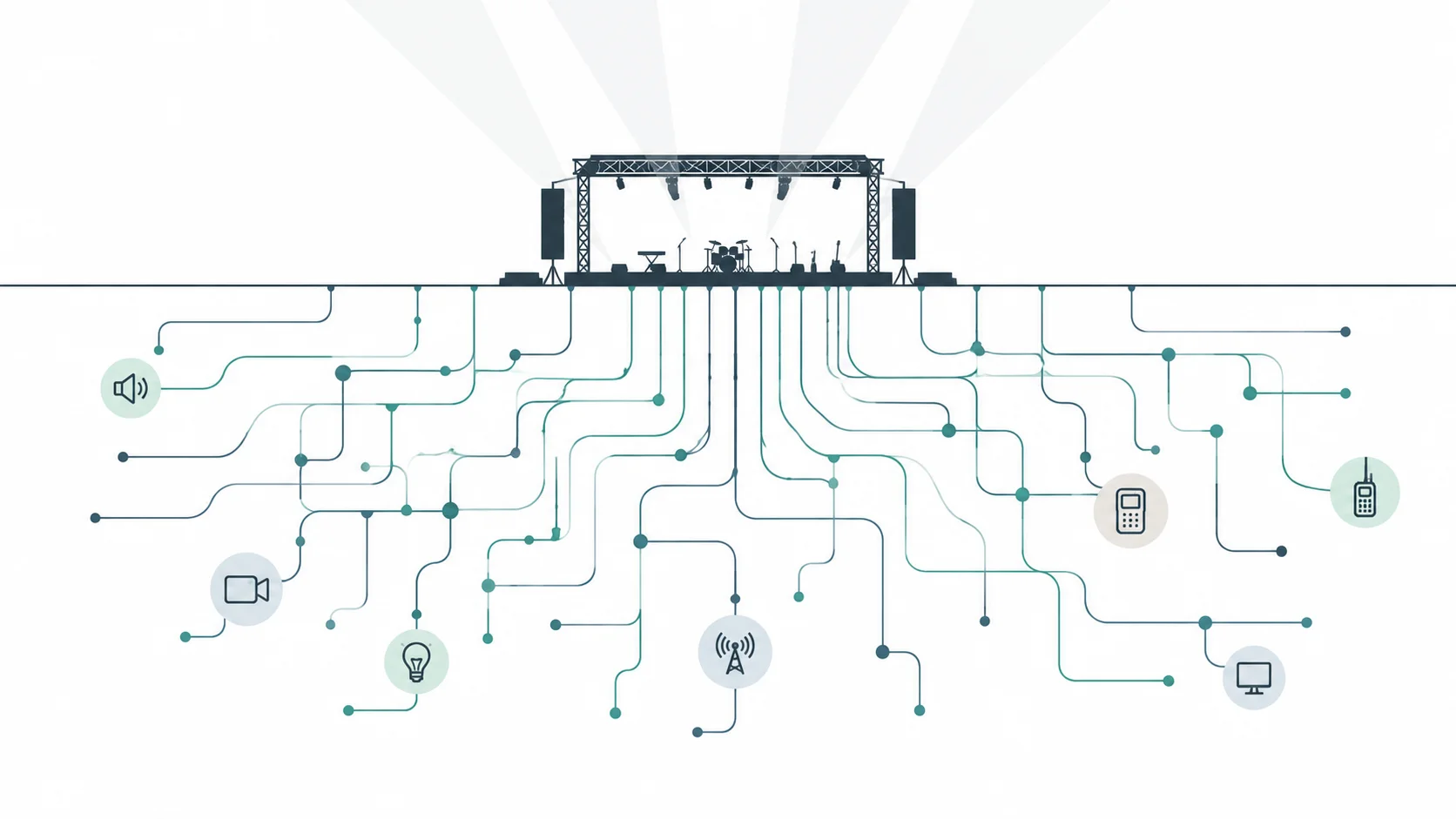

In this issue of Tech Tomorrow, we look at what's really running behind a modern music concert: the wiring infrastructure, from a singer's microphone to the LED wall the size of a building, all running on the same basic technology.
Before we dive in, if you're someone who enjoys understanding how technology, business, policy, and infrastructure shape the products and services you use every day, join the community if you haven't already. We publish one in-depth edition every two weeks. And if you're already a subscriber, thank you. Consider forwarding this to someone who'd enjoy thoughtful deep dives into the forces powering the country around them.
January 2025. Narendra Modi Stadium, Ahmedabad. Coldplay's Music of the Spheres tour. You're one of 111,000 people. Chris Martin's voice fills every corner of the stadium. An LED wall taller than a four-storey building shows his face in perfect sync. Hundreds of lights shift colour on the exact beat of "Yellow." You tap your phone, pay ₹300 for a biryani at a stall near Gate 4. Your friend next to you uploads an Instagram story from the middle of the crowd.
Each of those things – the voice, the wall, the lights, your payment, your friend's upload – is running on a different network. At least four. All built from scratch in the days before the show, and all dismantled within hours of the last song.
Most of us walk into a concert and experience it as one smooth thing. It isn't as simple as it looks. It's several independent systems running in parallel, and if any one of them fails, a different part of your experience breaks.
Let's start with the obvious one. The first network: the production network, that carries the show itself. It's a closed system, completely disconnected from the internet.
A metal box on stage, called a stage box, converts every microphone and instrument into digital data packets. Those packets travel over a standard Ethernet cable to the sound engineer sitting at a mixing console in the middle of the audience area, a spot called Front of House, about 50 to 100 metres from the stage. The engineer balances it all into a finished mix and sends it back to speakers around the venue. The protocol doing the heavy lifting is called Dante, and it can carry 512 audio channels on a single cable.
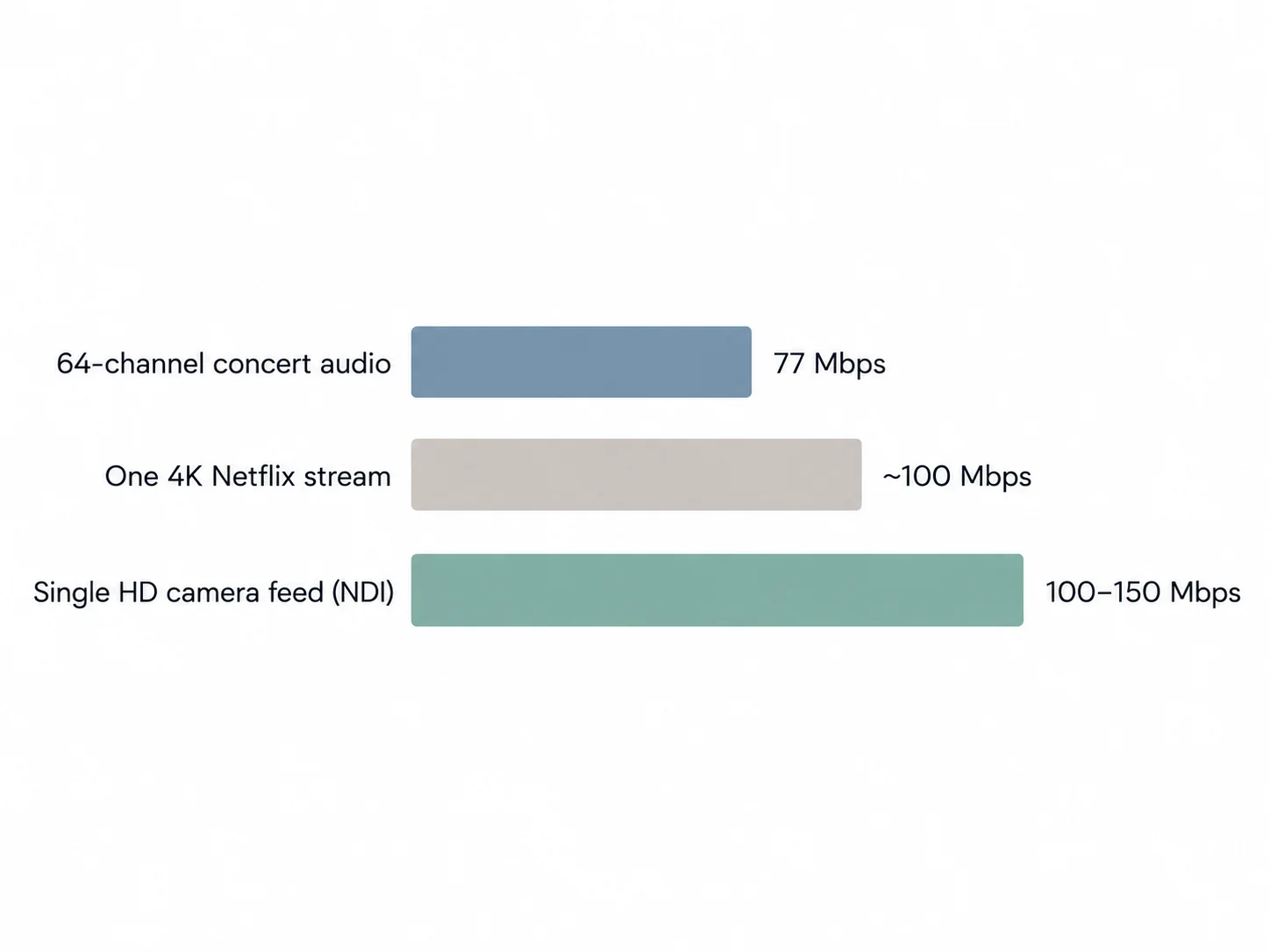
The bandwidth for a full 64-channel concert? About 77 Mbps. Less than one 4K Netflix stream. Your home broadband could handle it.
Video is where the network earns its keep.
Cameras film the performer, a video director switches between angles (exactly like an IPL broadcast), and an LED wall processor slices each frame into tiles for every panel in the wall. A single HD feed uses 100 to 150 Mbps. Uncompressed 4K can hit 6 to 12 Gbps. Multiple cameras, multiple screens, pre-produced visuals, all flowing through backbone links running at 10 Gbps. The acceptable delay between camera and wall is under 33 milliseconds. Two video frames. Any more and the performer's lips fall out of sync.
Then comes the lighting. A lighting designer programs thousands of cues before the show. For a gig with a changing setlist, the LD triggers each cue manually, hitting buttons on beat. For a tightly choreographed production like Coldplay's, the console automates it entirely, running a time-coded show file locked to the backing track. Every light command – colour, intensity, movement, and effects – fires at a precise timestamp. The operator still monitors and can override, and followspots tracking the performer are usually manual. But the bulk of the show runs on automation.
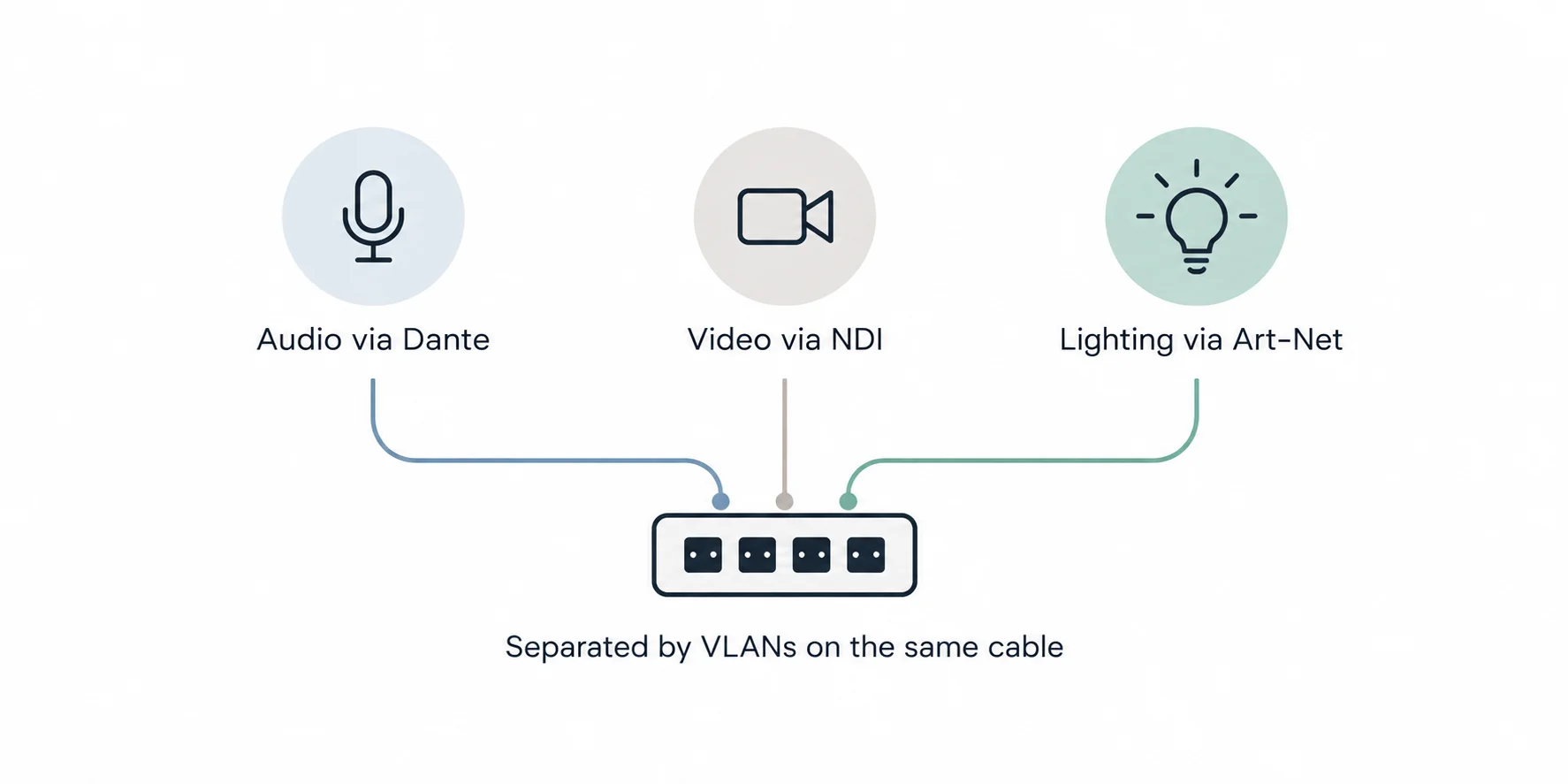
Voice, video, and lights all work on the same Ethernet infrastructure, kept from interfering with each other by VLANs, virtual walls inside the same network switch. That's the production network for you.
That accounts for the show. But what about the second network, the one handling 100,000 phones in the audience? How does the internet still work at a place with that many devices?
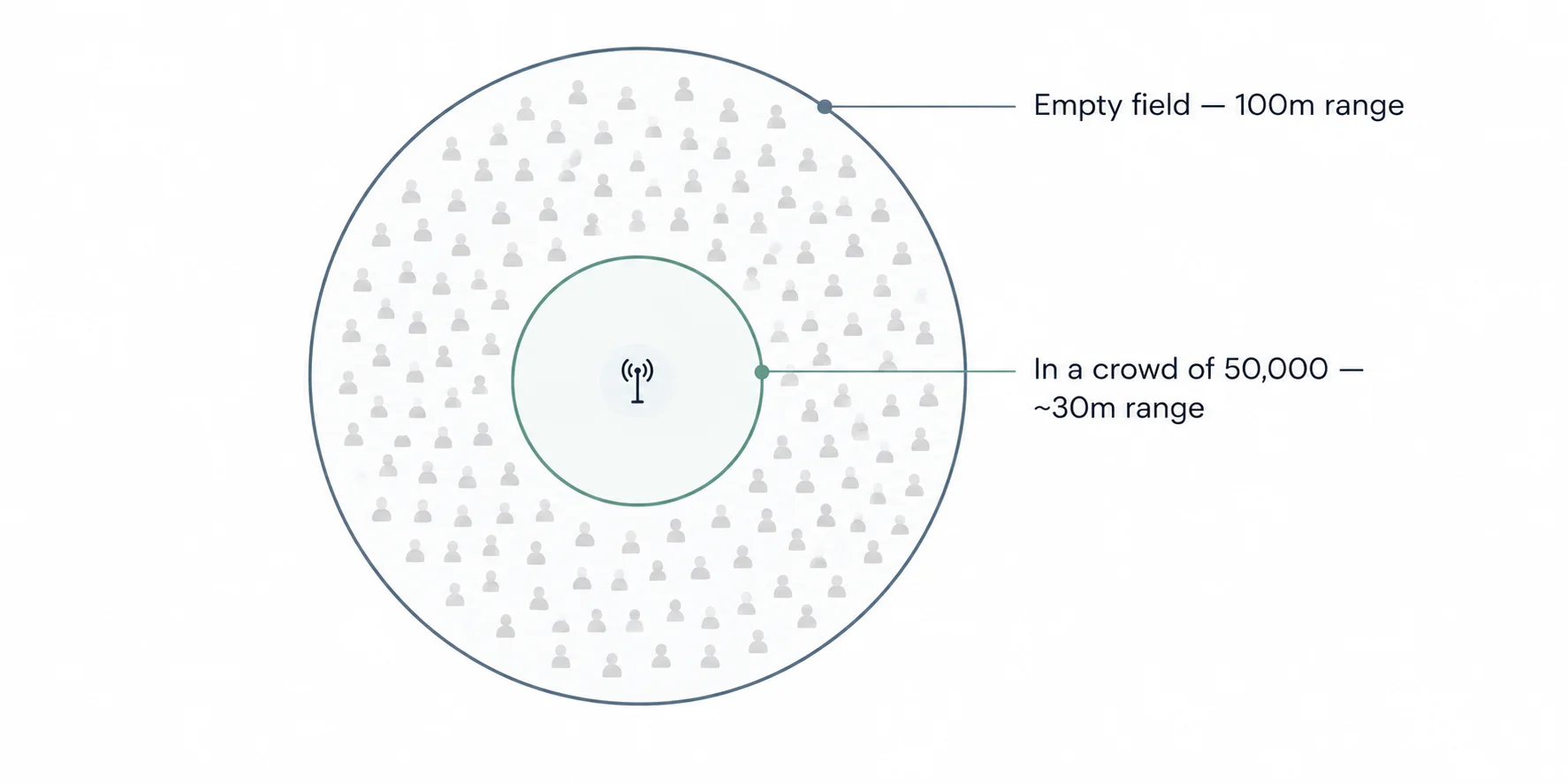
Your phone at a concert runs on the same Jio, Airtel, or Vi network it always does. The difference is that you're now sharing the nearest cell towers with 100,000 other people doing the same thing, uploading stories, making UPI payments, texting friends to find each other. Crowds absorb radio signals; a mobile signal that reaches 100 metres on an empty field can drop to about 30 metres with 50,000 people standing in the way. That's why your Instagram upload crawls, your UPI payment at the food stall takes multiple attempts, and sometimes it's difficult to even make a call.
The standard fix for this is something called a DAS (Distributed Antenna System). Instead of relying on distant cell towers, dozens of small antennas are placed across the venue, each covering a small zone of the crowd and connected back to the carriers' core network.
Purpose-built concert arenas have these installed permanently. For temporary venues like cricket stadiums or open grounds, carriers deploy portable DAS units for the event, though how much capacity they bring varies.
The production crew doesn't have to deal with any of this. They have their own separate Wi-Fi and internet. At Coldplay Ahmedabad, 24 Cisco Meraki access points covered the stage, both FOH positions, dressing rooms, and up to 20 production offices, backed by two 2 Gbps lines from separate ISPs. None of it is shared with the audience.
This network never touches the production network. The two run on physically separate cables.
The third network sits even further from the spotlight. The vendor side of every transaction needs its own connectivity. The POS terminal at the food stall, the card machine at the merch counter, the RFID wristband reader at festivals like NH7 Weekender or Sunburn. These devices don't run on mobile data as your phone does. They connect to a dedicated payments network set up by the event, sitting on its own VLAN, locked down to communicate only with the payment provider's servers, built to PCI security standards.
Your UPI payment reaches the stall's device through your carrier's network. But the stall's device reaches the payment gateway through the event's network. If that event-side payment network drops, every food and merch stall stops selling, even if your phone has full signal. That's revenue lost by the minute.
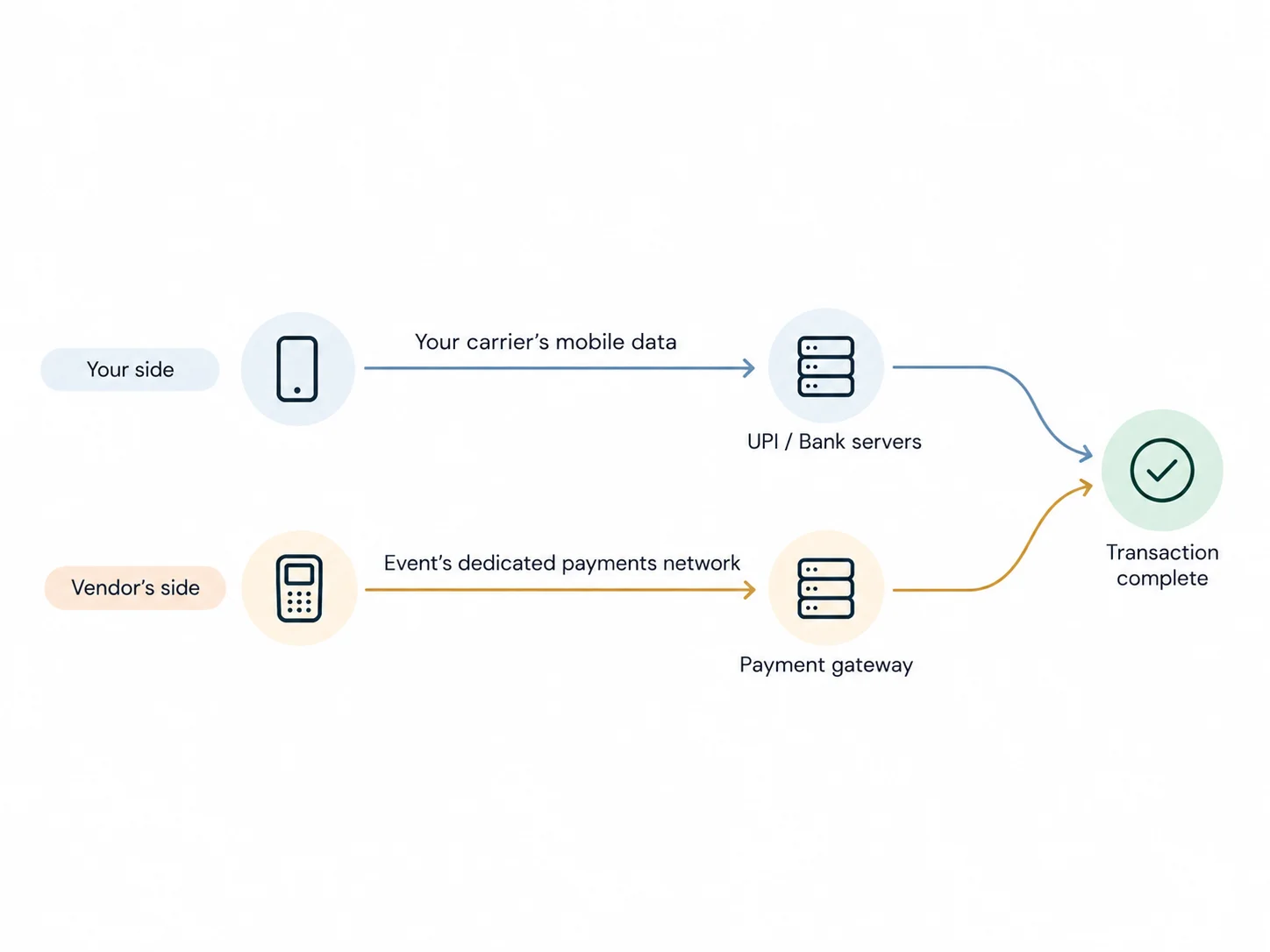
The smarter setups use offline-capable POS devices that store transactions locally and sync later, with cellular SIM failover if Wi-Fi fails.
And then there's the fourth network, the one keeping the crew connected.
200 Motorola radios and 50 Bolero wireless intercom beltpacks kept Coldplay's production running in Ahmedabad. Stage managers coordinated pyro, security managed gates, and the Disney+ Hotstar livestream team directed cameras with their own 100-person crew and 30-unit intercom network. The production had separate encrypted networks for each department, serving up to 20 backstage offices. All riding the same Ethernet backbone as the singer's voice, but on their own VLAN.
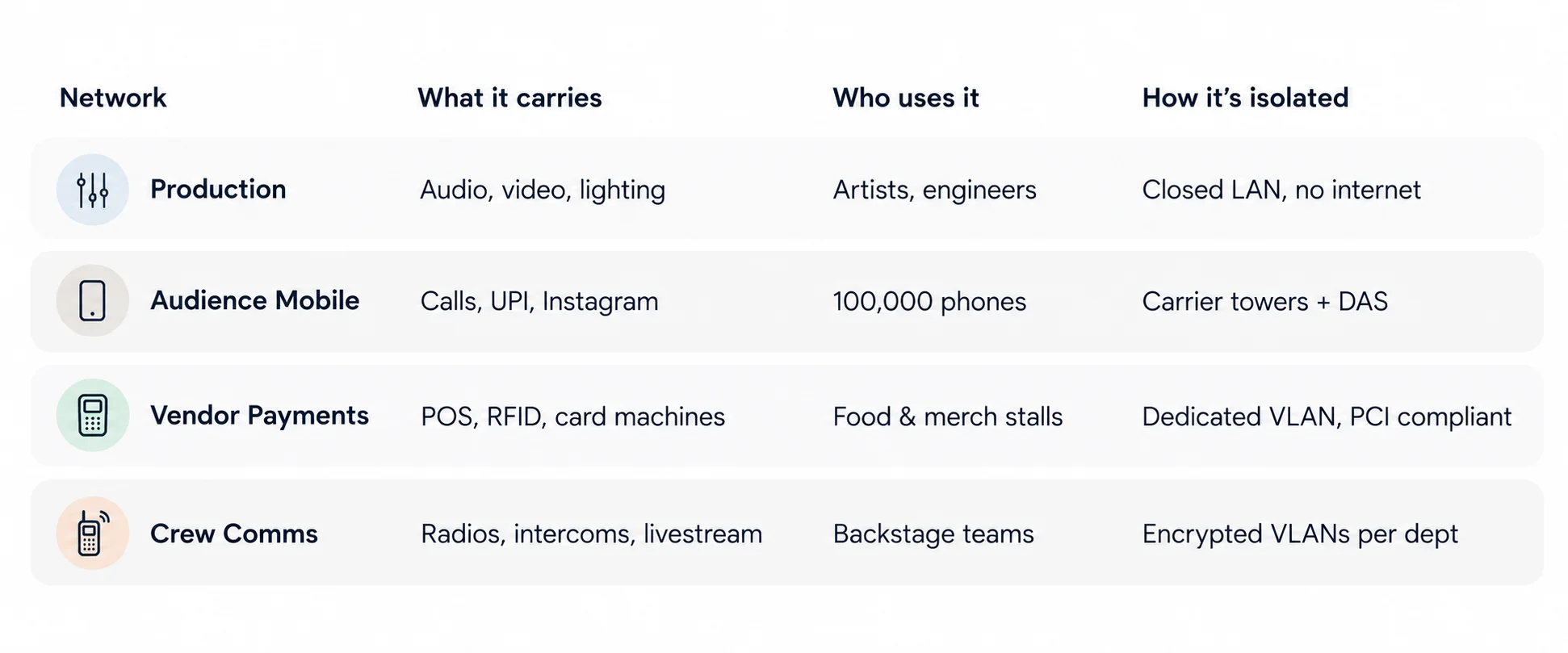
Four networks. Production, audience connectivity, payments, crew communications. They run simultaneously, kept separate, and managed through the same kind of network switches and Ethernet cables you'd find in an office building.
Except that nothing about this is permanent.
A major concert production takes three to four days to set up. Stage structure goes up first, then rigging, then sound, lighting, video, and networking.
The largest stadium tours require over 100 trucks of equipment. Every cable run, every switch rack, every access point is deployed, tested, stress-tested, and made show-ready.
On the night, everything critical runs in pairs. Dante runs primary and secondary networks simultaneously. Backup consoles monitor the primary and take over the moment it goes silent. Cables take physically different routes through the venue so one cut can't kill both paths.
After the last song, teardown starts within the hour. Sound and lights come down first. Structures next. Within 12 hours, equipment is loaded, and the trucks are driving to the next city. For a touring act, this entire cycle – build, test, perform, dismantle – repeats at every stop.
Teams of engineers build what amounts to a temporary data centre, making it run for a few hours, and packing it into trucks before sunrise.
Back in Ahmedabad, somewhere behind the crowd and below the stage, those switch racks and fiber cables were quietly holding the whole thing together.
So the next time a ₹15,000 concert ticket feels steep, it's worth remembering what that ticket is actually paying for. It's not just for the artist on stage, but it's also the on-demand network infrastructure that makes everything work.
Voice and video for the performers. Mobile and Wi-Fi for the audience. Payments for the stalls. Comms for the crew. Multiple independent networks, deployed by teams who do this in city after city, week after week.
Most of us walk out of a concert talking about the setlist. Maybe the next one also deserves a second look at what was running behind it.
Give us your honest feedback
|
😍 Loved it, more like this!
|
🙂 Good, could be better
|
😕 Not relevant to me
|