
 HD Cameras and Webcam
 Projectors and Speakers
 VOIP Phones and Gateway

 Access Control
 5G routers and 4G LTE Devices
 Smart Sensors And Automation

 Fiber and SFP Modules
 Firewall & Cloud Controllers
 Network Adapters and Accessories
 Network Switches
 PoE Switches
 Point To Point Wireless Radio
 Routers
 Wireless Access Points

 IP Cameras
 Memory Cards
 NVR
 Smart WiFi Cameras
 Storage Devices

 Desktop & Laptop RAMs
 Internal and External Hard Drives
 Storage Accessories and Enclosures
 SSD and NVMe Drives
 USB Flash Drives



The Hidden Cost of AI Infrastructure: Land, Electricity and Water

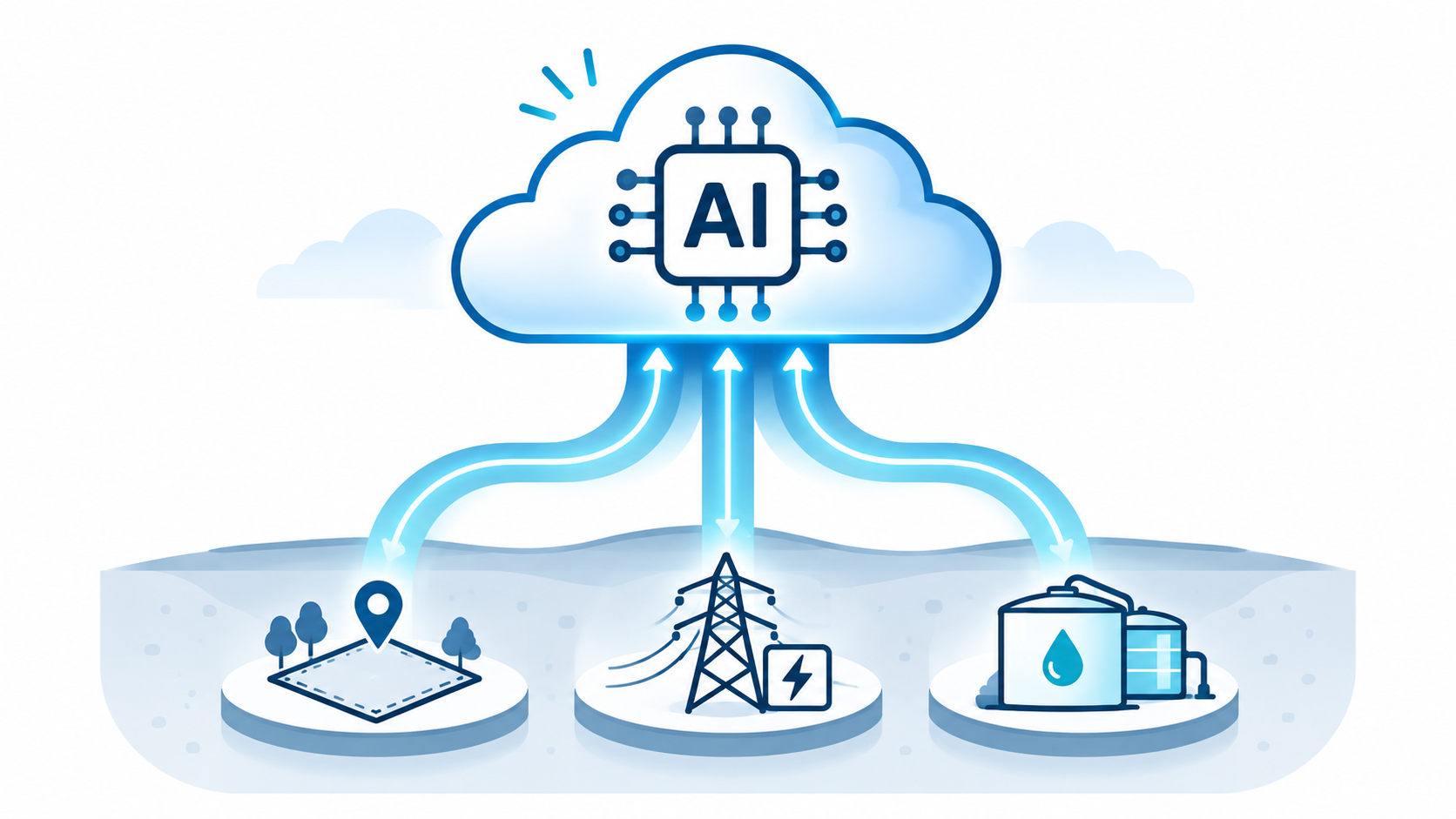

In this edition of Tech Tomorrow, let's look beyond the chips and servers to understand the resources required to build the AI infrastructure of tomorrow—and explore whether this growing demand has an impact on the resources, costs and everyday lives of ordinary people.
Before we dive in, if you're someone who enjoys understanding how technology, business, policy, and infrastructure shape the products and services you use every day, join the community if you haven't already. We publish one in-depth edition every two weeks. And if you're already a subscriber, thank you. Consider forwarding this to someone who'd enjoy thoughtful deep dives into the forces powering the country around them.
On 30 October 2026, Open AI Chief Sam Altman made headlines with an interesting argument about how we use computing resources. "From a global resource-allocation perspective, he questioned whether it makes sense for individuals to keep large amounts of RAM in their personal computers when much of that memory remains unused for most of the time." He suggested that centralised data centres could potentially put the same resources to more intensive use.
Whether Altman is right about the future of personal computing or not, his comments raise a much bigger question:
What does AI actually consume?
When we think about AI, we usually think about powerful processors, memory chips and computers. They need specialised processors, high-bandwidth memory (HBM), conventional server memory, storage and high-speed networking equipment to train and run AI models.
But where do all these components go?
Think about the desktop computers, small routers and Ethernet cables we use at our homes or offices as one single AI server. Now an AI infrastructure has thousands of such powerful servers working together, processing enormous amounts of data around the clock.
We obviously cannot put all these machines on office desks or arrange them in an ordinary room. They need a dedicated facility where thousands of servers can be installed, connected, powered and kept cool. That's what a data centre does.
The race to build AI infrastructure
Since AI promises huge potential and is called the next big thing of this decade or maybe this century, all major technology companies are betting heavily on AI systems and pushing all means and large investments (to the tune of some trillion dollars) to get ahead in this race.
And this investment is going not just to buy specialised memory chips, high-end servers, or networking equipment, they are being used to advanced power systems, cooling technology, and the physical infrastructure to bring everything together. The three major components of the physical infrastructure are: land, electricity and water. Let’s learn all three one-by-one and see if it has any effect on our daily lives.
1. Land: The physical space behind the cloud
When we hear the word cloud, it's easy to imagine something that exists entirely in the digital world. In reality, it means specialised buildings (i.e. data-centres) packed with computers, server rooms, redundant power systems, cooling equipment, security infrastructure and high-speed connectivity.
In other words, the land requirement goes well beyond the area occupied by the servers themselves and hence it is important for all tech companies to invest in large land parcels across the globe to acquire such lands which can hold such data centres.
India is attracting a lot of AI investments to build such data centres locally to cater growing demand locally as well as globally.
In May 2026, Amazon Data Services India acquired approximately 10.6 acres of land in Palava, Thane, for ₹125 crore. This was in addition to an earlier acquisition of approximately 38 acres in the same area. In June 2026, STT Global Data Centres also acquired a 3.48 acre land parcel in Navi Mumbai for ₹282 crore to develop another data-centre facility
Google, too, has explored a major data-centre site in Navi Mumbai.
These investments give us an idea of the scale of land requirements and the growing interest in the Mumbai region itself.
But the land acquisition is not just limited to Mumbai and Navi Mumbai. Hyderabad, Chennai, and Vishakhapattnam have also received similar large investments in recent years and other metro cities e.g. Delhi NCR, Bengaluru, and Pune are also expanding their data-centre locations.
But here's something worth thinking about.
Since all such metro cities face enormous demand for land for their homes, offices, schools, hospitals, roads, public spaces and gardens. Industrial and commercial businesses need land too. Data centres are now another participant in this competition.
Does this mean data centres are responsible for rising property prices across Mumbai and other metro cities? Not necessarily. Housing demand, infrastructure development, transport connectivity, construction costs and several other factors influence real-estate prices.
However, the expansion of data centres adds another source of demand for suitable industrial land, particularly in locations where reliable electricity and high-speed connectivity are available.
And unlike a typical office building, a data centre cannot simply be constructed anywhere in a rural area or on a barren land which is affordable and accessible. The location must also meet demanding technical requirements. Reliable power connections, fibre-optic connectivity, cooling infrastructure, security and the ability to expand are all important considerations.
This is what makes certain locations particularly attractive to data-centre developers.
The interesting part is that the cloud economy is now competing for one of the most tangible resources we have: land.
And land is only the beginning. Once a data centre is built, it needs something even more critical to keep running: electricity.
2. Electricity: A data centre cannot afford to switch off
Once the build-out is ready, the next big challenge is powering it
A data centre isn't like an ordinary office where computers can be switched off at the end of the working day. Its servers may need to operate continuously, supporting AI applications, cloud services and other digital workloads for customers around the world.
This means operators need a dependable electricity supply around the clock, supported by backup power systems and redundant, and reliable grid connections. A conventional data center was typically around 10 to 25 MW in size. But a hyperscale AI-focused data center can have a capacity of 100 MW or more — consuming as much electricity annually as 100,000 households. The power consumption alone is so great that we are measuring Data centres not in compute but energy consumption potential.
According to the Ministry of Electronics and Information Technology, the country's data-centre capacity increased from approximately 375 MW in 2020 to around 1,500 MW by 2025.
In March 2026, the government estimated that electricity demand from data centres could reach 13.56 GW by 2031–32. However, by July 2026, a newer government estimate put the additional power demand from AI data centres alone at 26.3 GW by 2031–32. That's almost double the earlier projection.
Let’s understand the scale also. India currently generates approximately 2,000 billion units of electricity annually, equivalent to an average power output of around ~225 GW. Against this, the projected additional power demand from AI data centres alone is estimated at 26.3 GW by 2031–32. That's equivalent to around 10-12% of India's current average electricity generation.
This is a considerable, sustained stress on the national energy grid. India is an energy surplus country, we don't have a generation problem (our current installed PowerGen capacity is around 500GW) but we have a distribution problem, despite being able to generate abundant amounts of power, the national grid suffers from the saturation problem, we can not efficiently deliver the power from the generation units to consumer units, Whether the same dysfunctional national grid be able to support such a massive spike in consumption without causing suffering to the average household needs to be seen.
Now imagine what happens when a company has secured the land, constructed the facility and installed thousands of servers, but the required electrical infrastructure isn't ready.
Power generation capacity must be planned. Substations, transformers and transmission lines must be developed. Grid operators also need to ensure that electricity can be delivered reliably to locations where these large facilities are being built.
And these things take time.
A data centre may be ready to operate, but if the necessary grid infrastructure or power supply isn't available, its computing capacity cannot be fully utilised.
The United States is already suffering from this phenomenon where data centers are just sitting dark because the operator can not secure electrical supply to power the build out.
There are examples of companies going desperate to source power in other countries, some are looking at restarting old coal/gas plants, some are looking into nuclear reactors and others are trying desperately to figure out if some renewables can be sourced as a sustainable power grid.
Also, electricity is needed not only to run the servers and processors, but also to operate networking equipment, cooling systems, backup infrastructure and other essential systems.
In fact, cooling can become a significant part of a data centre's overall energy requirement, depending on its design and operating conditions.
Now imagine what would happen if thousands of such facilities are added across different regions but our power generation capacity doesn’t add up in line with such expansion.
India needs electricity for homes, agriculture, manufacturing, transport and other industries too. The growing demand from data centres adds another major requirement that power planners must account for and if they are unable to keep up the pace, the overall power system might face shortages across the regions.
3. Water: The resource that keeps the machines running
Now suppose we've solved the first two problems. We have the land, the buildings, the servers, the memory and a reliable electricity supply (maybe with backups of Solar systems, and Batteries)
There's still another challenge: heat.
Powerful processors generate enormous amounts of heat while performing calculations. As more powerful processors are packed into smaller spaces, managing this heat becomes increasingly important.
If temperatures exceed the equipment's operating limits, systems may reduce performance, shut down or even suffer damage.
Data centres therefore require carefully designed cooling systems.
Some facilities use conventional air-based cooling, while others use liquid cooling systems that circulate fluids to transfer heat away from processors. Depending on the design, this heat is eventually released through cooling towers, air-cooled equipment or other arrangements.
And this is where water enters the picture.
Some cooling systems rely on evaporation to remove heat. This is the most cost-effective way to cool large facilities, but it also means that water is continuously consumed and needs to be replenished. Water is used only because it is cheap, there are more exotic solutions like glycol based coolants which are not used because of the cost.
How much water are we talking about?
A 2025 study by the Takshashila Institution estimated annual water consumption of approximately 25.5 million litres per megawatt of data-centre capacity under its assumed cooling conditions.
Let's apply that estimate to a hypothetical 100 MW data centre.
100 MW × 25.5 million litres = 2.55 billion litres annually. This is equivalent to annual expected water demand for 50,000 people annually (135 litre per day per person consumption)
Of course, this is an illustrative estimate, not a universal requirement for every data centre. Actual water consumption varies significantly depending on the cooling technology, local climate, operating conditions and facility design. Some modern systems can reduce direct water consumption substantially.
But the potential scale is still worth understanding.
A large data centre can become a significant industrial water user, particularly when it relies on water-intensive cooling in a region already facing water stress.
Can data centres use seawater instead?
For a city like Mumbai, this seems like an obvious question.
We have the Arabian Sea right next to us. Why should data centres depend on freshwater when seawater is available in such large quantities?
The answer is not quite that simple.
Seawater contains salts and minerals that can cause corrosion, scaling and other engineering problems. It cannot simply be pumped through ordinary cooling equipment without specialised design and treatment.
However, seawater cooling is possible. With appropriate heat exchangers, corrosion-resistant materials and separate cooling circuits, seawater can be used to remove heat without directly exposing sensitive equipment to it.
Other alternatives include treated wastewater, closed-loop liquid cooling and advanced air-based cooling systems.
Each approach has its own costs, engineering challenges and environmental considerations.
The bigger question: Who pays for the AI boom?
AI promises enormous opportunities. It can improve productivity, accelerate scientific research, transform healthcare and change how businesses operate.
But building the infrastructure behind these possibilities requires enormous resources.
Some of the costs are visible, such as the price of a laptop or a memory upgrade. Others are less obvious, such as the demand placed on electricity networks, industrial land and local water resources. There are some healthcare, environmental and livelihood concerns too with such centres nearby, of-course such claims are difficult to justify and prove since they are long-term in nature, but it doesn’t mean that the problems don’t exist at all. If you like this part of the newsletter, and feel we should extend this to cover such concerns in our next newsletter then do share your thoughts with us and share your inputs on the same.
The challenge is not to stop building AI infrastructure. The challenge is to build it intelligently.
As India positions itself as a major digital and AI economy, we need to think beyond how many data centres we can build or how much computing capacity we can install.
We also need to ask whether our cities, power networks, water systems and manufacturing supply chains are ready to support this growth.
The cloud may be invisible, but the resources behind it are very real. And increasingly, the decisions made by the world's largest technology companies may have an impact on the choices, costs and resources available to the rest of us.
If this changed how you think about the real cost of AI, share it on WhatsApp or LinkedIn.
Give us your honest feedback
|
😍 Loved it, more like this!
|
🙂 Good, could be better
|
😕 Not relevant to me
|