
 HD Cameras and Webcam
 Projectors and Speakers
 VOIP Phones and Gateway
 Access Control
 LTE and 5G Devices
 Smart Sensors And Automation
 Fiber and SFP Modules
 Firewall & Cloud Controllers
 Network Adapters and Accessories
 Network Switches
 PoE Switches
 Point To Point Wireless Radio
 Routers
 Wireless Access Points
 IP Cameras
 Memory Cards
 NVR
NVR Smart WiFi Cameras
 Storage Devices
 Desktop & Laptop RAMs
 Internal and External Hard Drives
 Storage Accessories and Enclosures
 SSD and NVMe Drives
 USB Flash Drives


Is sleeping near a WiFi router dangerous?

No, sleeping near a wifi router isn't something you need to worry about. Here's why, and what's actually worth knowing.
Wifi routers emit non-ionizing radiofrequency (RF) radiation in the 2.4 GHz and 5 GHz bands. Non-ionizing means it doesn't carry enough energy to break chemical bonds or damage DNA, unlike X-rays or gamma rays which are ionizing.
According to Ireland's Environmental Protection Agency, typical indoor exposure from a wifi router measures around 2 V/m at one metre and 5 V/m at half a metre. The ICNIRP's safety limit for these frequencies is 61 V/m.
So even sitting right next to your router, you're exposed to roughly 1/12th of what international guidelines consider the threshold worth worrying about.
Table of contents
- What kind of radiation does a router emit
- How much are you actually exposed to
- The "cancer" classification, explained properly
- Your router isn't blasting radiation nonstop
- Your phone matters more than your router
- Why "safe distance" numbers online don't agree
- What about people who say they feel it
- India-specific context
- Precautions worth taking anyway
- The real reason to move your router
What kind of radiation does a router emit?
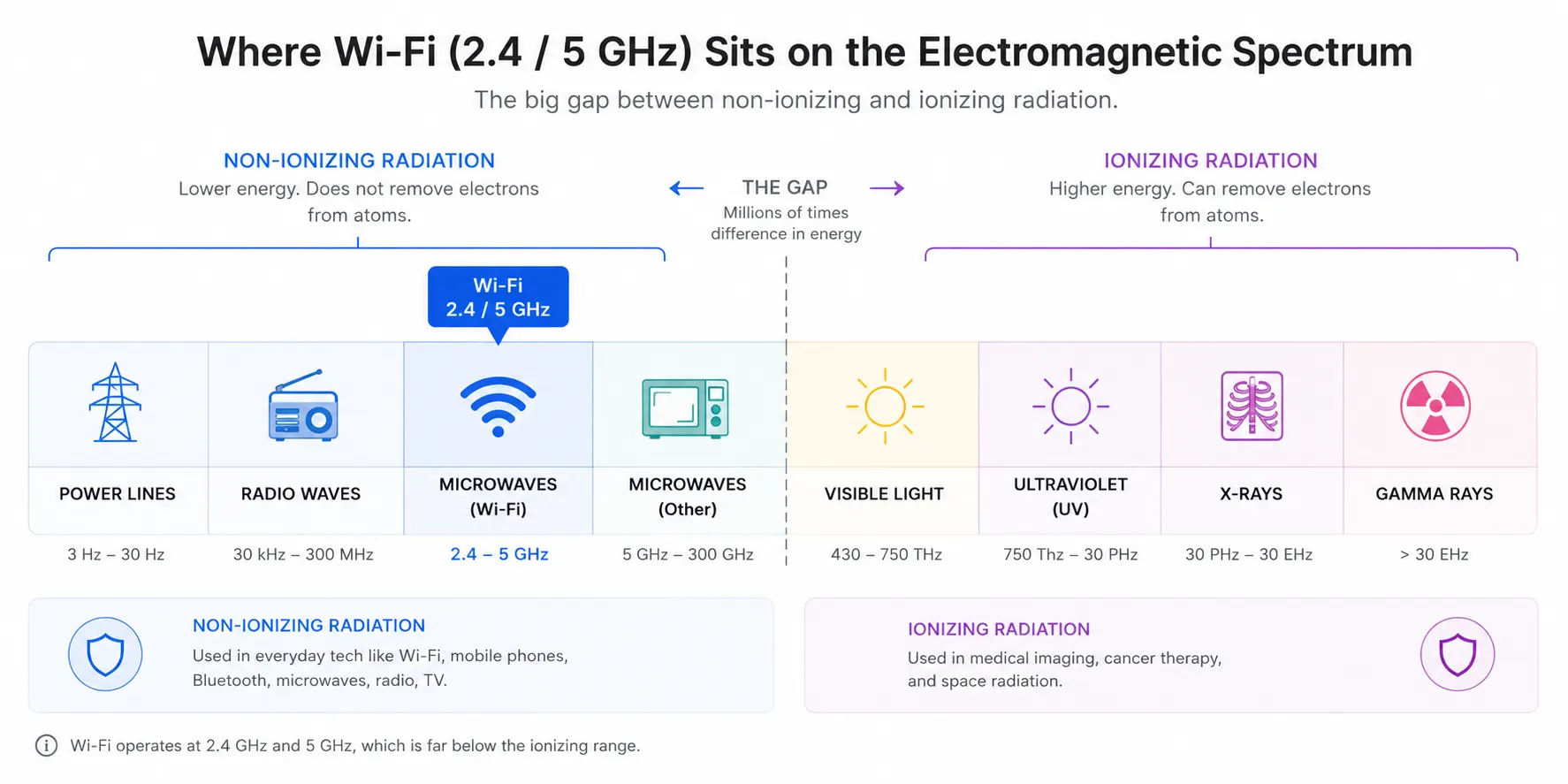
Wifi routers emit non-ionizing radiofrequency (RF) radiation in the 2.4 GHz and 5 GHz bands.
Non-ionizing means it doesn't carry enough energy to break chemical bonds or damage DNA. That's the key difference from ionizing radiation: X-rays and gamma rays, which do carry that kind of energy and are the type actually linked to cellular damage.
Understanding the type of radiation emitted by a Wi-Fi router makes it much easier to separate common myths from what current scientific evidence actually shows.
How much are you actually exposed to?
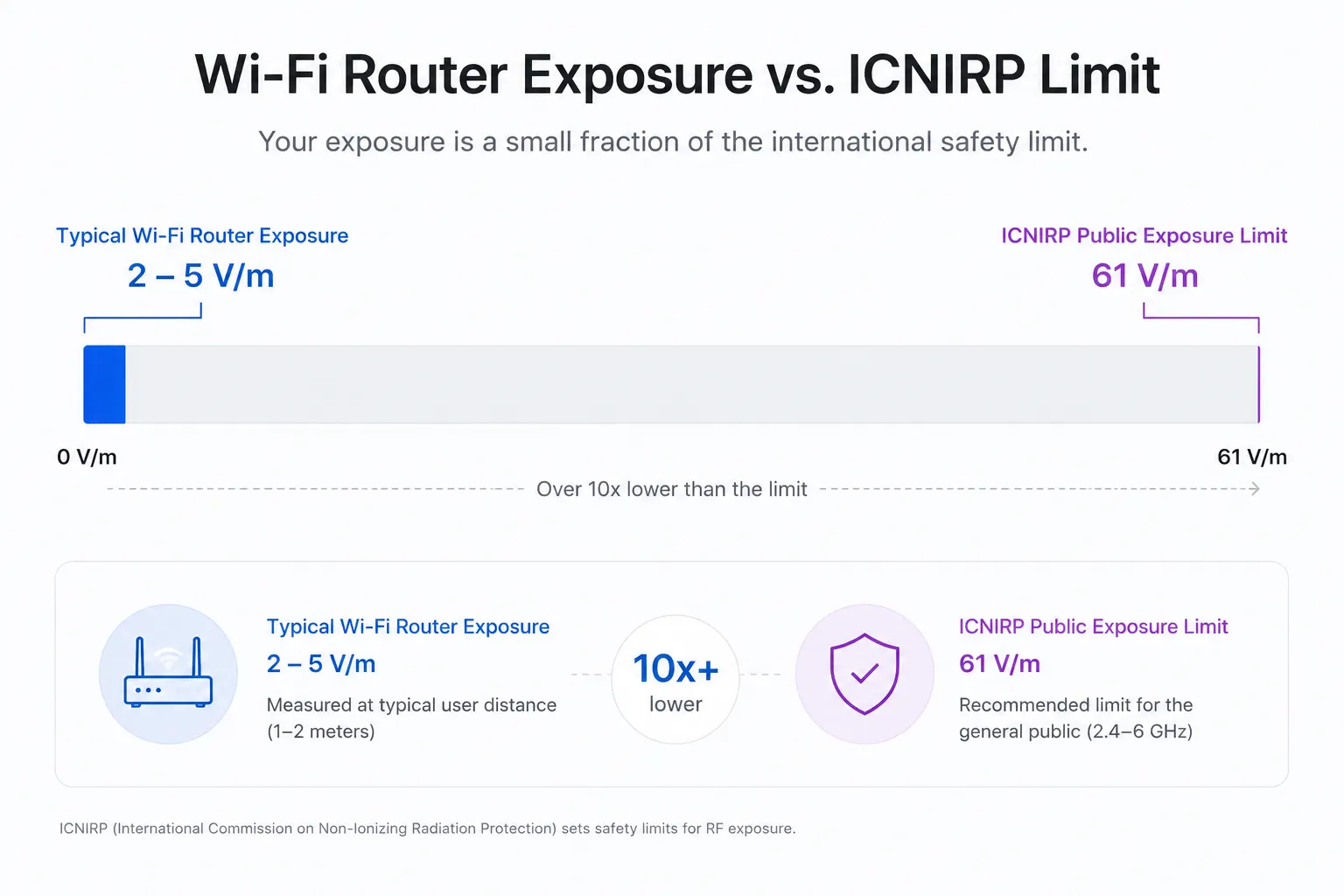
According to Ireland's Environmental Protection Agency, typical indoor exposure from a wifi router measures around:
- 2 V/m at one metre
- 5 V/m at half a metre
The ICNIRP's safety limit for these frequencies is 61 V/m.
So even sitting right next to your router, you're exposed to roughly 1/12th of what international guidelines consider the threshold worth worrying about.
The "cancer" classification, explained properly
The WHO and ICNIRP have both reviewed decades of research and concluded there are no established health effects from wifi exposure at normal levels.
The IARC did classify radiofrequency radiation as "Group 2B, possibly carcinogenic" back in 2011; this is the line that gets quoted the most, usually without the context that makes it meaningful. Two things worth knowing:
- That classification was built on studies of heavy mobile phone use - a device held directly against your head for extended calls, not on router exposure, which is lower-power and at a distance.
- Group 2B is a broad, cautious bucket. It means there's limited evidence that warrants continued research, not proof of harm. It's the same category pickled vegetables sit in.
A few researchers have since argued this classification should be upgraded based on newer studies. IARC has flagged RF radiation as a high priority for re-review sometime in the 2025-2029 cycle, but as of now, the 2011 Group 2B call still stands.
A few researchers have since argued this classification should be upgraded based on newer studies. IARC has flagged RF radiation as a high priority for re-review sometime in the 2025-2029 cycle, but as of now, the 2011 Group 2B call still stands.

Is your router blasting radiation nonstop?
There's a detail most articles on this topic leave out, and it matters: a router isn't transmitting RF energy continuously.
It only transmits when it's actually sending data; this is called duty cycle. One measurement study across 179 real-world locations found routers transmitting for a median of just 1.4% of the time, even with the router running 24x7. This is part of why the real-world exposure numbers above are already low: not despite the router running 24x7, but partly because it isn't transmitting at full power for all those hours.
Your router spends most of its time listening, not talking. It's only actively transmitting for a small fraction of the time it's plugged in.
Your phone matters more than your router?
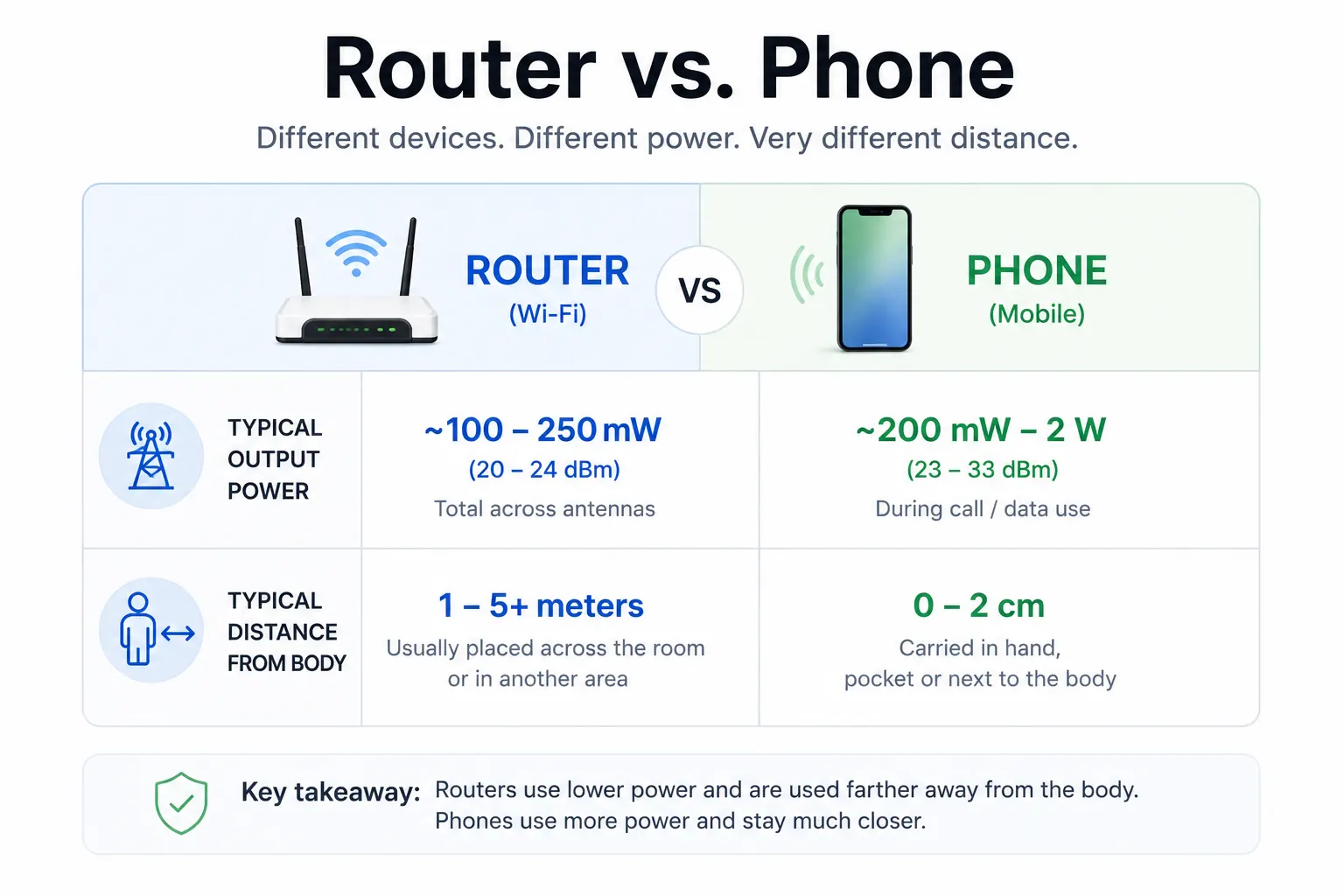
If you're comparing what's actually near your body while you sleep, your phone is a bigger factor than your router.
A phone held to your ear, or kept under a pillow, transmits at higher power and at a much closer range than a router sitting a few feet away ever does. If you're going to be selective about what you keep close to your bed, that's the device worth thinking about first.
If you're worried about what's near your body while you sleep, it's the phone under your pillow, not the router across the room, that actually deserves the thought.
Why "safe distance" numbers online don't agree?
You'll come across a lot of "safe distance" claims. Some say 10 feet, others say 25-35 feet, some say 40-45 feet.
These numbers don't come from any regulatory body. ICNIRP and the FCC set exposure limits, not blanket distance rules, and most of these figures show up on sites selling EMF shielding products. Worth being skeptical of any specific-sounding number that isn't tied to an actual source.
What about people who say they feel it?
A small number of people report headaches, fatigue, or sleep issues they attribute to wifi exposure, a condition sometimes called electromagnetic hypersensitivity (EHS).
The WHO doesn't recognise EHS as a medical diagnosis, and in controlled studies, people who report these symptoms haven't been able to reliably detect when RF exposure is actually present versus absent. That doesn't make the symptoms less real for the person experiencing them; it just means RF exposure isn't the cause.
India-specific context
If you're in India, it's worth knowing that the Department of Telecommunications (DoT) sets SAR (Specific Absorption Rate) limits for mobile phones, and India's limit is stricter than the international default.
Routers aren't SAR-tested the same way phones are, since SAR applies to devices used against or near the body. That's part of why you won't find an "SAR rating" printed on a router box the way you would on a phone.
Precautions worth taking anyway
No established health effects" isn't the same as "proven safe forever." RF research is ongoing, and health agencies that favour a precautionary approach, including Health Canada and the UK's Health Protection Agency, suggest a few basic steps:
- Keep the router at some distance from where you sleep
- Turn it off when you're not using it, if you want to
- Use wired connections where practical
These are sensible habits, not urgent warnings.
The real reason to move your router
Here's the practical angle. If your router is on your bedside table, moving it to another room is a good idea regardless of radiation concerns.
Routers perform better when placed centrally in your home, elevated, and away from obstructions. Sleeping next to one means it's in a corner, which is the worst possible spot for coverage.
So the health question and the performance question have the same answer: don't keep it next to your bed. Not because it's dangerous, but because it's a waste of your router's range.
Sources: Ireland EPA (RF exposure measurements) · ICNIRP (RF exposure guidelines) · WHO/IARC (2011 Group 2B classification, 2011 press release) · WHO EMF fact sheet · India DoT (mobile SAR norms)