
 HD Cameras and Webcam
 Projectors and Speakers
 VOIP Phones and Gateway
 Access Control
 LTE and 5G Devices
 Smart Sensors And Automation
 Fiber and SFP Modules
 Firewall & Cloud Controllers
 Network Adapters and Accessories
 Network Switches
 PoE Switches
 Point To Point Wireless Radio
 Routers
 Wireless Access Points
 IP Cameras
 Memory Cards
 NVR
NVR Smart WiFi Cameras
 Storage Devices
 Desktop & Laptop RAMs
 Internal and External Hard Drives
 Storage Accessories and Enclosures
 SSD and NVMe Drives
 USB Flash Drives


What is an NPU and why every new laptop has one? The AI PC Tax on Indian consumers who don’t need Copilot+.


In this issue of Tech Tomorrow, we look at the NPU, a chip now being forced into every new laptop, and why most buyers in India will be paying a premium for silicon they'll never use.
Before we dive in, if you're someone who enjoys understanding how technology, business, policy, and infrastructure shape the products and services you use every day, join the community if you haven't already. We publish one in-depth edition every two weeks. And if you're already a subscriber, thank you. Consider forwarding this to someone who'd enjoy thoughtful deep dives into the forces powering the country around them.
A ₹45,000 laptop with a Ryzen 5, 16GB RAM, and a 512GB SSD handles Tally, Excel, Chrome with multiple tabs, and Zoom calls without breaking a sweat. It does everything a small business owner, accountant, or student needs a computer to do. It's been the sweet spot for Indian buyers for years.
That laptop is getting harder to find.
Intel's mobile lineup, Core Ultra, ships with an NPU across every SKU. AMD's Ryzen AI 300 series does the same.
If you walk into Croma or search Amazon for a current-generation business laptop today, most of what you'll see carries AI silicon inside, and a price tag to match.
In its place, Intel, AMD, and Qualcomm are shipping processors with a new component baked in: an NPU, or Neural Processing Unit.
It's a dedicated chip on the processor designed to handle AI inference tasks, things like real-time language translation, on-device image generation, and intelligent search, more efficiently than the CPU or GPU alone could.
The CPU still schedules and governs these tasks, but the heavy computation runs on the NPU. Think of it as a separate co-processor inside your processor, purpose-built for running neural network operations.
Intel's Core Ultra 200V series carries an NPU rated at up to 48 TOPS (trillion operations per second). AMD's Ryzen AI 300 series pushes that to 50 TOPS, according to AMD's product specifications. Qualcomm's Snapdragon X Elite hits 45 TOPS.
Every major chipmaker has made the NPU a standard part of its latest processor lineup.
The reasons: Microsoft and the AI hype train.
Microsoft created a hardware category called Copilot+ PC and set a hard floor: to qualify, a laptop needs an NPU capable of at least 40 TOPS, 16GB of RAM, and a 256GB SSD, according to Microsoft's Windows 11 specifications page.
Laptops that meet this threshold unlock a set of exclusive Windows features. Laptops that don't meet the threshold still run full Windows 11, just without the added features.
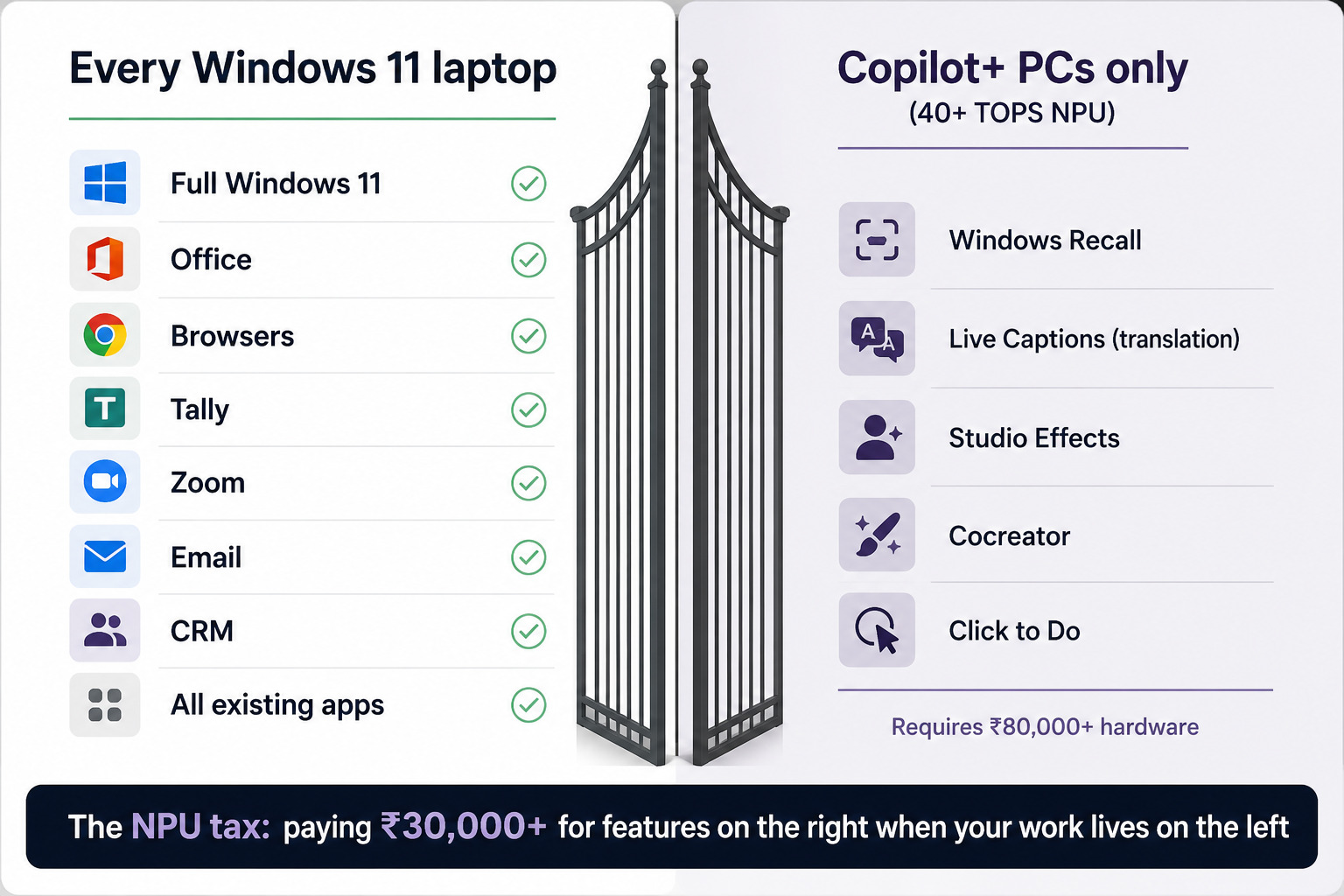
The some of the features locked behind that 40 TOPS gate are actually useful. Features liek Windows Recall, which takes regular screenshots of your PC screen to build a visual timeline, allowing you to easily search for and find anything you looked at or did in the past. Live Captions with real-time translation across 40+ languages. Windows Studio Effects for AI-driven video call enhancements. Cocreator in Paint for AI image generation. And Click to Do, a context-aware action tool rolling out through 2026.
The problem is who they're useful for, and who's being asked to pay for them.
An accountant running Tally Prime and GST software won't use Recall. A college student writing assignments in Google Docs or a network engineer configuring VLANs through a browser-based dashboard won't use Cocreator. A gamer on a handheld or gaming laptop won't either, because no game today runs on the NPU.
For a large share of Indian laptop buyers, the NPU sits idle from the day they power the machine on to the day they replace it.
And idle silicon costs money.
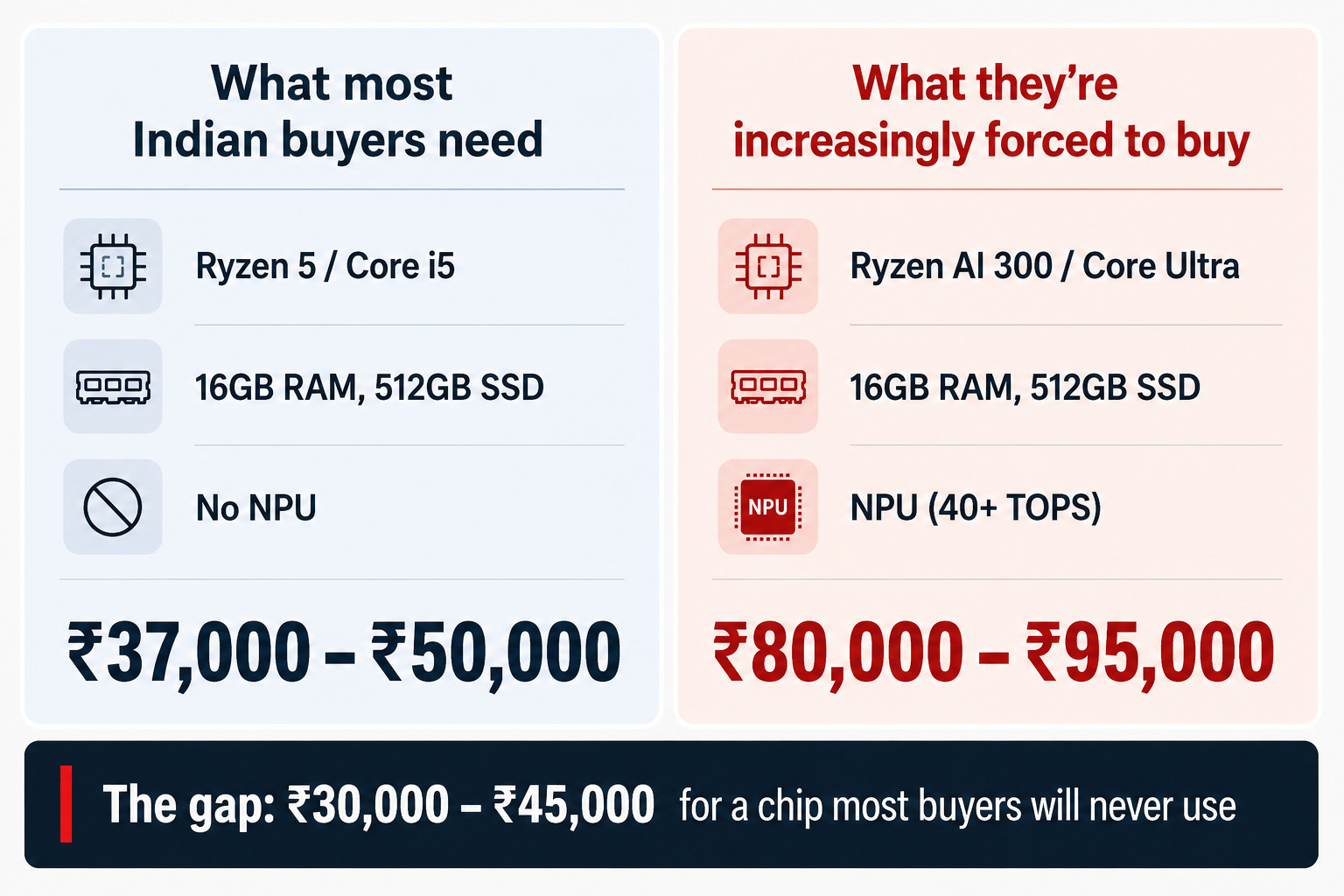
In India, entry-level Copilot+ laptops from HP, Lenovo, and ASUS start at roughly ₹80,000 to ₹95,000. A capable 16GB laptop without NPU-class processors, something with a Ryzen 5 or a 13th-gen Core i5, sits in the ₹37,000 to ₹50,000 band.
The gap between "runs Windows" and "runs Windows AI features" is ₹30,000 to ₹45,000.
For an Indian SMB buying five machines for a new office, that's an extra ₹1.5 to ₹2.25 lakh spent on hardware capabilities nobody in the office will touch.
Budget laptops in the ₹25,000 to ₹35,000 range still run on previous-generation processors and aren't affected today. Those chips remain perfectly capable for everyday workloads, generational improvements in this segment have been marginal for years. The question is how long manufacturers keep them in production as their current lineups shift to NPU-equipped silicon.
The timing makes this worse.
Windows 10 reached end of support in October 2025, which means millions of PCs in India stopped receiving security updates. Businesses and individuals who delayed upgrades are now forced to buy new hardware at price points inflated by components they don't need.
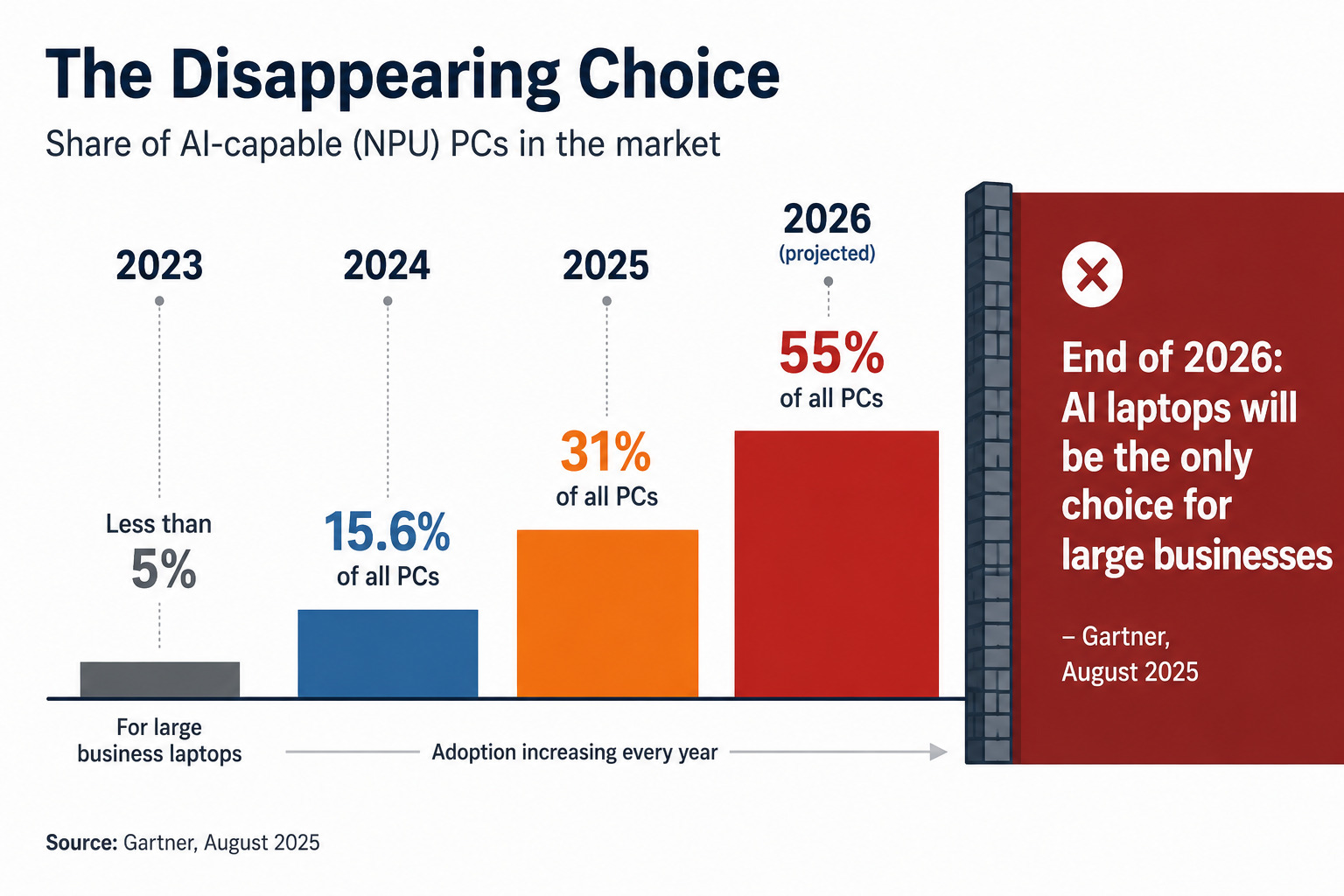
According to Gartner's August 2025 forecast, AI PCs (defined as PCs equipped with an NPU) are projected to represent 55% of total worldwide PC shipments in 2026, up from 15.6% in 2024. For laptops specifically, that number climbs to 58.7%.
Gartner predicts that by the end of 2026, AI laptops will be the only choice available to large businesses purchasing new machines, up from less than 5% in 2023.
Read that last line again. The only choice available.
The NPU isn't being offered as an upgrade. It's being imposed as a baseline.
Consumers – who don't want it, don't need it, and won't use it – are losing the option to say no.
And the software that would justify the hardware hasn't arrived yet.
Gartner's same forecast notes that only 2% of software vendors invested in AI capabilities on PCs in 2024. That figure is expected to reach 40% by the end of 2026, but "expected to" and "has" are very different things.
For example, Apple has been promising on-device AI Siri since the iPhone 15 days. Two hardware generations and a class action lawsuit later, Apple has agreed to compensate users for not delivering on the promised features.
Tally doesn't use the NPU. Most CRM, billing, and inventory tools Indian businesses run daily don't use the NPU.
The chip is there, drawing a few watts, doing nothing, while the apps that could put it to work are still a roadmap bullet point.
There's also a reasonable counter-argument. NPUs could become essential.
On-device AI is genuinely more private than cloud-based AI because your data stays on your machine. Local processing is faster than a round trip to a server. And if software catches up, a laptop bought today with an NPU could age better than one without.
Running a small language model locally, doing real-time transcription without an internet connection, having your laptop understand context across your files – they're technically possible on 40+ TOPS hardware.
The question is whether that future arrives within the usable life of the laptop you're buying today.
Most Indian consumers keep a laptop for three to four years. If the NPU becomes meaningfully useful in year four, you've paid a ₹30,000+ premium for one year of relevance. If it becomes useful in year five, after you've already replaced the machine, the premium bought you nothing at all.
There's also a compatibility wrinkle worth knowing about.
Qualcomm's Snapdragon X processors use ARM architecture instead of the x86 architecture that Intel and AMD use.
x86 is the processor instruction set that Intel introduced in 1978, and that has run virtually every Windows PC since. ARM is a different instruction set, originally designed for mobile phones, built around lower power consumption.
Windows runs most traditional x86 applications on ARM through an emulation layer called Prism. Still, some specialised software, certain VPN clients, older enterprise tools, niche Indian accounting and billing packages, can behave unpredictably or refuse to run entirely.
If your workflow depends on legacy Windows software, a Snapdragon-based Copilot+ PC might create new problems while solving none.
So what should an Indian Tech buyer do right now?
If your work is email, browsers, Office, Tally, and Zoom, a ₹45,000 to ₹55,000 laptop with a current-gen Ryzen 5 or Core i5 and 16GB RAM covers you for three to four years. The NPU, for this workload, does not matter.
If you do professional creative work, video editing, or run local AI models, a Copilot+ PC makes sense and the NPU will earn its keep.
If you're buying a fleet, audit what your team runs. Most Indian SMB workloads live entirely in browsers and lightweight desktop apps.
The NPU is a genuinely capable piece of engineering. For developers, creators, and power users can leverage the on-device neural processing to their advantage. It changes what a laptop can do without an internet connection.
But for the vast majority of India's laptop buyers, it's a tax on a future that hasn't arrived, bundled into hardware they can't opt out of, at a price they shouldn't have to pay.
And that gap, between what the chip can do and what the buyer needs it to do, is only going to widen until the software catches up or the pricing comes down.
One of those will happen first. The industry is betting on software. The bill, for now, lands on the buyer.
If this changed how you think about what's inside your next laptop, share it on WhatsApp or LinkedIn.
This story was shaped by conversations with Bhanu Sharma, whose input on the real-world gap between AI hardware marketing and everyday use cases informed much of this piece.