
 HD Cameras and Webcam
 Projectors and Speakers
 VOIP Phones and Gateway
 Access Control
 LTE and 5G Devices
 Smart Sensors And Automation
 Fiber and SFP Modules
 Firewall & Cloud Controllers
 Network Adapters and Accessories
 Network Switches
 PoE Switches
 Point To Point Wireless Radio
 Routers
 Wireless Access Points
 IP Cameras
 Memory Cards
 NVR
NVR Smart WiFi Cameras
 Storage Devices
 Desktop & Laptop RAMs
 Internal and External Hard Drives
 Storage Accessories and Enclosures
 SSD and NVMe Drives
 USB Flash Drives


Can 5G Home Internet Replace WiFi? (Honest 2026 Answer for India)

If you have been searching “can 5G home internet replace WiFi,” you are asking the wrong question, and here is why the confusion exists: most people do not realize that 5G and WiFi are not competing technologies. They actually work together.
Think of it like asking, “can electricity replace light bulbs?” 5G is the power source (like your electrical connection), while WiFi is how that power gets distributed inside your home (like the light fixtures). Both fiber internet routers and 5G home internet routers CREATE WiFi networks.
The real question you should be asking is: “Can 5G FWA (Fixed Wireless Access) replace fiber broadband?”
That is what we are going to answer honestly. No sales pitch, no vague “it depends”—just real data from India’s rapidly growing 5G home internet market, projected to reach 30 million users by 2027, making India the world’s largest 5G FWA market.
Learn everything about 5G routers in our comprehensive buyer's guide.
Here is what you will discover:
- Why the terminology “5G vs WiFi” is fundamentally confused
- The 1TB FUP reality that Jio/Airtel ads do not highlight (and whether it will actually affect you)
- Real-world speed and latency comparisons—not marketing numbers
- Exactly who should switch to 5G home internet and who absolutely should not
- The hybrid approach almost nobody talks about
By the end, you will know whether 5G home internet is right for YOUR situation, or if fiber remains the smarter choice.
The fundamental confusion: What people really mean when they search “5G home internet vs WiFi”
Before we dive into whether 5G home internet can replace your current setup, we need to clear up the biggest source of confusion: 5G cellular is NOT the same as 5GHz WiFi. This mix-up trips up even tech-savvy people.
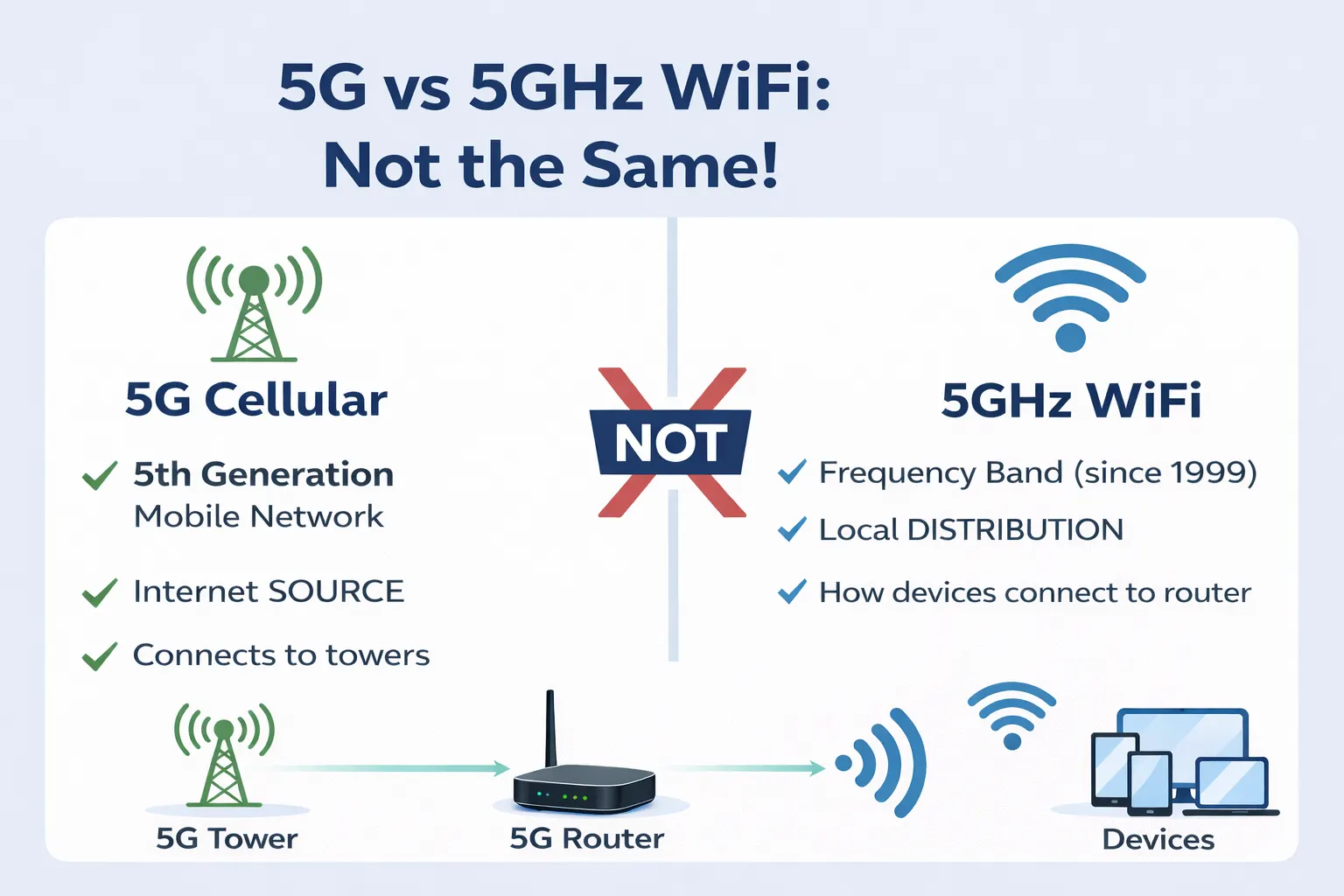
5G Cellular: This is the fifth generation of mobile network technology; the same 5G your phone uses when browsing on Jio or Airtel network. When we talk about 5G home internet, we are talking about using this cellular technology to power your home internet instead of a fiber cable.
5GHz WiFi: This is simply a frequency band (5 gigahertz) that WiFi routers have been using since 1999. It has nothing to do with 5G cellular networks. Your current fiber WiFi router probably already broadcasts both 2.4GHz and 5GHz WiFi bands.
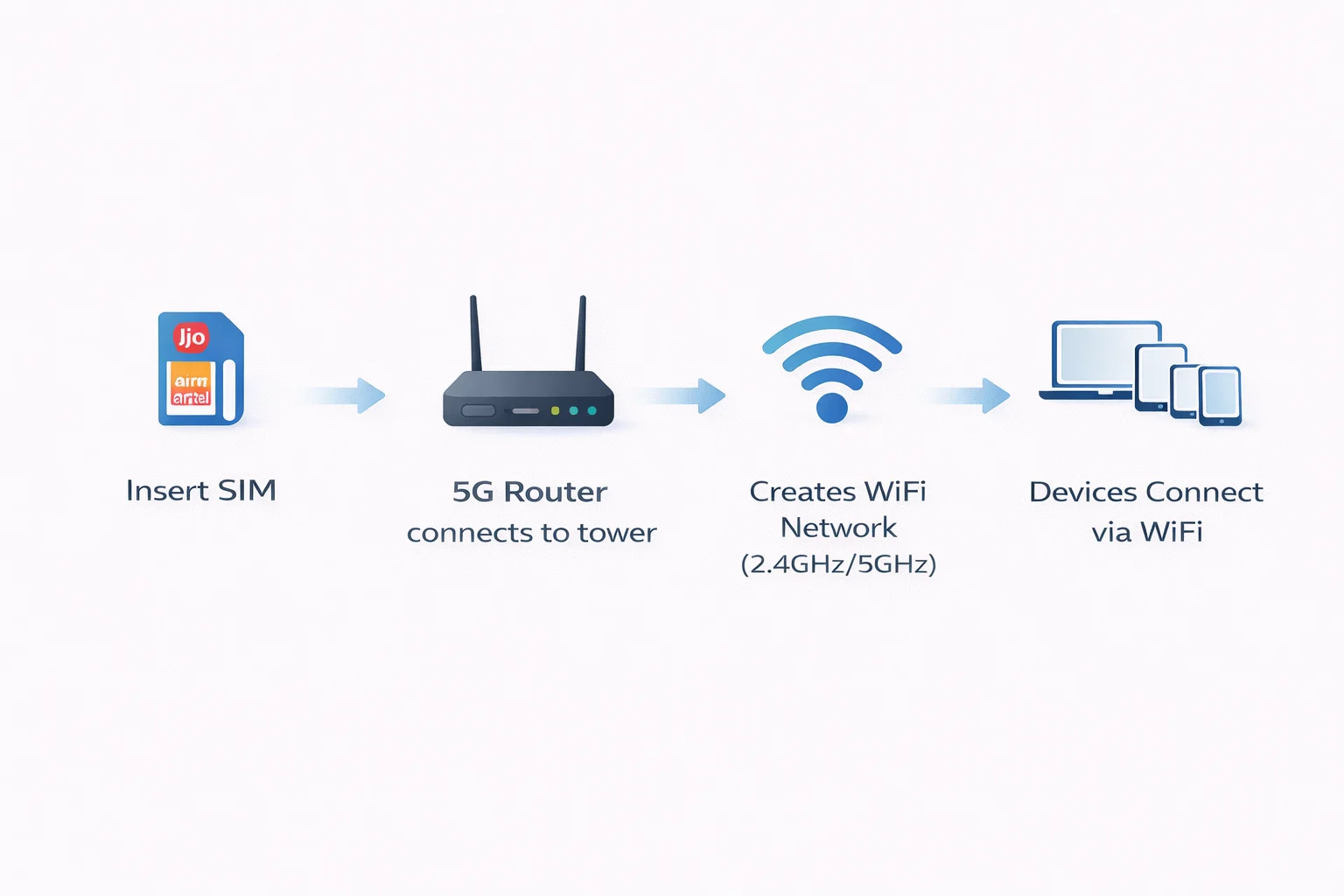
Here is how 5G home internet actually works:
- A 5G router accepts a SIM card (just like your phone)
- The router connects to nearby 5G cell towers
- The router then creates a WiFi network inside your home (using 2.4GHz/5GHz bands)
- Your devices (phone, laptop, TV) connect to this WiFi network, exactly like they would with fiber
5G does not replace WiFi; it powers it. Just like fiber internet does not replace WiFi; it provides the internet connection that your WiFi router distributes. Whether you have fiber or 5G providing the internet, you will still have a WiFi network at home.
So when we ask “can 5G home internet replace your home WiFi,” what we are really comparing is 5G FWA (Fixed Wireless Access) versus fiber broadband as your internet source. Both will still give you WiFi in your home.
5G Home Internet in India 2026: From experimental to mainstream reality
Here’s something most people will not tell you: India is becoming the world’s largest 5G FWA market, and 5G home internet here is not experimental; it is a legitimate alternative to fiber.
The numbers tell the story:
- 9.5 million subscribers on Jio AirFiber alone (world’s largest 5G FWA operator)
- Projected to hit 30 million+ users by 2027
- 469,000 5G base stations deployed across India
- Coverage in 779 out of 783 districts (99.9%)
- 43% of mobile data traffic in metros now runs on 5G
Why is India different from the US or Europe? In those markets, 5G home internet is seen as “backup technology”. In India, it is mainstream because:
- Fiber infrastructure gaps - Many tier-2/3 cities lack fiber
- Mobile-first economy - Indians trust cellular networks
- Competitive pricing - Jio/Airtel aggressively price FWA to compete with fiber
- Rapid deployment - 5G reaches new areas faster than laying fiber cables
This context matters because recommendations for “should I switch to 5G home internet?” depend heavily on which country you are in. What works in Bangalore might not work in Boston.
Speed, Latency & Performance: The real-world comparison
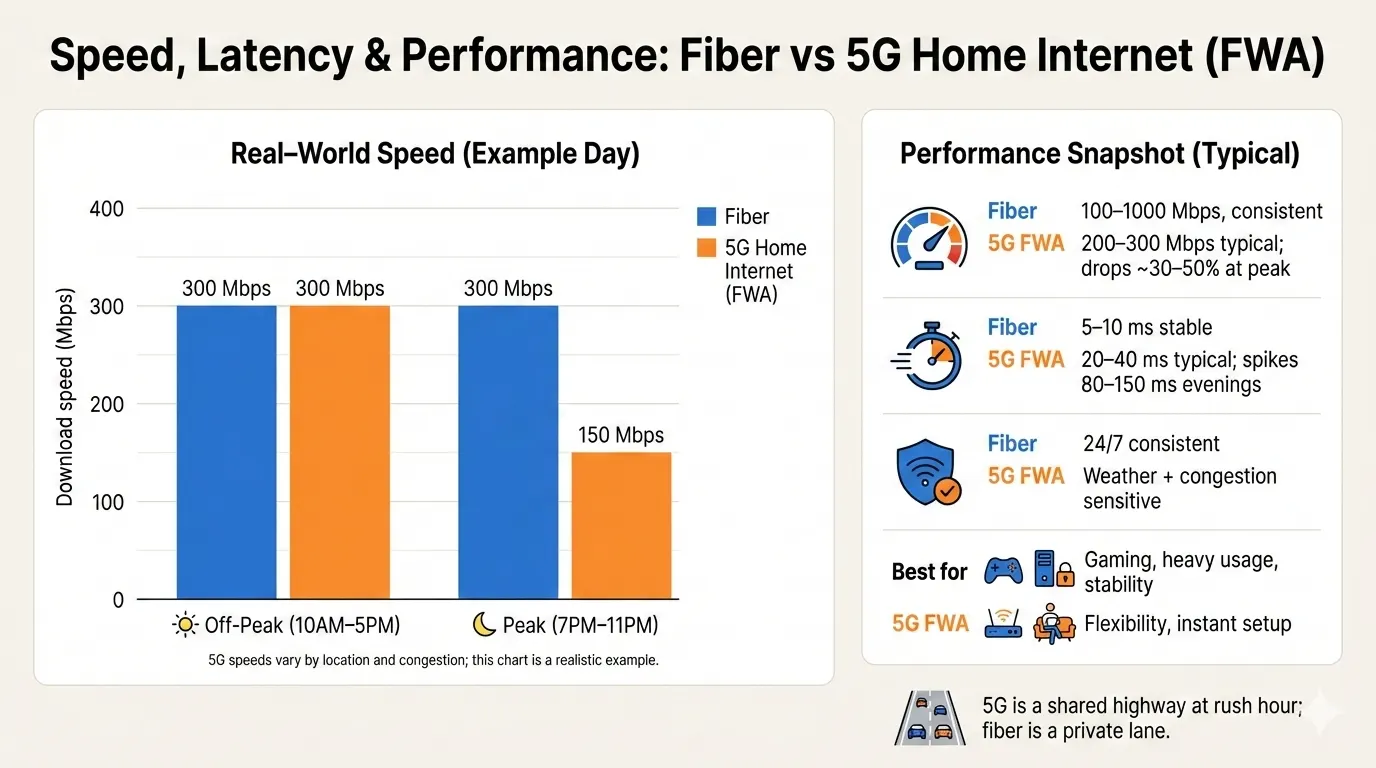
Let’s cut through the marketing. Here is what 5G home internet actually delivers versus fiber broadband in Indian conditions:
| Metric | Fiber Broadband | 5G Home Internet (FWA) |
|---|---|---|
| Speed (Typical) | 100–1000 Mbps consistent |
200–300 Mbps (drops 30–50% at peak hours) |
| Latency (Ping) | 5–10 ms stable |
20–40 ms (spikes to 80–150 ms evenings) |
| Reliability | 24/7 consistent | Weather & congestion sensitive |
| Best For | Heavy usage, gaming, stability | Flexibility, instant setup |
Headline speeds vs Daily reality
Jio and Airtel market their 5G home internet plans with speeds up to 1 Gbps. That is technically true but misleading.
Real-world performance:
- Off-peak hours (10 AM - 5 PM): 200-400 Mbps typical
- Peak hours (7 PM - 11 PM): Drops by 30-50%
- Reason: You are sharing cell tower capacity with 200-300 other homes
- Fiber delivers advertised speeds 24/7 (dedicated line)
Think of 5G home internet like a shared highway. During rush hour (evenings), everyone is commuting, so traffic slows down. Fiber is like having your own private lane; speed stays constant regardless of how many others are on the road.
Latency & real-time applications
For video calls, gaming, and live streaming, latency (delay) matters more than speed. Here is the uncomfortable truth about 5G home internet:
- Fiber: 5-10ms ping (stable)
- 5G FWA: 20-40ms typical, spikes to 80-150ms during congestion (peak hours)
- For Zoom calls: Both work fine (under 150ms is acceptable)
- For competitive gaming: Fiber wins decisively.
Bottom line: If you are a casual user (Netflix, browsing, occasional calls), 5G home internet performs great. If you are a pro gamer or run a home-based business with critical video calls, fiber’s stability justifies the extra cost.
Unlimited’ Reality Check: Will unlimited 5G home internet be enough?
This is one of the most important factors in deciding if 5G home internet will work for you.
FUP Limits: What “Unlimited” actually means
Every Jio AirFiber and Airtel Xstream 5G home internet plan in India comes with a Fair Usage Policy (FUP):
- ALL consumer plans on AirFiber: 1TB (1,000 GB) monthly limit
- After 1TB: ⦁ Jio drops to 64 Kbps, Airtel to 2 Mbps
- No option to buy additional data on FWA plans
- Fiber comparison: Airtel Fiber has 3,333 GB limit - 3.3x more data
Average data consumption in India (2026)
Will 1TB be enough for YOUR household? Here is the data:
- Average FWA household: 330-400 GB/month (within 1TB limit)
- Heavy streaming family (4K Netflix daily): 1,200-1,400 GB/month (EXCEEDS limit)
- Average Indian mobile user: 27.5 GB/month
- 5G users consume 2.7x more data than 4G users (faster speeds = more usage)
Activity based data usage breakdown
| Activity | Data Usage | Monthly (30 days @ 2 hrs/day) |
|---|---|---|
| 4K streaming (Netflix, Prime) | 7–8 GB/hour | 420–480 GB |
| HD streaming (1080p) | 3 GB/hour | 180 GB |
| SD streaming (480p) | 1 GB/hour | 60 GB |
| Video calls (Zoom, Teams) | 1 GB/hour | 60 GB |
| Online gaming | 50–100 MB/hour | 3–6 GB |
| Browsing, social media | 100 MB/hour | 6 GB |
Will 1TB work for YOUR household? Real scenarios
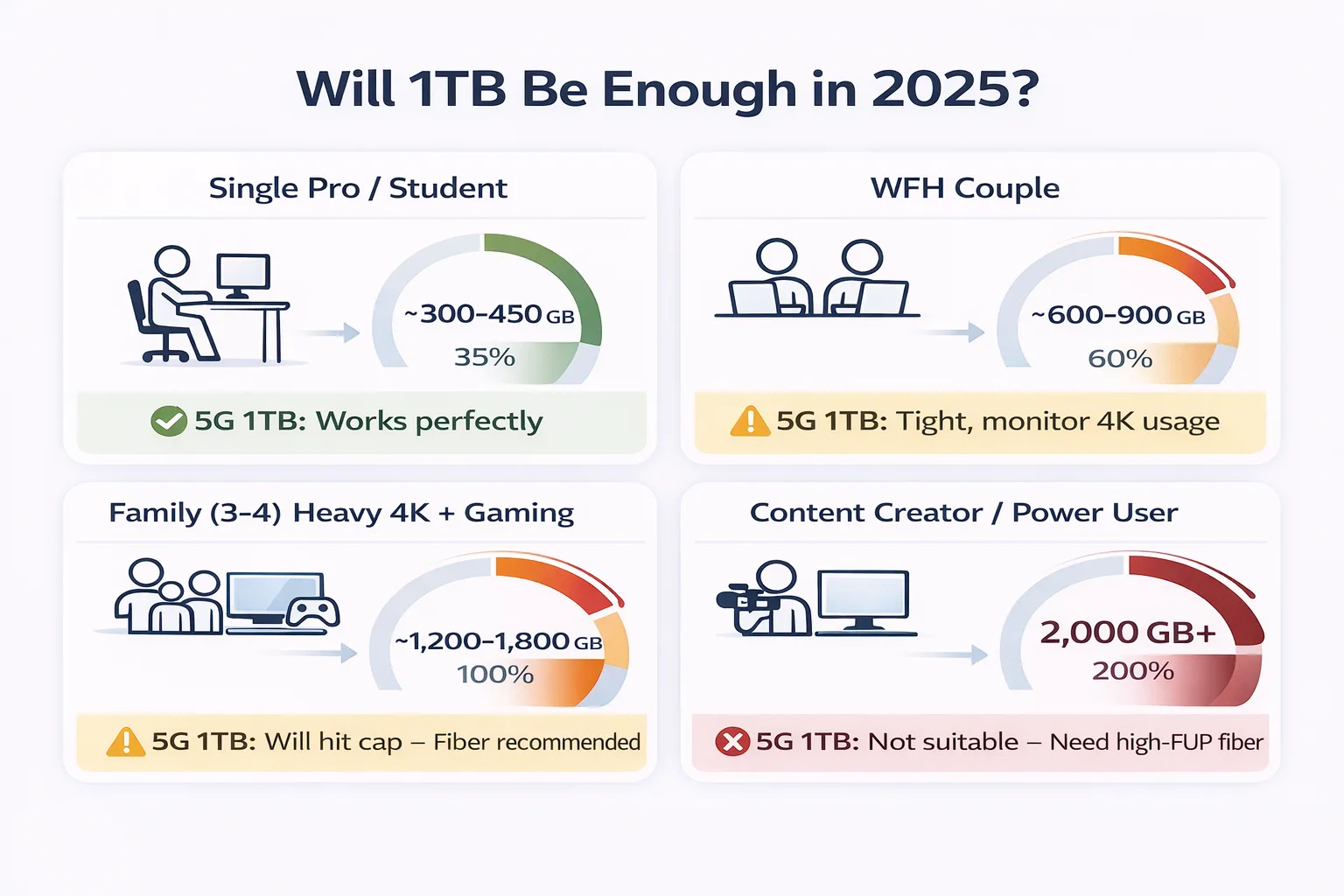
Scenario 1: Single pro/student (mix of HD and some 4K)
Usage assumption:
- 2–3 hours/day of streaming (mix of 1080p and occasional 4K) = 6–15 GB/day
- 1–2 hours/day of HD calls/classes = 1–5 GB/day
- Browsing, socials, app updates = 0.5–1 GB/day
Monhtly: ~300–450 GB.
Verdict: 5G home internet works perfectly
Scenario 2: Couple, both work from home (HD calls + HD/4K streaming)
Usage assumption:
- Video calls: 3–4 hours/day (total 6–8 hours) ≈ 8–16 GB/day
- Streaming: 2–3 hours/day total, often 1080p/4K mix ≈ 10–25 GB/day
- Browsing, updates, phones, tablets, etc.: 1–2 GB/day.
Monthly: roughly 600–900 GB
Verdict: 5G home internet works but is tight; a 1TB cap is OK; avoid constant 4K and keep an eye on usage.
Scenario 3: Family of 3–4, heavy 4K + gaming
Usage assumption:
- 4K streaming 4–5 hours/day across TV/devices ≈ 30–50 GB/day.
- Online gaming + downloads/updates: easily 10–20 GB/day averaged over a month
- Phones, tablets, laptops in background use: 3–5 GB/day.
Monthly: around 1,200–1,800 GB
Verdict: Will hit 1TB FUP almost every month on 5G; wired fiber with 3,333 GB FUP is strongly recommended.
Scenario 4: Content creator/power user (one person or shared home)
Usage assumption:
- Regular 4K streaming and consumption: similar to Scenario 3 for one TV.
- Uploading videos/streaming/cloud backup: can easily add hundreds of GB per month alone.
- Large downloads (games, raw footage, project files): 500 GB–1 TB+ per month is common for serious creators.
Monthly: often 2,000 GB+
Verdict: 5G home internet with 1TB FUP is not suitable; Realistic need is awired fiber (or business‑grade) with a much higher FUP like Airtel’s 3,333 GB on fiber.
Setup, Installation & Flexibility: Where 5G home internet wins big
If speed and data caps favor fiber, where does 5G home internet shine? Setup and portability.
| Technology | Setup Time | Installation Cost | Technical Skill | Portability |
|---|---|---|---|---|
| Fiber Broadband | Days to weeks | ₹1,000 – 2,000 | Technician required | Fixed location |
| 5G Home Internet | Same day | ₹0 | Plug-and-play | Take anywhere |
This matters if you:
- Rent and move frequently (students, young professionals)
- Need internet TODAY (just moved, emergency backup)
- Live in a location where the landlord will not allow fiber installation
- Want backup internet for critical work-from-home needs
- Travel between two locations (city apartment + hometown)
Example: Ravi just got a job in Bangalore and needs internet at his new flat today. With 5G home internet, he buys a router, inserts his SIM, and is online in 10 minutes. Fiber would take at least 5-7 days.
Cost Comparison: Beyond the monthly plan price
Let’s talk money. At first glance, 5G home internet and fiber seem similarly priced. But the 24-month total cost reveals hidden differences.
Monthly plan pricing (India 2026)
| Provider | Speed | Monthly Cost | FUP Limit |
|---|---|---|---|
| Jio AirFiber (5G) | 300 Mbps | ₹1,499 | 1 TB |
| Airtel AirFiber | 100 Mbps | ₹899 | 1 TB |
| Jio Fiber (5G) | 300 Mbps | ₹1,499 | 1 TB |
| Airtel Fiber | 300 Mbps | ₹1,599 | No cap shown |
24-Month total cost of ownership
5G Home Internet (Jio/Airtel 300 Mbps FWA, ~₹1,499 plan):
- Router cost: Included / small deposit
- Monthly: ₹1,499 x 24 = ₹35,976
- Installation/activation: Typically ₹0–₹3,000 (varies by offer, often waived)
- Total: ~₹36,000–₹39,000 over 24 months (before taxes)
5G SIM Router (true standalone 5G CPE with SIM, e.g., Four‑Faith / ZENIQ class):
- Router cost: ~₹10,000–₹30,000 one‑time for proper 5G hardware, not the cheap “MiFi” style boxes
- Monthly: ~₹800–₹1,500 x 24 = ₹19,200–₹36,000 for a mobile plan big enough to replace home broadband
- Installation: ₹0 self‑mounted / self‑installed
- Total: ~₹30,000–₹76,000 over 24 months (before taxes)
Airtel Fiber (₹799–₹1,599 plans, 100–300 Mbps):
- Router cost: ₹0 (ISP router included on rental; you can optionally buy a better Wi‑Fi 6 router for ₹3,000–₹7,000)
- Monthly: ₹799–₹1,599 x 24 = ₹19,176–₹38,376
- Installation: ~₹0–₹1,500 (often waived on long‑term payment or promo)
- Total: ~₹19,000–₹40,000 with ISP router, or ~₹22,000–₹47,000 if you also buy your own high‑end router (before taxes)
Cost verdict: Fiber is usually the best value: lower or similar total cost, “unlimited” data, and the option to upgrade the router. Operator 5G FWA (Jio/Airtel boxes) costs roughly the same as mid/high‑tier fiber but comes with a 1TB cap, so you pay for portability and easier relocation. True 5G SIM routers are a little expensive option over 24 months, and only make sense for niche cases where fiber is not available or you specifically need that kind of hardware.
Who should choose what: Honest answer
Let’s cut through the noise. Here is exactly who 5G home internet works for—and who should stick with fiber.
Choose 5G Home Internet if:
- No Fiber Availability: Your area does not have fiber coverage (tier-2/3 cities, new developments)
- Temporary accommodation: You are renting for a temporary period of time, or a student in temporary housing
- Light-moderate data usage: single/couple, no heavy 4K streaming
- Instant setup need: You need internet TODAY (just moved, cannot wait for fiber installation)
- Backup internet: You want a redundant connection for critical work (hybrid setup with fiber)
Choose Fiber broadband if:
- Heavy data consumption: You exceed 800 GB/month
- 4K Streaming Enthusiasts: You watch Netflix/Prime in 4K regularly
- Gaming or Low-Latency Needs: You play competitive games or need stable ping for professional work
- Content Creators: You upload large videos, do cloud backups, or download big files
- Multi-User WFH Household: Multiple family members on video calls simultaneously
- Long-Term Stability: You will stay at the same address 2+ years and want predictable costs
Hybrid approach: Why not both?
For critical work-from-home setups or small businesses, consider running both:
- Primary: Fiber broadband (main connection)
- Backup: 5G home internet on a cheaper ₹599/month plan
- Total cost: ~₹1,400/month for 99.9% uptime
- Use case: If your internet goes down, you lose ₹10,000+ in work - redundancy pays for itself
Decision Framework: Steps to choose between 5G home Internet and fiber
Follow these steps to make the right choice:
Step 1: Check availability - Verify 5G coverage in your area (use Jio/Airtel network check) - Check fiber ISP availability (Airtel, ACT, Local ISPs) - Test 5G speeds with your mobile phone at your location
Step 2: Calculate your data consumption - Check last month’s usage from current ISP dashboard - Use the estimates above based on activities - Add 20% buffer for future growth - If >800 GB/month: Fiber is safer
Step 3: Evaluate your priorities - Need internet immediately? → 5G home internet - Moving in next 12 months? → 5G home internet - Heavy 4K streaming or gaming? → Fiber - Work-from-home with critical calls? → Fiber
Step 4: Budget reality check - Calculate 24-month total cost (use examples above) - Factor in router purchase for 5G - Consider opportunity cost of downtime
The honest answer: Can 5G Home Internet replace WiFi?
Let’s answer the original question clearly:
5G home internet CAN replace fiber broadband for many Indian households, but not all. The 1TB FUP limit and peak hour speeds are the real differentiators.
It works brilliantly for:
- 70% of households that use <600 GB/month
- Singles, students, or couples without heavy 4K streaming
- People who rent or move frequently
- Areas without fiber availability
- Anyone needing internet immediately
It is NOT suitable for:
- Families exceeding 800 GB/month
- Heavy 4K streaming households (Netflix/Prime daily)
- Competitive gamers needing low latency
- Content creators uploading large files
- Work-from-home professionals needing guaranteed stability
Bottom line: 5G home internet is a legitimate alternative to fiber in India; not a compromise. But choose based on YOUR needs and data consumption patterns, not marketing hype. The 1TB limit will either be a non-issue or a deal-breaker, depending on your household usage.
Ready to shortlist models? Browse FGTech Store’s complete selection of 4G LTE and 5G routers to compare and buy from our full range.
Frequently Asked Questions
Does a 5G router create WiFi, or do I need a separate WiFi router?
Yes, a 5G router creates a WiFi network. You do not need a separate WiFi router. The 5G router connects to cellular towers for internet, then broadcasts WiFi (both 2.4GHz and 5GHz bands) for your devices. It is an all-in-one solution.
Is 5G home internet truly “unlimited”?
No. All Jio and Airtel 5G home internet plans have a 1TB monthly FUP (Fair Usage Policy). After 1TB, Jio throttles to 64 Kbps, Airtel to 2 Mbps. There is no option to purchase additional data.
What happens when I exceed the 1TB limit?
Your internet becomes frustratingly slow. 64 Kbps cannot load websites properly. 2 Mbps might handle basic browsing, but not streaming. You will have to wait until the next billing cycle for speeds to be restored.
Should I switch from fiber to 5G home internet?
Only if: (1) You use <800 GB/month, (2) You value portability over stability, (3) Fiber costs significantly more in your area. For most established households with heavy usage, fiber remains the better choice.
Can I use a 4G WiFi router with a 5G SIM?
Technically yes, but you will only get 4G speeds. A 4G WiFi router lacks the modem chipset to decode 5G signals. To get 5G speeds, you need a 5G-capable router.
Which is better for gaming - 5G home internet or fiber?
Fiber wins for competitive gaming due to lower, more stable latency (5-10ms vs 20-150ms). Casual mobile gaming works fine on 5G home internet. Read our dedicated gaming guide for details. Check out our detailed article on 5G Router for Gaming
Can I take my 5G home internet router to a different city?
Yes, that is the main advantage. As long as there is 5G coverage, your router works. This makes 5G home internet perfect for people who travel between cities or move frequently.
Is 5G radiation from the router harmful?
No. 5G routers emit the same type of non-ionizing radiation as your phone and WiFi router. Radiation levels are well below safety limits set by international bodies. The fear around 5G radiation is largely unfounded.