
 HD Cameras and Webcam
 Projectors and Speakers
 VOIP Phones and Gateway
 Access Control
 LTE and 5G Devices
 Smart Sensors And Automation
 Fiber and SFP Modules
 Firewall & Cloud Controllers
 Network Adapters and Accessories
 Network Switches
 PoE Switches
 Point To Point Wireless Radio
 Routers
 Wireless Access Points
 IP Cameras
 Memory Cards
 NVR
NVR Smart WiFi Cameras
 Storage Devices
 Desktop & Laptop RAMs
 Internal and External Hard Drives
 NAS Storage & Enclosures
 SSD and NVMe Drives
 USB Flash Drives


Two 8 port switch vs One 16 port switch – Is it better to get two 8 port switch instead of one 16 port?

For most home networks, home labs, and small offices, one 16-port switch is usually the better choice than two 8-port switches. A single switch is simpler to manage, uses less power, avoids bottlenecks between switches, and gives every device direct access to all available ports. However, two 8-port switches can make sense when devices are spread across different rooms or when you want to expand your network gradually instead of paying for a larger switch upfront.
Advantages and Disadvantages: Two 8 port switch vs one 16 port switch
Option | Advantages | Disadvantages |
|---|---|---|
One 16-Port Switch | Simpler network design, fewer cables, easier troubleshooting, lower overall power consumption, all devices communicate through the same switch fabric | Higher upfront cost, must be installed in a single location, less flexibility if devices are spread throughout a building |
Two 8-Port Switches | Can be placed in different rooms, easier to expand gradually, potentially lower initial cost if you only need 8 ports today | Requires an uplink between switches, more cables, more power adapters, additional management complexity, potential bottlenecks between switches |
Why One 16-Port Switch Is Generally Better
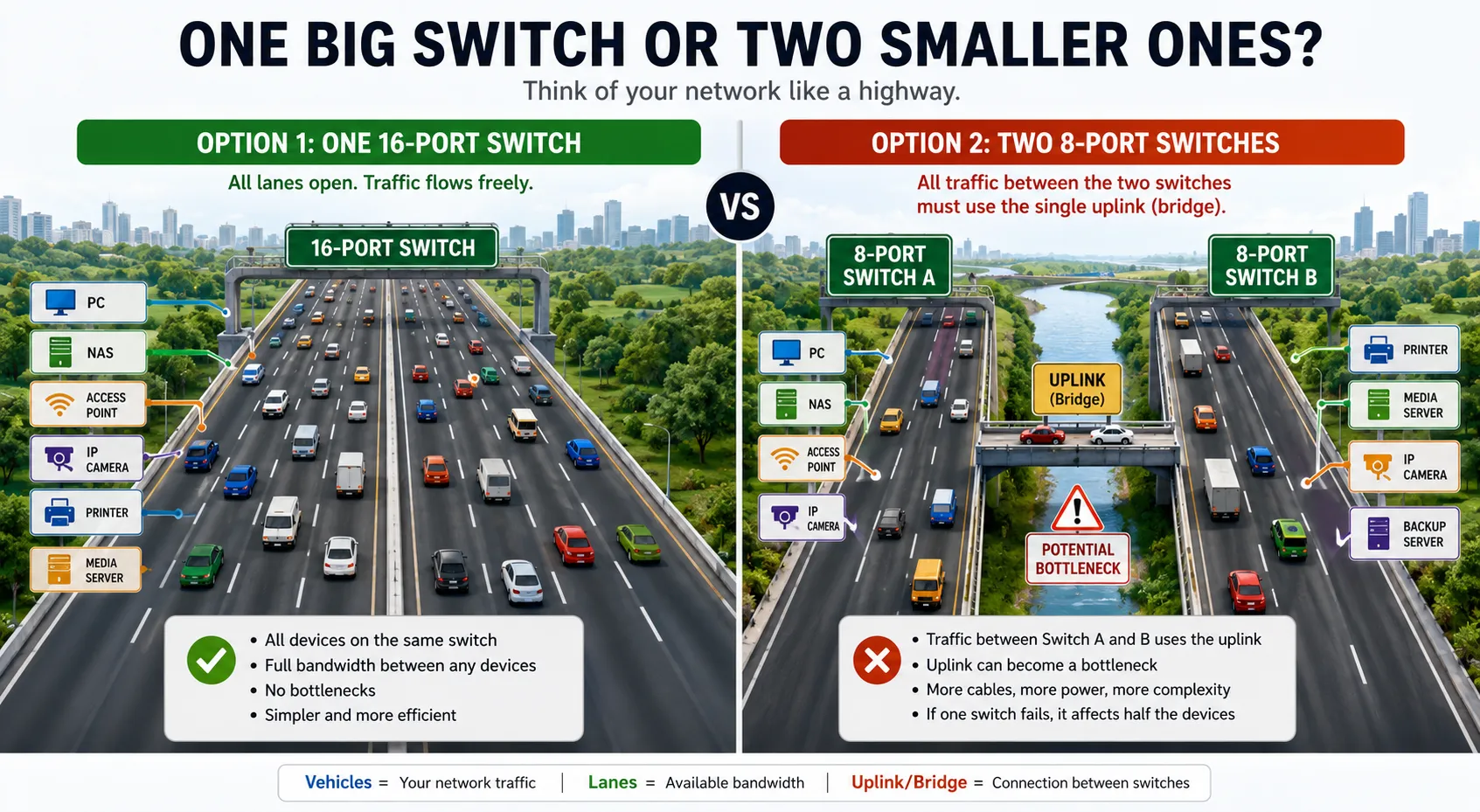
The biggest advantage of a 16-port switch is that everything stays on a single switching fabric. Devices can communicate directly without traffic needing to pass between multiple switches. This reduces complexity and eliminates the uplink bottleneck that exists when two switches are connected together.
For example, imagine a NAS, desktop PC, media server, security cameras, and access points all connected to the same 16-port switch. Traffic can move freely between devices at full switch speed. With two 8-port switches, communication between devices connected to different switches must travel through the single link connecting them.
A single switch also means:
- Fewer failure points
- Less cable clutter
- Easier troubleshooting
- Lower power consumption
- Simpler network documentation
In most cases, if all your equipment is located in the same rack, cabinet, or room, a 16-port switch provides the cleaner and more efficient solution.
When Two 8-Port Switches Make Sense
There are situations where two 8-port switches are the smarter choice.
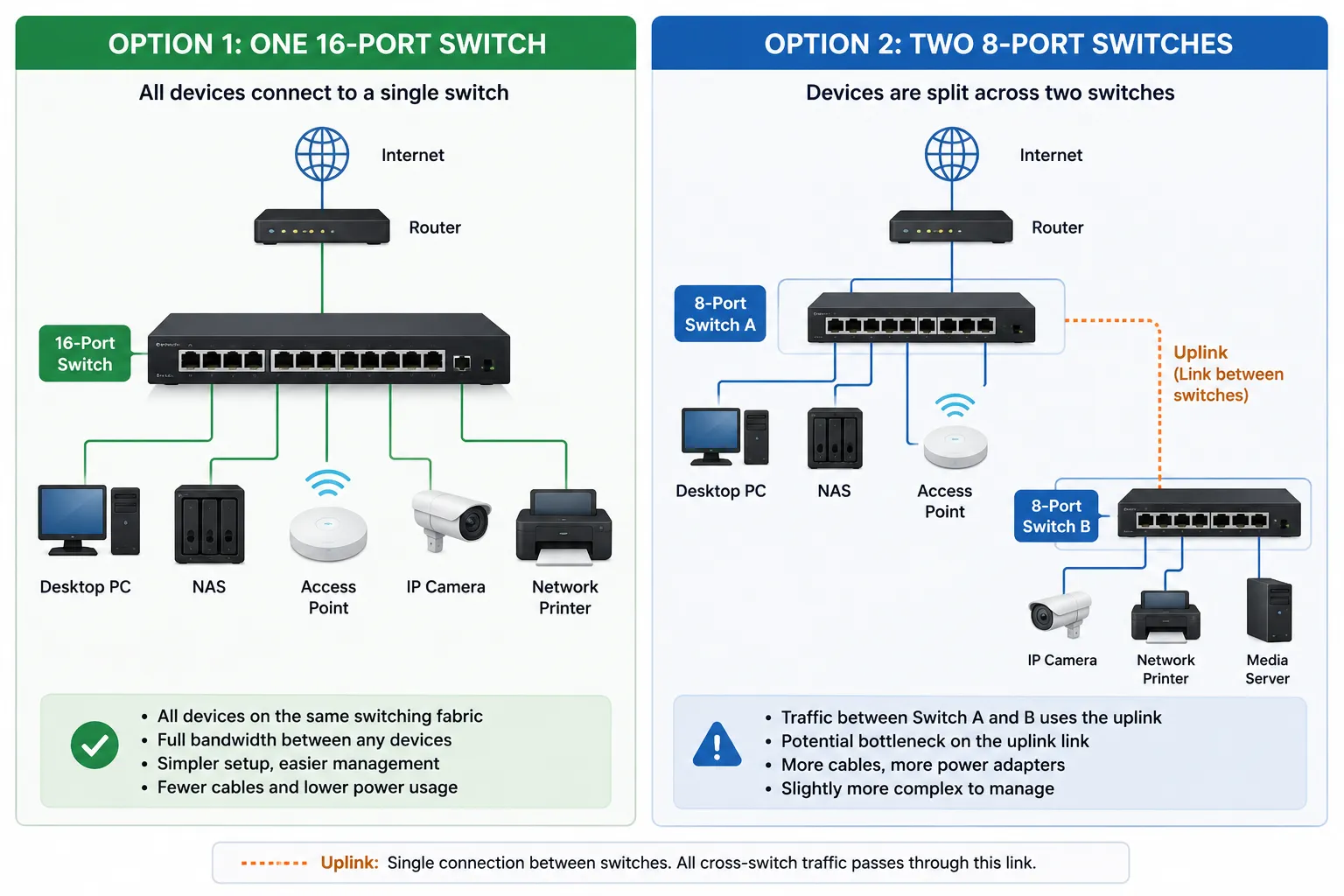
The most common example is when devices are located in different areas of a home or office. Instead of running eight separate Ethernet cables across the building, you can run one cable to a second switch and connect local devices there.
Two 8-port switches can also make sense when:
- You're expanding gradually and only need 8 ports today.
- Different rooms require their own network distribution point.
- You already own one 8-port switch and only need additional ports.
- You want some redundancy, where a failure affects only part of the network.
For most users choosing between the two from scratch, one 16-port switch is the better long-term investment. Choose two 8-port switches only when physical layout, future expansion, or budget considerations make distributed switching more practical.