
 HD Cameras and Webcam
 Projectors and Speakers
 VOIP Phones and Gateway
 Access Control
 LTE and 5G Devices
 Smart Sensors And Automation
 Fiber and SFP Modules
 Firewall & Cloud Controllers
 Network Adapters and Accessories
 Network Switches
 PoE Switches
 Point To Point Wireless Radio
 Routers
 Wireless Access Points
 IP Cameras
 Memory Cards
 NVR
NVR Smart WiFi Cameras
 Storage Devices
 Desktop & Laptop RAMs
 Internal and External Hard Drives
 Storage Accessories and Enclosures
 SSD and NVMe Drives
 USB Flash Drives


BIS ER-01: India’s New Cybersecurity Rule for CCTV Cameras

India's new BIS ER-01 certification means every IP camera sold after April 1, 2026 must meet mandatory cybersecurity standards — here's what it means, who's certified, and what you should do today.
In this issue
- What BIS ER-01 actually is (and what it replaced)
- What a certified camera must pass: the cybersecurity checklist
- Real-world hacking incidents that made this regulation necessary
- The April 1 deadline, penalties, and who's certified so far
- What this means if you're buying a camera in 2026
🔒 The Regulation


What is BIS ER-01? (And why it exists now)
Until recently, a CCTV camera only needed to pass a basic electrical safety test (IS 13252) to be sold in India. That test checked whether the camera was safe to plug in: protection against electric shock, insulation, and fire hazards. That's it.
Think of it like a restaurant that only needed a fire safety certificate to open. Nobody checked if the kitchen was clean, if the food was fresh, or if employees washed their hands. The building wouldn't burn down, but you might still get sick.
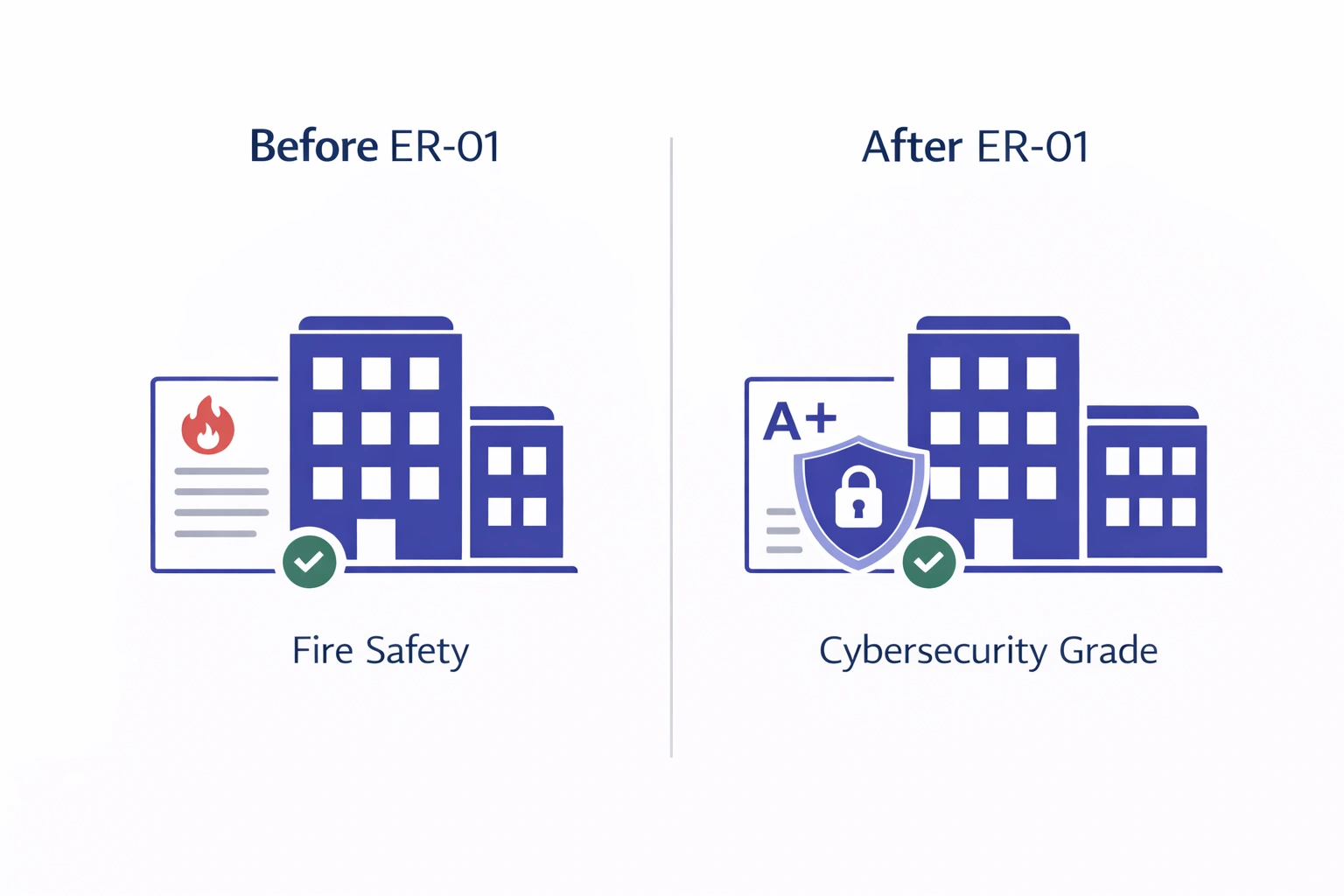
Before vs After ER-01: from electrical safety only to full cybersecurity certification
BIS ER-01 changes that. Issued by MeitY (Ministry of Electronics and IT) via a gazette notification in April 2024 and administered by BIS, it adds a mandatory cybersecurity layer on top of the existing electrical safety requirement. Now, every IP camera (any camera that connects to your network) sold in India must prove it's not just safe to plug in, but also safe to connect to your network.
There's one more thing worth knowing before we move on. Two government bodies are involved in camera certification: BIS and STQC, and they're not the same thing. One is your licence to sell to anyone. The other is a passport for government projects. Here's how they compare:
If you are intersted to know more about STQC, check our detailed explanation where we also cover full list of STQC certified CCTV camera models.
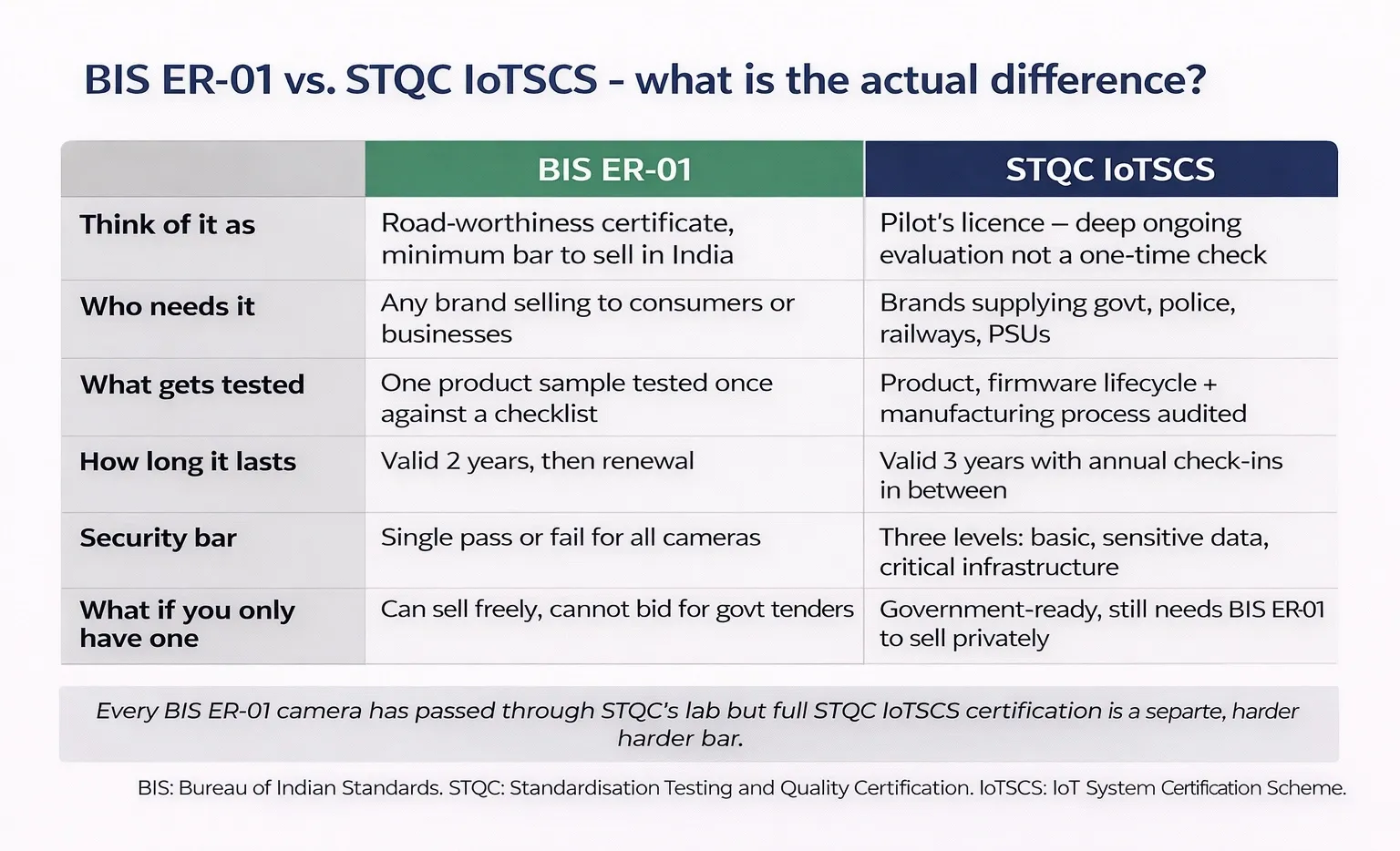
BIS ER-01 vs STQC IoTSCS: two certifications, different purposes
🔎 The Checklist
What does a camera need to pass?
Six key cybersecurity requirements every IP camera must now pass —
1. No default passwords – The "admin/admin" era is over. Cameras must force unique, strong passwords during the first setup. This alone would have prevented many of the incidents we'll cover below.
2. Encrypted video streams – All data must travel over TLS/HTTPS. No more sending unprotected video across your network where anyone can intercept it.
3. Secure boot & signed firmware – The camera verifies its own software integrity every time it starts up. Only cryptographically signed firmware can run, so nobody can inject malicious code.
4. Disabled test ports – Manufacturer debugging interfaces must be shut down before the camera leaves the factory. Open debug ports are one of the most common entry points for hackers.
5. Supply chain transparency – Manufacturers must declare the origin of chipsets, PCBs, and processors. Think of it like ingredient labelling on food; now the government checks where your camera's brain comes from.
6. Vulnerability disclosure policy – Brands must maintain a formal process for reporting and patching security flaws. This means ongoing accountability, not just a one-time test.
On top of all this, cameras are stress-tested against simulated cyberattacks, and manufacturing facilities are audited for quality control.
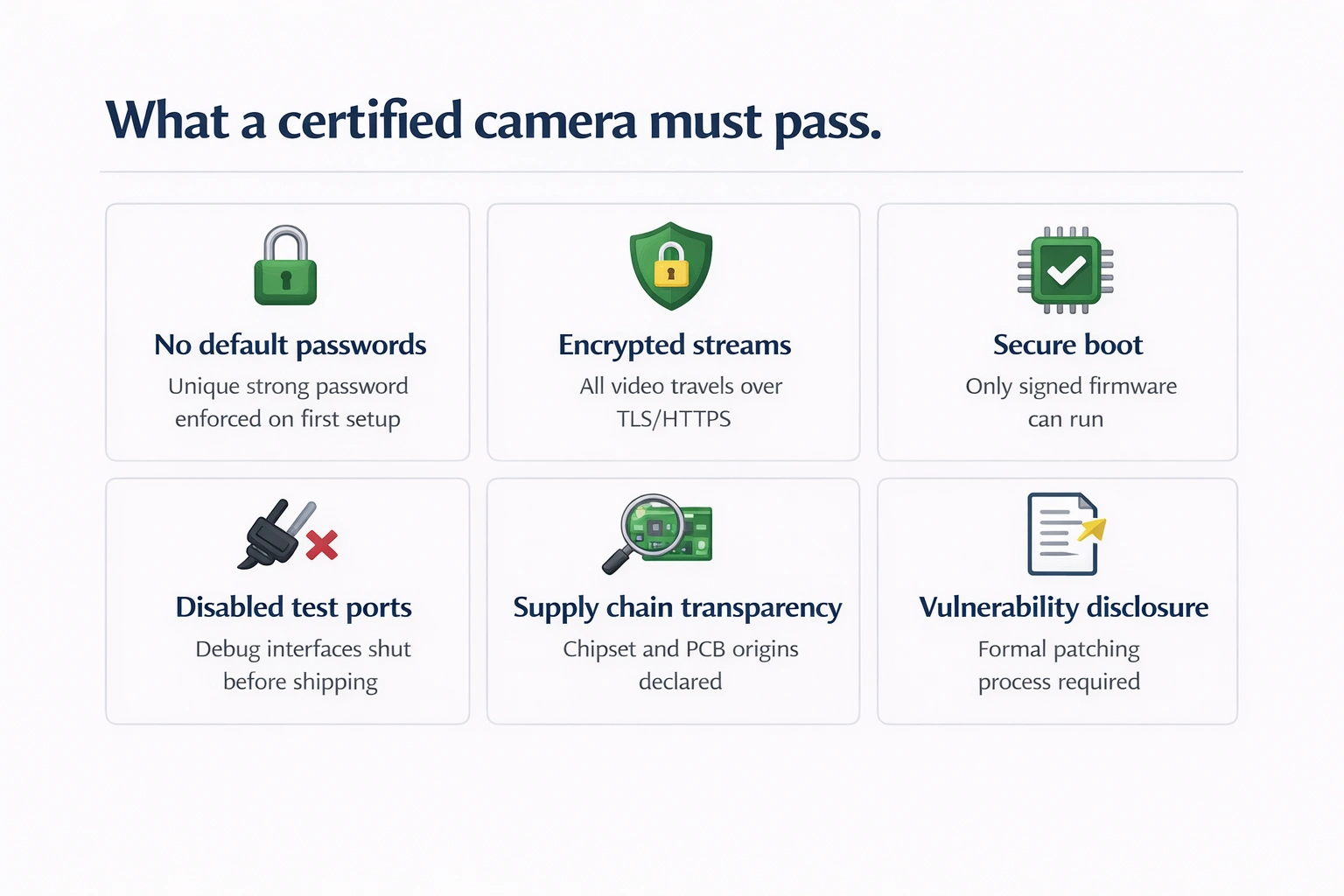
Six cybersecurity requirements every IP camera must pass under BIS ER-01
What's coming next
The pipeline is building. HiFocus has announced plans to certify 50+ models. CP PLUS and PRAMA are actively expanding their certified ranges. TP-Link is expected to put more VIGI models through certification now that the process is underway — getting the first two approved is the hardest part, and the rest of a product line typically follows faster. Sparsh, already India's widest-certified range, continues to add models. The short version: the certified catalogue is going to look very different by the end of 2026 than it does today.
What this means if you're buying a camera in 2026
Look for BIS ER-01 compliance. It's the closest thing to a guarantee that your camera meets basic cybersecurity hygiene.
If you already own cameras
They'll keep working. But be aware that firmware updates, patches, and support for non-compliant brands will gradually dry up. DVRs and NVRs are currently unregulated but expected to come under similar rules soon.
Take these 3 steps today:
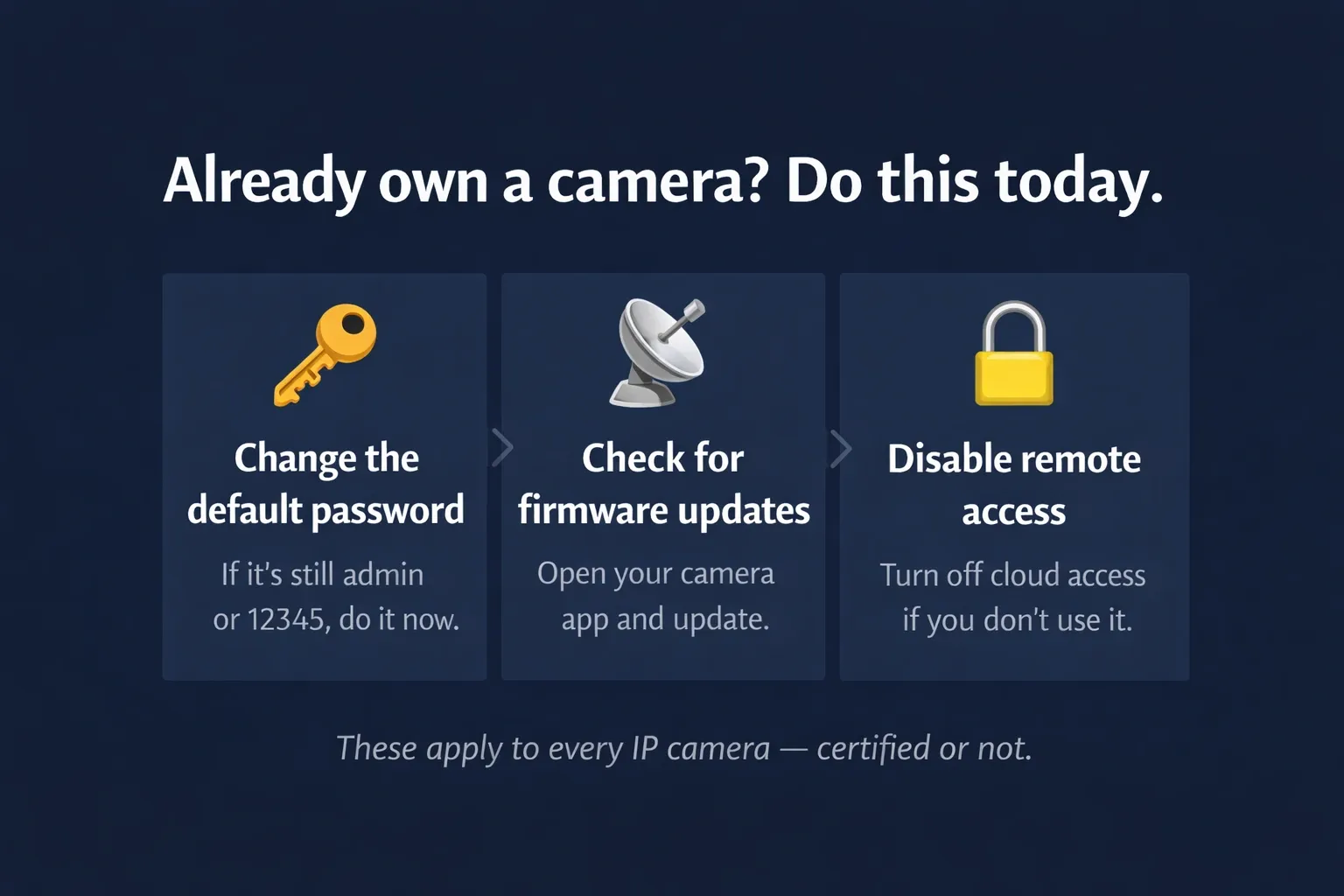
3 steps to secure your camera today
✅ Verify It
Verify it yourself
5 steps to check if a camera is legitimately certified
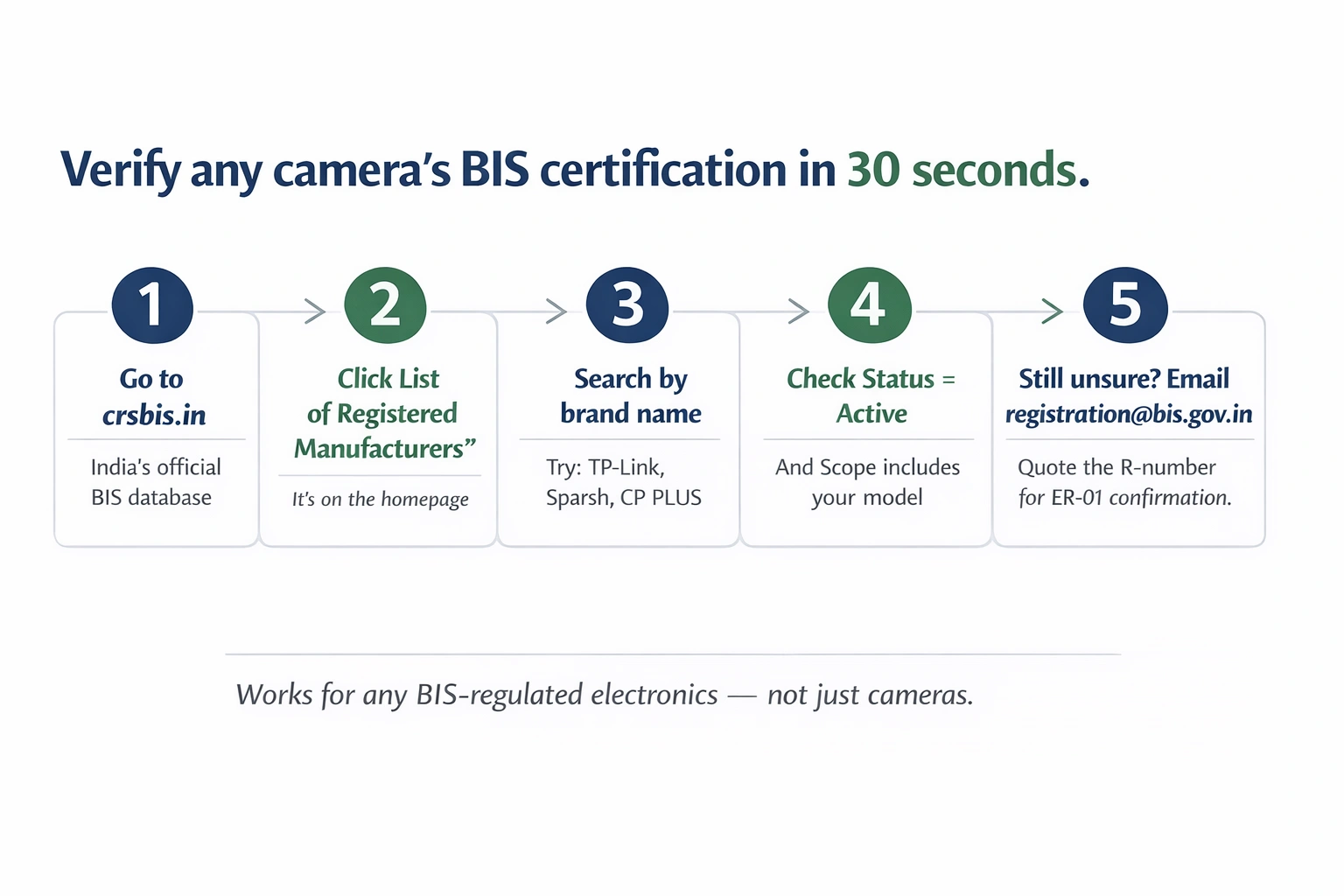
5-step verification: works for any BIS-regulated electronics, not just cameras
This database is public and free. Bookmark it — it works for any BIS-regulated electronics, not just cameras.
If you're buying a new CCTV system and want to make sure you get everything right — from resolution and IP ratings to which brands are actually certified — read our complete guide to choose the right CCTV camera in India.Before You Go...
Hit reply and tell us:
- What brand of CCTV camera do you currently use?
- Did you know about ER-01 before reading this?
Give us your honest feedback
This issue was a different topic from our usual hardware series: a deep dive into a regulation that directly affects camera buyers.
Was this useful? Should we cover more regulation explainers like this?

